
Category: Marble guides

  • Marble-effect worktop or real marble: a four-material comparison

    Marble-effect worktop or real marble: a four-material comparison

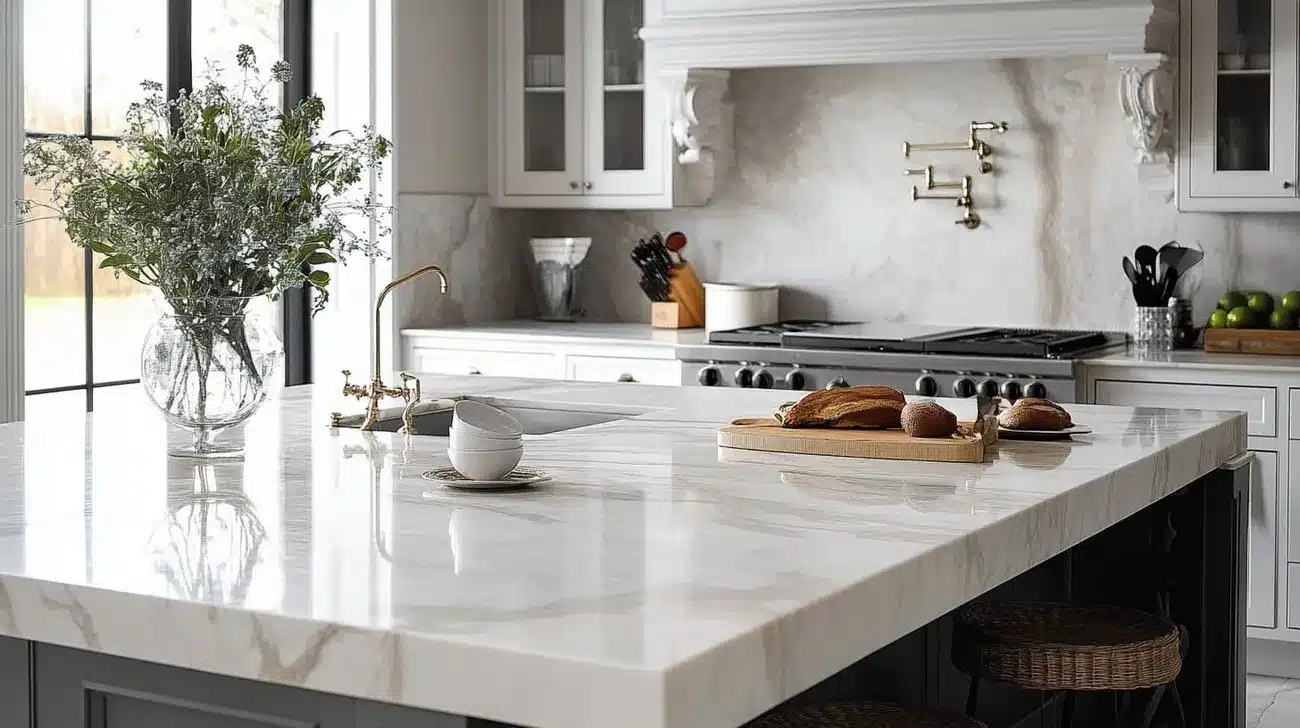
    A “marble-effect” worktop is a marble décor applied to another material: laminate, porcelain stoneware, engineered quartz, adhesive film or resin. Real marble is a rock. It scratches and etches with acid, but it can be repolished. Imitations stand up better to daily life and cannot be repaired: they are replaced.

    This comparison sets four product families against the same criteria. It comes down twice out of six in favour of the imitation. For the stone side alone, see our page on marble worktops in a kitchen.

    Key points

    • Four families are sold under this décor: laminate, the porcelain stoneware and engineered quartz, the adhesive film and resin. For worktops, the volume competitor is laminate, not ceramics.
    • Three separate bodies of standards. Natural stone: NF EN 1469, 12057, 12058. Agglomerated stone: NF EN 14618, 14617, 15285, 15286. Ceramics: NF EN 14411.
    • Reparability is the one argument no imitation can counter. A dulled marble can be repolished. A scratched laminate, a torn film or a chipped tile are replaced.
    • A ceramic décor repeats. XTONE publishes 4 designs in 6 mm and 2 in 12 mm for its Calacatta Gold. A stone slab never repeats.
    • Marble remains calcite, grade 3 on the Mohs scale, dissolved by vinegar and lemon. For a rental or a tight budget, laminate is the best answer.

    Four product families are sold under the words “marble effect”

    “Marble effect” is not a material but a décor, and it covers four industrial families with different standards and repair methods. The term itself appears in no product standard.

    Le laminate is a wood-based panel faced with a resin-impregnated decorative sheet. It is the dominant marble-effect worktop product in DIY stores. The stated thickness, 28, 38 or 39 mm depending on the products found, is that of the substrate panel, not of the décor.

    Le porcelain stoneware is a pressed or extruded and then fired ceramic tile, falling under NF EN 14411 “Ceramic tiles”, November 2016 version, which classifies it by manufacturing method and water absorption. This European standard is harmonised: CE marking is mandatory.

    La agglomerated stone is, according to NF EN 14618, an industrial product based on hydraulic cement, resin or both, stones and other additives. It is the family of engineered quartz.

    That leaves two solutions that cover the existing worktop without replacing it: decorative adhesive film on a roll and poured epoxy resin . They meet a real need: changing the look without removal.

    The comparison table for the four materials

    Cells marked “not documented” or “no data” are not oversights: no verifiable source fills them in the research file for this article. Filling them with estimates would be more comfortable and less honest.

    CriterionGenuine marbleLaminatePorcelain stoneware and engineered quartzAdhesive film and resin
    NatureRock. Overwhelmingly calcite, 91.5 to 98% on the data sheets consulted. Veining throughout the body.Wood-based panel, resin-impregnated decorative sheet. Printed décor.Pressed and fired ceramic tile, surface décor. Or hydraulic cement, resin or both, plus stones.Covering applied over the existing worktop.
    Thicknesses20 and 30 mm as standard cut.28, 38, 39 mm found in DIY stores. Thickness of the panel, not of the décor.Ceramic 3, 5, 6, 12 mm (Laminam, XTONE, Neolith). Quartz: not documented.Not comparable.
    Product standardNF EN 1469, 12057, 12058. Naming NF EN 12440.No standard identified.NF EN 14411, harmonised, CE marking mandatory. Quartz: NF EN 14618, 14617, 15285, 15286.No standard identified.
    Heat and acidsNo temperature limit published; tests NF EN 14066 and 16306, 0% mass loss on the data sheets that declare them. Sensitive to acids : calcite dissolves.Values in °C stated without testing. Wood-based substrate. Dissolution of carbonates not relevant.No test value found. Ceramics unaffected by acids; quartz, chemical resistance under NF EN 14617-10.No data found.
    ReparabilityRepolishing. Loss of polish is a loss of material, not a stain. Limit: thickness.Not repairable. The worktop is replaced.Surface décor cannot be repolished; a chip means replacement. Quartz: repair according to the manufacturer.Not repairable, but renewable.
    LifespanNo standardised value. Several repolishings, within the limit of the thickness.No standardised value. End of life when the décor is worn through.No standardised value. End of life at chipping or wear of the décor.No standardised value. Renewable.
    Budget rankingHigh.Low, and the family most represented in DIY stores.Mid to high.The lowest, without removal.
    No prices are published here. The amounts available cover incomparable scopes: the details are in the publication notes.

    The useful way to read the table is diagonally. Only one column ticks “repairable”, and only one offers 20 to 30 mm of homogeneous material. The other three win on everyday durability and on budget.

    What stone has that imitation does not

    Three differences withstand the sales pitch, because buyers can check them for themselves. Two are documented by the makers of substitutes.

    Reparability, the deciding argument

    A damaged marble can be repaired; a damaged imitation is replaced. The ICOMOS-ISCS glossary on stone deterioration patterns classes dulling among features induced by loss of material, not among stains. An acid etch mark is therefore not a deposit to be cleaned: it is a surface that has become rough, and is reworked by restoring the finish.

    Levantina writes in its March 2025 data sheet that natural stone “can always be restored by repolishing the surface”. The limit is clear, since repolishing removes material and thickness bounds it. On 20 or 30 mm the margin is real; on a surface décor it is nil. The habits that avoid getting there are in our article on how to clean marble.

    The uniqueness of the veining, quantified by the competitor’s manufacturer

    A ceramic décor repeats, and the number of patterns is public. XTONE states for its Calacatta Gold porcelain stoneware 4 designs in 6 mm and 2 in 12 mm, in a 160 × 320 cm format, with continuity of pattern between pieces. That is an industrial quality, consistency being exactly what you are buying. But beyond a few slabs, the pattern comes round again. A marble slab comes from a block: two neighbouring slabs look alike, none repeats.

    Thickness and standard settle it in one sentence

    A 3 mm “marble-effect” slab is not stone, and the thickness alone says so. Large-format ceramics are cut in 3, 5, 6 and 12 mm; marble commonly in 20 and 30 mm. The second question concerns standards, and it is written in the texts themselves: NF EN 1469 and NF EN 12058 explicitly exclude artificially agglomerated stone materials from their scope.

    Three families, three separate bodies of standards, one commercial décor. Asking under which standard the product is declared settles the question without any geological expertise. The reasoning also applies to floors and vanity tops: see our guide to the uses of marble.

    What marble does not do, and what needs saying

    Marble has three nameable weaknesses in the kitchen, and keeping quiet about them helps nobody. The first is its hardness: it is essentially calcite, and the Earth Sciences Museum at theUniversity of Waterloo points out that calcite is number 3 on the Mohs scale and “is easily scratched with a knife blade”.

    The second isacid etching. The same university source states that vinegar is used to identify a limestone, because calcite dissolves in it, releasing carbon dioxide. Vinegar is therefore not merely “not recommended” on marble: it is the test reagent. Lemon, wine and descaler act in the same way, at different speeds.

    The third is porosity, and its variability is the real trap. On the same NF EN 1936 test, the data sheets consulted give 0.2 to 1% open porosity for a Nero Marquina and 16 to 17% for a Bulgarian limestone sold as marble. It is not the rock family that determines susceptibility to staining; it is the stone, batch by batch. A water repellent reduces absorption and does not protect against an acid: see our page onwater repellent for marble.

    One point deserves correcting rather than repeating: the temperature limits in degrees that circulate in this market are backed by no published test, whether for marble, laminate or quartz.

    Four situations where imitation is the right choice

    A comparison that comes down four times out of four in favour of stone is not a comparison. In the following four situations, imitation is the best answer.

    • A rented home. Marble’s strength is reparability over decades, and therefore length of ownership. In a rented property, with uses you cannot control, laminate makes sense: replaceable in one visit, with no care instructions to pass on.
    • A tight budget. Laminate sits at the bottom of the budget ranking and delivers the desired décor. Putting stone into a project with no margin means sacrificing something else in the kitchen.
    • A renovation without removal. If the existing worktop is sound and only its look is unwelcome, adhesive film or resin meet the need exactly: no dismantling, no splashback rework, no sink reconnection.
    • A kitchen where nobody takes care. If nobody is going to wipe up lemon juice or get out a chopping board, porcelain stoneware is the best trade-off: surface décor, but no carbonate dissolution to fear and a declared performance under NF EN 14411.

    The decision criterion is therefore not “real or fake marble”. It is how long you will keep this worktop, and how much care you are willing to give it.

    Frequently asked questions

    What are the drawbacks of a marble kitchen worktop?

    Three, and they can be named. Calcite is at grade 3 on the Mohs scale and scratches with a knife blade. Everyday acids dissolve it, leaving a dulled area. And open porosity ranges from 0.2 to 17% depending on the stone on the same NF EN 1936 test, which makes susceptibility to staining impossible to state by family. The honest counterpoint is that all three kinds of damage can be reworked by repolishing.

    How much does a marble kitchen worktop cost?

    This page publishes no prices, and the reason is methodological. The amounts available cover incomparable scopes: a whole panel on one side, a price per square metre on the other, with or without shaping or a sink cut-out. What is reliable is the ranking: adhesive film and resin at the bottom, then laminate, then porcelain stoneware and engineered quartz, then marble. For a quote on real dimensions, go through our contact page.

    What is the best material for a kitchen worktop?

    There is none in absolute terms, and any single answer is a sales pitch. By use: laminate for a rental or a constrained budget, adhesive film or resin to change the look without removal, porcelain stoneware for an intensively used kitchen with no care instructions, marble for a unique piece you keep and repair. The discriminating criterion is reparability, combined with length of ownership.

    What is the difference between granite and marble?

    Mineralogy, and it determines resistance to acids. The USGS writes that granite is composed mainly of silicates, feldspar and quartz, “resistant to acid attack”, while marble and limestone are composed mainly of calcite, “which dissolves readily in a weak acid”. Two shortcuts are wrong: density does not separate the two families, their ranges overlapping on the same NF EN 1936 test, and attributing a single Mohs hardness to a granite is a category error, the scale being defined for minerals. The details are in our marble and granite comparison.

    What to check before signing

    Two questions qualify any marble-effect worktop: under which product standard is it declared, and what is its thickness in millimetres? The answer places the product in one of the four families and tells you whether a repair will be possible. If your choice leans towards stone, the rest is settled on drawings, not from a catalogue: see our marble worktops.
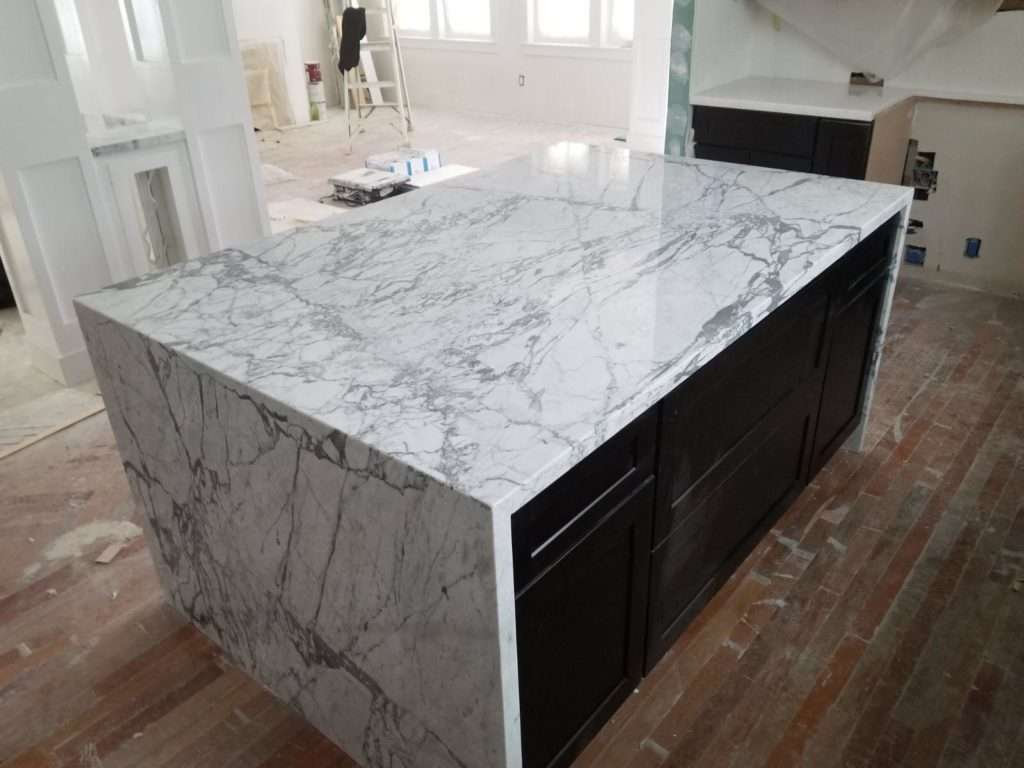
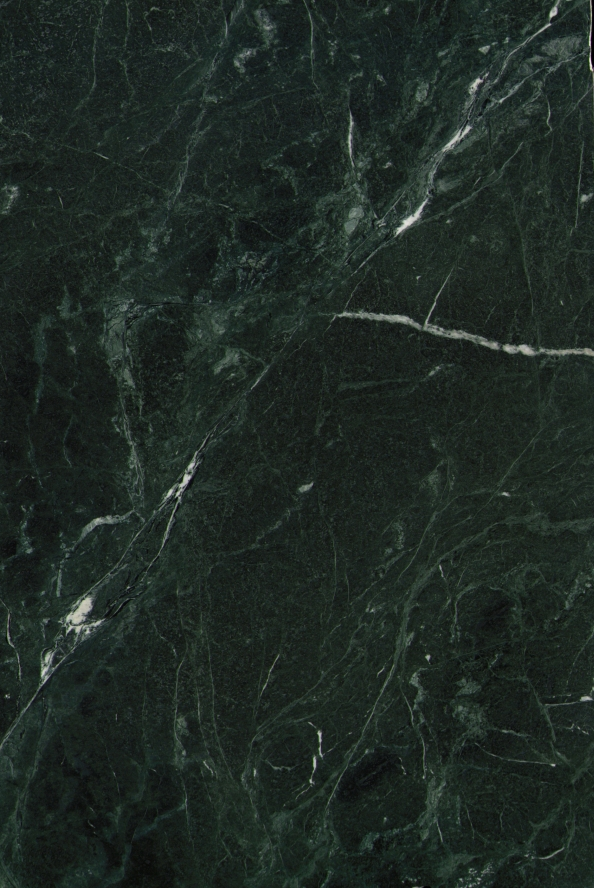
  • Calacatta marble: real Carrara marble or a finish name?

    Calacatta marble: real Carrara marble or a finish name?

    “Calacatta Gold” refers to two different products. It is first a marble quarried in the Carrara basin, a breccia with yellowish-white clasts. It is also a commercial finish name used by makers of porcelain stoneware and engineered quartz. Same name, different materials, different standards, and price levels with no connection.

    Key points

    – Calacatta is a breccia : clasts of yellowish-white marble separated by a carbonate matrix rich in muscovite and chlorite, greener and more ochre than the clasts. The name comes from the locality of Calacata, north of the village of Torano.

    – There is no protected designation for “Calacatta” in 2026. Gold, Oro, Borghini, Michelangelo, Macchia Vecchia: these are names of quarries, blocks, beds or companies.

    – “Calacatta” is also a finish name at Laminam, XTONE, Neolith and Silestone. A “Calacatta” slab 3 mm is not stone.

    – A porcelain stoneware tile repeats. XTONE states 4 designs in 6 mm and 2 in 12 mm for its Calacatta Gold. A natural stone never repeats.

    – “Calacatta is harder than Carrara” is false : same minerals, same calcite, hardness 3 out of 10 on the Mohs scale.

    What Calacatta marble is

    Calacatta is not a white marble with more veining than others: it is a breccia. The most solid petrographic definition available is that of Piero Primavori, who nominated Carrara marble as a Global Heritage Stone Resource with the Geological Society of London (Special Publications 407, 2015). He describes Calacata as “a breccia of very light yellowish-white marble clasts, set in a carbonate matrix rich in muscovite and chlorite, greener and more ochre-yellow than the clasts themselves” (Litos Online). The name comes from a specific place: the locality of Calacata, north of the village of Torano, in the Carrara basin in the strict sense. Primavori adds two useful points: the variety is rare, and makers of artificial stone copy it massively.

    The material belongs to the Marmi formation of the Apuan Alps, in Tuscany. Its protolith is a Lower Lias carbonate platform limestone, and the metamorphism took place in the greenschist facies during the building of the Apennine chain. Note: the geological literature gives a metamorphic peak of 350–450 °C and a protolith of the order of 210 to 200 million years. These values come from an article whose PDF could not be checked line by line.

    Calacatta, Bianco Carrara, Statuario: a difference of structure

    The three names do not describe three intensities of the same marble. They describe three rock structures, and nobody explains this in French.

    • Bianco Carrara : marble homogeneous, white to pearl-grey background, bright grain, diffuse smoky-grey veining. This is the standard production, in sub-varieties C, C/D, D and P.
    • Statuario : marble very pure, ivory-white to cream background, rare light grey veining, renowned for carving with a chisel. Production markedly lower than the ordinary whites.
    • Calacatta : breccia. The bold, contrasting gold, ochre or green veining is not a pattern within a homogeneous mass; it is the matrix that separates the clasts.

    It is a difference in rock structure, not a difference of taste. It explains why you cannot get a Calacatta by selecting a “more veined” Bianco Carrara: the material is not built in the same way. The Apuan basin also produces other breccias and veined marbles: Paonazzo, Arabescato, Bardiglio, Nuvolato, Zebrino, Cremo.

    Seven varieties, more than fifty names

    You very often read that Carrara marble accounts for 95% of Italian quarry production and Calacatta 5%. This split is backed by no source: it has spread from commercial pages that cite none. It adds a territory to a variety, and it applies a ratio of white marbles to the whole of Italian stone production, granites and travertines included. No public breakdown of Carrara basin production by variety could be found, including in the work of the Osservatorio del Marmo.

    Two figures, however, can be verified. In 2023, the municipality of Carrara recorded 656,000 tonnes of marble extracted as blocks, a historic low, from about 70 active quarries (Il Tirreno, 23 March 2024; Legambiente Carrara monitoring based on municipal records). And above all, the academic figure: in the nine basins of the Frigido valley, Massa and Pieruccioni identify 7 geologically characterised commercial varieties, including Calacatta, corresponding to more than fifty local names (Geoheritage, 2020). Carrara’s trade nomenclature is not a taxonomy.

    Neither harder nor more resistant than a Bianco Carrara

    Calacatta is a marble: its dominant phase is calcite. Its hardness is therefore that of calcite, 3 out of 10 on the Mohs scale, identical to that of a Bianco Carrara and a Statuario, since these are the same minerals (Handbook of Mineralogy, Calcite data sheet). The claim that “Calacatta is harder, or more resistant, than Carrara” is false.

    Calcite is a carbonate: acids dissolve it. Lemon juice, vinegar or descaler leave acid etching, that is, a matt haze where the stone has been eaten away. This applies to all Carrara marbles, Calacatta included, and is corrected by repolishing, not cleaning. A water repellent or an impregnator reduces absorption but does not protect against an acid.

    Marble, porcelain stoneware, engineered quartz: what separates them

    These three families do not fall under the same standards, and that is not a specialist subtlety: it is the criterion that settles a quote.

    Calacatta marble“Calacatta” porcelain stoneware“Calacatta” engineered quartz / mineral surface
    NatureMetamorphic carbonate rock, breccia with a muscovite-chlorite matrixPressed and fired ceramic product, printed décorIndustrial product based on resin, hydraulic cement or a mixture of the two, with mineral fillers
    Commercial references foundCalacatta Franchi, Crestola, Macchia Oro, Gold, OroLaminam I Naturali Calacatta Michelangelo, Calacatta Oro Venato, Calacatta Viola ; XTONE Calacatta Gold, Green, Antico, Viola ; Neolith Calacatta Gold CG01 ; Apavisa collection CalacattaSilestone Eternal Calacatta Gold
    ThicknessesStandard cut in 20 and 30 mm3, 3+, 5, 5+, 6, 12, 12+, 20+ mm according to the Laminam, XTONE and Neolith cataloguesNot documented in the sources consulted
    FormatsSlabs cut from a block, dimensions variableFormats constant : 1000×3000, 1200×3000, 1600×3200, 1620×3240 mmNot documented
    MaintenanceSensitive to acid etching (calcite); can be repolished; water repellent depending on useUnaffected by acid etching; surface décor cannot be repolishedDepends on the binder; follow the manufacturer’s data sheet
    Applicable standardsNF EN 1469 (cladding slabs), NF EN 12058 (floors and stairs), NF EN 12057 (modular tiles), designation under NF EN 12440NF EN 14411 “Carreaux céramiques” (November 2016)NF EN 14618 (terminology and classification), NF EN 14617 (test methods, 16 parts), NF EN 15285 and NF EN 15286 (product standards)

    The decisive point is written into the standards themselves. NF EN 1469 “Natural stone products, slabs for cladding, requirements”, April 2015 version, explicitly excludes artificially agglomerated stone materials from its scope. NF EN 12058 does the same. In other words, an agglomerated product cannot be declared under the natural stone standard, and vice versa.

    And the comparison is not rhetorical, because the three families have the same legal standing. NF EN 14411 “Ceramic tiles: definitions, classification, characteristics, assessment and verification of constancy of performance and marking”, November 2016 version, is a harmonised European product standard. It makes CE marking mandatory, like the product standards of the other two families. It classifies tiles by manufacturing method and water absorption, with the suffixes GL for glazed and UGL for unglazed, and its scope also covers mosaics, defined as any piece fitting within 49 cm². Three families, three separate bodies of standards, one trade name. Asking under which standard the product is declared settles the question in one sentence, without geological assessment.

    A note on engineered quartz, because the sales argument has changed. Writing today that “Silestone is 90% natural quartz” is out of date. Cosentino reformulated its range with HybriQ technology from 2022 to reduce crystalline silica content, and now presents Eternal Calacatta Gold as a hybrid surface combining minerals and recycled materials.

    For the thicknesses, edge finishes and formats available in stone, see the marble tiles and the marble worktops.

    The family of names: who defines a “Calacatta Gold”?

    Nobody. That is the heart of the matter. In 2026 there is no protected designation for “Calacatta” : no standards consortium, no collective mark in force, no specification. Gold, Oro, Borghini, Michelangelo, Macchia Vecchia, Crestola, Franchi are names of quarries, blocks, beds or companies. The spellings Calacata and Calacatta are in fact both historically attested, the Carrara dialect reducing double consonants.

    A certification mark « Marmo di Carrara », covering origin and quality, is being set up. It stems from the agreement of 4 August 2026 signed within the framework of theOsservatorio del Marmo (Comune di Carrara, Camera di Commercio Toscana Nord-Ovest, Agenzia delle Dogane). It covers Carrara marble, not commercial sub-names. A “Calacatta Gold” will therefore fall under it no more after its creation than it does today.

    DesignationWhat is establishedWhat is not
    Calacatta (family)Breccia with yellowish-white clasts, muscovite-chlorite matrix; name taken from the locality of Calacata, north of ToranoThat a specification exists
    Calacatta Gold / OroCommon name for Calacattas with golden veining. Also a product name at Silestone, Neolith and XTONEThat a colour threshold or a quarry defines it
    Calacatta BorghiniCited by Carrara producers, dove-grey to gold veinsNOT SOURCEABLE : its quarry of origin
    Calacatta MichelangeloName of a Laminam porcelain stoneware. In natural stone, present in merchants’ listsNOT SOURCEABLE : its quarry, and that it refers to an identified geological variety
    Calacatta Macchia VecchiaCited by several producers: white background, grey-gold networked veiningNOT SOURCEABLE : its quarry of origin
    Calacatta CrestolaQuarry Crestola, basin of Torano
    Calacatta FranchiQuarries of Bettogli
    Calacatta Macchia OroSub-variety cited by Primavori
    Calacatta VagliQuarried in Garfagnana (Vagli), another basinThat it is a Carrara Calacatta in the strict sense

    Only three quarry-to-name attributions can be sourced: Crestola, Franchi and Macchia Oro. Everything else is commercial usage, and that is exactly the information a buyer needs.

    The direct consequence for online searching: when you type “calacatta michelangelo” or “calacatta oro”, you partly get ceramic products. These names are catalogue references at ceramics makers. This is neither fraud nor a Google error: it is a homonym you need to know about before comparing two quotes.

    How to recognise the stone in practice

    Five checks are enough, and none requires geological expertise.

    1. Does the pattern repeat? This is the simplest marker, and it is given by the maker of the competing product itself. XTONE publishes that its Calacatta Gold exists in 4 patterns in 6 mm and 2 in 12 mm. After a few slabs, the pattern comes round again. A natural stone never repeats: each slab is a unique cut through a block.

    2. What thickness? Marble is commonly cut to 20 and 30 mm. Ceramic catalogues go down to 3 mm. A 3 or 5 mm “Calacatta” slab is not stone, and the question is settled before you even look at the veining.

    3. Are the formats constant? 1620 × 3240 mm, 1600 × 3200 mm, 1200 × 3000 mm: these perfectly stable dimensions are an industrial signature. A marble block yields slabs of varying dimensions.

    4. What does the edge show? On a stone, the veining runs through the thickness; on porcelain stoneware, the décor stops at the surface, except for full-body products. Note: this criterion follows from the nature of the products, but no standard or technical source consulted states it in black and white. Use it as an indication, not as proof.

    5. Ask for the documents. NF EN 12440 “Denomination criteria” requires the trade name to be accompanied by a petrographic name, a colour and a place of origin. Porcelain stoneware and agglomerates have no petrographic name. Then ask under which standard the product is declared: NF EN 1469, 12057 or 12058 for stone, NF EN 14618 and following for agglomerates, NF EN 14411 for ceramics. All three are harmonised product standards: in each case, the manufacturer has a declaration of performance to produce.

    A word on the vinegar test, often recommended on forums. It works, since calcite reacts to acids, but it is destructive : it leaves a permanent matt mark. It must never be done never on a laid slab, on a sample entrusted to a client, or on an offcut intended for use.

    As for test values, only one producer data sheet was consulted for a Calacatta. Mandarin Stone declares a water absorption of 0,10 % under NF EN 13755, an apparent density of 2,680 kg/m³ and an open porosity of 0,30 % under NF EN 1936. The declared flexural strength is 7.72 MPa under NF EN 12372. Note: these values could not be re-checked against the source PDF. Above all, they are not “the values of Calacatta”: a test value applies to a batch, not to a variety. NF EN 12058 requires the manufacturer to declare these characteristics, and it is the supplier’s data sheet that is authoritative.

    Frequently asked questions

    What is Calacatta marble?

    It is a marble quarried in the Carrara basin, in Tuscany, and more precisely a breccia. Clasts of yellowish-white marble are separated by a carbonate matrix rich in muscovite and chlorite, which gives the bold, contrasting veining. Its name comes from the locality of Calacata, north of the village of Torano. It is not a synonym for “white marble”, nor a particularly veined Bianco Carrara: the structure of the rock is different.

    What colour is Calacatta?

    A very light background, white to yellowish-white, crossed by bold veining ranging from gold to ochre-yellow, with green tints. This colouring is not decorative: it comes from the matrix rich in muscovite and chlorite, greener and more ochre than the clasts it separates. Trade names follow this colouring, Gold and Oro for golden veining, without any threshold being defined.

    Why is Calacatta so expensive?

    Two factors are documented. The variety is rare at the scale of the basin, as Primavori explicitly points out. And Carrara’s block production is low: 656,000 tonnes in 2023, a historic low, from about 70 active quarries. Over the period 2005–2022, blocks accounted for only 22.8% of the material extracted, the rest going to aggregates and fillers. Add to that the sawing yield on a brecciated material and selection at slab level. No prices are published here; see the publication notes.

    What does Calacatta marble cost per m²?

    This article publishes no prices. What is useful to know for reading a quote: the price is set by the batch, not by the name. Four parameters count: the quarry and batch of origin, the thickness and slab format, the finish, and the quality of veining selection. One figure to watch: the cheapest “Calacatta” products on online comparison sites are ceramic tiles, not stone, and are no price reference for a marble.

    In summary

    The word “Calacatta” does not tell you which material it is. A single question does: under which standard is the product declared? Stone falls under NF EN 1469, 12057 and 12058, which expressly exclude agglomerated materials; agglomerates fall under NF EN 14618, 14617, 15285 and 15286; ceramics under NF EN 14411. Three separate bodies of standards, three different declarations of performance, one trade name. The rest, golden veining, quarry name, thickness, format, can be checked in a few minutes with the five checks above. To look at real slabs and read the data sheets of the batches available, contact us.


  • Green marbles: Guatemala, Alps, Maurin, verde mare

    Green marbles: Guatemala, Alps, Maurin, verde mare

    Guatemala green, Alpine green, Maurin green and verde mare are sold as marbles. They are serpentinites and ophicalcites, serpentine rocks that the European terminology standard explicitly distinguishes from marble. The difference is not one of vocabulary: it changes laying, care and possible uses.

    Key points

    – None of these stones is a marble in the petrographic sense. La NF EN 12670 defines serpentinite as a distinct rock, with an explicit cross-reference to the entry “green marble”.

    – The Guatemala green is an Indian serpentinite, quarried mainly in Rajasthan.

    – The “vert des Alpes” covers two deposits : the French Maurin green, whose quarry is abandoned, and the active Verde Alpi from the Aosta Valley. What you buy in France in 2026 is Italian.

    – Maurin green cannot be sourced today. No current production is documented.

    – These stones are laid with two-component epoxy, not cement-based adhesive : the mixing water can warp the slab, which is then lost.

    Four trade names, two rock families

    Commercial vocabulary and geological vocabulary do not say the same thing, and that is the source of almost every unpleasant surprise with these stones. A marble, in the petrographic sense, is a metamorphic carbonate rock, composed mainly of calcite or dolomite. A serpentinite is a metamorphic rock composed almost entirely of serpentine, a magnesium silicate whose varieties antigorite and chrysotile are named by NF EN 12670 (2019 edition). An ophicalcite is a serpentinite breccia cut by calcite veins.

    NF EN 12670 goes further than a simple definition: its “serpentinite” entry refers explicitly to the “green marble” entry. European standardisation has therefore acknowledged the shift in naming, and corrects it. NF EN 12440 “Denomination criteria”, November 2017 version, requires the trade name to be accompanied by a petrographic name, a colour and a place of origin.

    Trade name in FrancePetrographic natureOriginStatus
    Vert de Maurin / Vert des Alpes / Brèche de l’AlpetophicalciteSaint-Paul-sur-Ubaye (04)abandoned, ≈ 1945-1950
    Verde AlpimetaophicalciteAosta Valley, Italyactive
    Verde GuatemalaserpentiniteIndia (Rajasthan)active
    Vert de mer / Vert de GênesophicalciteGenoa regionhistoric
    Verde Mare (contemporary)serpentiniteVal Malenco, Lombardyactive
    Verd antiqueserpentinitic brecciaThessaly, Genoa, Pyrenees, Egypthistoric

    This is not an isolated case. Carmignano and Brandao, in the Material Science & Engineering International Journal (2023, DOI 10.15406/mseij.2023.07.00208), list more than 60 trade names of ornamental serpentinites, including Verde Alpi, Verde Antique and Verde Antique Guatemala. The authors note that these names make it difficult to identify the use of serpentinite in some buildings.

    Real origin: India, the Aosta Valley, the Ubaye, Liguria

    None of the four names refers to where the stone is quarried today. The detail matters, because NF EN 12440 makes the place of origin a naming criterion, and because the availability of a deposit governs the lead time and feasibility of a project.

    Guatemala green comes from India

    The stone sold under this name is a serpentinite quarried in India, mainly in Rajasthan. It also circulates under the names Verde Guatemala, Forest Green, Verde Guatemala Indiano, Indian Green Marble and “Indian green marble”.

    The trade explanation comes from merchants, not from a scientific source. The original “Verde Guatemala” was indeed a green stone quarried in Guatemala; the civil war cut off supply, and an Indian rock of similar appearance took over the name. The story is consistent and widely repeated, but it does not amount to proof.

    The proof, for its part, lies in the standards. Within European standards, a serpentinite must be designated as a serpentinite: the trade name “Guatemala green marble” does not exempt it from the petrographic name required by NF EN 12440.

    Alpine green: two deposits under one name

    In older French usage, “vert des Alpes” is a synonym of vert de Maurin, alongside “brèche de l’Alpet”. The stone was quarried in the commune of Saint-Paul-sur-Ubaye, in the Alpes-de-Haute-Provence, above the hamlet of Maljasset, near Maurin, at between 2,000 and 2,200 m altitude. The vein measured about 200 m by 50 m. The main operator, Dervillé et Cie, employed around a hundred workers there, mostly Italian, from about 1840 to 1960, the last significant work dating from around 1945–1950. The quarry is abandoned. Note: all these data rest on a single online synthesis whose bibliography, though serious, could not be consulted.

    On historic uses, caution is needed: the Fondation Napoléon writes that the base of Napoleon’s tomb at Les Invalides is made of green Vosges granite, not Maurin green, an attribution that is nevertheless widely repeated. The other prestigious uses attributed to it remain to be verified.

    The “vert des Alpes” sold in France in 2026 is something else: it is Verde Alpi from the Aosta Valley. Petrographically, it is a metaophicalcite belonging to the upper Penninic Tsaté nappe, Combin zone: tectonic breccias of angular serpentinite fragments in a light to greenish matrix of carbonates and silicates. The Aosta Valley family includes Verde Aver, Verde Issorie, Verde Saint-Denis and Verde Issogne, and ophicalcite quarries are documented at Verrayes.

    The same rock family, then, but two deposits: one French and closed since about 1950, the other Italian and active. The practical consequence, and it is a service to the buyer: Maurin green cannot be sourced today. A quote promising “vert des Alpes” will deliver Italian stone unless proven otherwise.

    Verde mare: Genoa yesterday, Val Malenco today

    “Vert de mer” is a trade name, and it too covers two realities. The historic French meaning is Genoa green, an ophicalcite whose serpentine gives the green and talc the white veins. It was quarried around Genoa from the 16th century, at Passo della Bocchetta, Voltaggio and Pietra Lavezzara, some twenty kilometres north of the city. Four abandoned quarries are recorded in the Monte Figogna tectonic unit. The uses cited are the windows of Versailles, panels of the Pont de la Concorde and pillars of Saint-Sulpice. Note: these attributions come from an online encyclopaedic source, without institutional confirmation.

    The contemporary meaning is Verde Mare, a serpentinite from Val Malenco, in Lombardy, province of Sondrio, also sold as Verde Malenco and Malenco Serpentinite.

    The parent term for this whole family is the verd antique, theatracius lapis of the Romans: a serpentinitic breccia with dark green serpentine flecked with white in a matrix of calcite, dolomite or magnesite. It was worked in Thessaly near Larissa, on the Genoa coast, in the Pyrenees and in Egypt.

    Data sheet: what is measured, and what is not

    For this query, no French page publishes a single technical value. Here is the real situation, with the corresponding test standards and the gaps acknowledged. A test value applies to a batch, not to a variety: the supplier’s data sheet is what counts.

    FeaturesTest standardStatus of the data
    Petrographic nameNF EN 12407serpentinite or ophicalcite depending on the stone
    Water absorption at atmospheric pressureNF EN 13755Verde Guatemala: 0,30 % declared by Tino Natural Stone (not re-checked)
    DensityNF EN 1936Verde Guatemala: 2.72 g/cm³, same data sheet (not re-checked)
    Impact resistancestandard not specified on the data sheetVerde Guatemala: 1,250 N, same data sheet (not re-checked)
    Open porosityNF EN 1936not available for these stones
    Frost resistanceNF EN 12371not sourceable : to be declared by the supplier
    Flexural strength under centre-point loadNF EN 12372not available
    Hardnessno EN standard in force for the rockmineralogy alone: antigorite 2.5 to 3.5 Mohs, calcite 3

    The three figures above come froma single producer data sheet, for a single stone, and they could not be re-checked against the source PDF. They do not describe “green marble”: they describe the batch that data sheet documents.

    On hardness, two sources contradict each other. The Natural Stone Institute gives serpentine between 3 and 6 Mohs; the reference mineralogical data sheets give antigorite between 2.5 and 3.5, with a measured density of 2.65 g/cm³. The difference can be explained, and the explanation is more useful than the comparison: a serpentinite is not monomineralic. Magnetite, chromite and olivine raise the hardness; talc and chrysotile lower it. A serpentinite is therefore heterogeneous in hardness, from one point to another on the same slab. Scratch resistance cannot be deduced from a single figure. So we should stop repeating that “green marble is harder than white marble”: it is not established.

    Frost resistance, for its part, is documented nowhere for these stones. Before any exterior use in a frost zone, require the declaration of performance for the batch under NF EN 12371, which provides for two types of test: technological, over a set number of freeze-thaw cycles, and identification, until failure.

    On thicknesses, the data sheets consulted give nothing. Commonly cut slab thicknesses are 20 and 30 mm, to be confirmed stone by stone: this point is not neutral, for a reason explained in the next section.

    Asbestos: a quarrying and works issue, not a finished-product issue

    The BRGM maps the environmental asbestos hazard at the request of the Direction générale de la prévention des risques, at scales from 1:1,000,000 to 1:5,000. It notably identifies tremolite asbestos in mylonitic serpentinites and actinolite asbestos in ophiolitic metabasalts. Serpentinites therefore belong to formations mapped under this hazard.

    The framing must be precise: the hazard concerns outcrops and works on natural ground, not a laid polished slab. It is a quarrying and works issue, regulated as such, not a finished-product issue. The mapped areas cover the Alps, Corsica, the Pyrenees, the Massif Central, the Armorican Massif, the Vosges and the Maures-Tanneron massif. Note: the Alpes-de-Haute-Provence do not appear by name in the 1:50,000 list consulted, unlike the Hautes-Alpes.

    Laying: two-component epoxy, not cement-based adhesive

    This is the most useful information in this article, and it is missing from every French page selling these stones. Laid with cement-based adhesive, a green marble slab can warp and debond, and is then lost.

    The mechanism is described by Mapei in its technical bulletin 010403-TB, “Installing moisture-sensitive stone”, edition of 22 June 2015. Water reacts chemically with the minerals in the stone, and the slab changes shape, which the bulletin calls cupping, curling, doming or warping. It gradually comes away from its bed and ends up breaking the bond. Mapei writes that a slab that has changed shape generally can be neither repaired nor relaid. The aggravating factor is explicit: the thinner and larger the slab, the greater the risk. That is why thickness is not an aesthetic detail with these stones.

    The same bulletin lists by name, among moisture-sensitive stones, Verde Alpi, the Verde Guatemala, the Verde Mare and theIssoire Green Marble, which the bulletin also gives under the names Verde Issori and Verde Aver. It adds non-green stones such as Nero Marquina, Portoro and Rosso Levanto. Also covered are cement- or resin-based agglomerates made with chips of these stones.

    The prescription comes from the sector’s reference manual. The Natural Stone Institute, in the Dimension Stone Design Manual version VIII, § 3.1.4.1, calls for a 100% solids two-part epoxy as a laying bed for green marbles and serpentines prone to warping. Custom Building Products writes, in its bulletin TB19, that all other adhesive mortars, epoxy emulsions and mastics contain water and must not be used. Laticrete intends its LATAPOXY 300, compliant with ANSI A118.3, for marbles that tend to stain, darken or warp when laid with water-based products.

    Mapei adds two limitations that are often forgotten. Even with water-free laying products, use remains limited to dry rooms or rooms with limited water exposure. And a waterproofing or uncoupling membrane lengthens the drying of the mortar, which can make a normally non-sensitive stone move: in that case, a rapid-setting mortar is required.

    Take care not to confuse this phenomenon with the bowing of white marble façade panels, which stems from the anisotropic thermal expansion of calcite and from Siegesmund’s work. Different mechanism, different stone, different context.

    No French standard names these stones

    It is better to say so frankly than to invent a reassuring French reference. Having checked, no French standard names green marbles or serpentinites as water-sensitive stones. Neither NF DTU 52.2, published on 25 June 2022, nor NF B10-601, nor the CTMNC documents consulted mention them. The August 2015 note on the changes to the amended NF DTU 52.2 deals with bonding surfaces, flatness, classes C1, C2 and C2S and cleavable materials, without a word about water sensitivity.

    What NF DTU 52.2 does govern, and can be cited, is something else. The choice of adhesive mortar depends on the open porosity measured to NF EN 1936, with a threshold of 2%, and on the surface area of the element. The rule on greens comes from the Natural Stone Institute manual and from adhesive manufacturers. Hence the only robust instruction: ask the supplier whether the stone is water-sensitive before laying it, and get the answer in writing.

    Care: these stones do not react like marble

    The simplest test is also the most telling. The Natural Stone Institute, through an article by the geologist Karin Kirk published on 13 March 2018, points out that marble is attacked by vinegar, serpentine is not. A serpentinite therefore does not behave like a calcitic marble when faced with a descaler or lemon juice. A necessary caveat: this test is destructive; it must not be done on a laid slab or on a sample intended for a client.

    An ophicalcite is a mixed case, and this is mineralogical reasoning, not a measured value: its veins are calcite, so they can be attacked by an acid, while the serpentine background cannot. An Alpine green or a verde mare therefore does not behave uniformly under acid attack. Note: no source consulted quantifies the acid resistance of an ophicalcite, the only sourceable statement being qualitative.

    The same heterogeneity applies to abrasion, since hardness varies from one mineral to another within the rock. For a worktop or a busy floor, this matters more than an average hardness figure. A water-repellent or impregnating sealer reduces absorption without making the stone waterproof, and is renewed according to exposure. It does nothing, however, about the risk of warping, which is a laying-bed problem, not a surface one.

    Greens compared: which exist, and for which use

    Three greens can actually be sourced in 2026: Verde Guatemala (Indian serpentinite), the Verde Alpi (Aosta Valley meta-ophicalcite) and Verde Mare (serpentinite from Val Malenco). vert de Maurin, the Genoa green and verd antique are historic stones: you come across them in restoration and reuse, not in a catalogue. Any promise to deliver Maurin green deserves to be checked at source.

    Names that describe appearance do not describe the rock. “Light green marble”, “emerald green”, “green and white” are visual descriptions: they say nothing about the petrographic nature, the origin or the water sensitivity. Two stones of identical appearance can belong to two different families and be laid differently. That is exactly what NF EN 12440 targets by requiring, alongside the trade name, a petrographic name, a colour and a place of origin: ask for all three, and you have your answer.

    For use, three criteria come before aesthetics. Thickness and format first, because the risk of warping increases with thinness and large size. Then the laying method, which must be decided before ordering, not on site, particularly for a marble slab over a large area. Finally, exposure to water, which remains the main contraindication: these stones should be kept for dry rooms or rooms with limited water exposure. That steers them towards walls, splashbacks, table tops and made-to-measure interior floors outside wet rooms, rather than a shower floor.

    One last distinction concerns the material: for this query, polished porcelain stoneware tiles are sold under the name “Guatemala green marble”. These are ceramic products, with neither the same product standard, nor the same behaviour, nor the same laying constraints as the stone described here.

    Frequently asked questions

    What is green marble called?

    There is no single name, and none is a rock name. The most common names in France are vert du Guatemala (an Indian serpentinite), vert des Alpes or Verde Alpi (Aosta Valley meta-ophicalcite), vert de mer or vert de Gênes (a Ligurian ophicalcite). To these can be added Verde Mare (serpentinite from Val Malenco), vert de Maurin (an ophicalcite from the Ubaye) and verde antico. The scientific literature lists more than 60 trade names for ornamental serpentinites. The only name that commits a supplier on a quote is the petrographic name required by NF EN 12440.

    What is the rarest marble colour?

    No standard and no public inventory ranks stones by rarity of colour: a quantified answer would be invented. The question of availability can be checked, and is more useful. Among the greens, Maurin green, Genoa green and verde antico are no longer quarried; only Verde Guatemala, Verde Alpi and Verde Mare can be sourced today. A historic name still found in catalogues therefore does not guarantee that a stone still exists.

    What is the most expensive marble in the world?

    There is no public, verifiable ranking of natural stone prices, and this article publishes no prices. What determines the cost of a green can be identified: the real nature of the rock, the state of the deposit and its availability, the thickness and format required, the finish, and the laying method. That last point is often underestimated: laying with two-component epoxy has neither the same cost nor the same constraints as laying with cement-based adhesive. For an estimate on your project, contact us.

    In summary

    These four green stones all bear a name that describes neither their rock nor their origin. They are serpentinites and ophicalcites: NF EN 12670 says so and NF EN 12440 requires it to be written. Two consequences govern everything else: Maurin green is no longer available, and these stones are laid with two-component epoxy, on pain of losing the slab. Before ordering, have three things written on the quote: the petrographic name, the place of origin, and the answer to the question “is this stone water-sensitive?”. To look at the greens available and decide on thickness, format and laying method, contact us.


  • Nero Marquina: material guide to the black marble from Markina

    Nero Marquina: material guide to the black marble from Markina

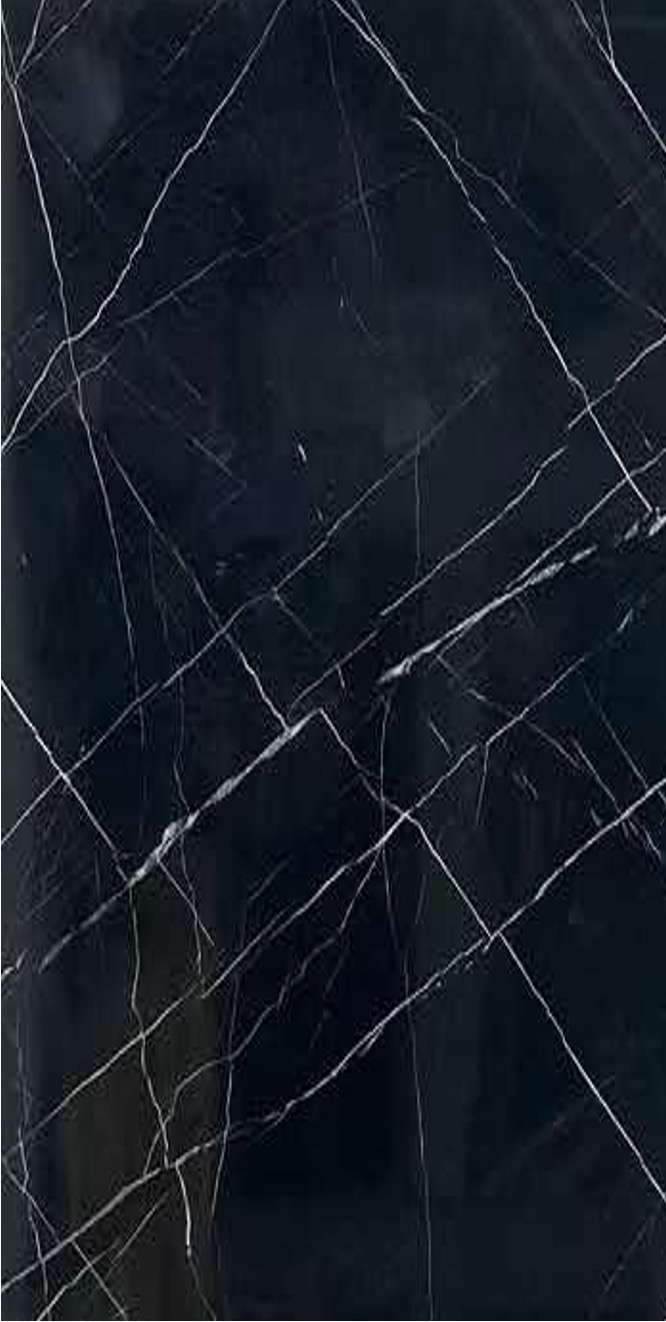
    Nero Marquina is a black fossil-bearing limestone quarried at Markina-Xemein, in Biscay, in the Spanish Basque Country, and sold as marble. Its black background carries fine white calcite veins and fossils visible to the naked eye. Its petrographic name, established by examination under NF EN 12407, is “limestone”.

    Key points

    – Geologically, it is not a marble but a limestone : named “caliza” under NF EN 12407, as written by the producer Levantina itself.

    – A single origin: the limestone band between Markina-Xemein and Aulesti, in Biscay.

    – The fossils are the mark of authenticity: rudists and Chondrodonta, named by the University of the Basque Country.

    – Values vary from one batch to another: compression from 96 to 145 MPa across the four quarry data sheets consulted.

    – Two risks to manage before laying: slip resistance of 10 to 15 SRV when polished and wet, and stone classed as moisture-sensitive by Mapei, a warped slab being lost.

    A single origin, in Biscay

    The deposit is confined to the slopes separating Markina-Xemein from Aulesti, in an area worked without interruption for more than a century (University of the Basque Country, Tierra y Tecnología, 2013). Canteras Olaspe has worked two open-pit faces there since 1964. Marnemar works three and states that its two main ones, Lekoitz and Jaime, account for more than half of total production.

    The point deserves to be made firmly: the first search result for this query presents the stone as “famous in China”. That is wrong. The deposit is Basque, and it is unique.

    Trade names, meanwhile, multiply: Negro Marquina, Negro Markina in Basque spelling, Marquina Black, Black Marquina, and Negro Markina Florido for batches with pronounced white veining. A European standard does, however, govern them: NF EN 12440.

    On the origin of the black colour, a reservation. Google’s knowledge panel, sourced from English Wikipedia for lack of a French page, describes a “bituminous limestone” whose colour is said to come from natural bitumen. None of the four quarry data sheets consulted documents this mechanism.

    A limestone, not a marble, and what that changes

    The argument comes from the producer, which makes it hard to dispute. On its Negro Marquina data sheet (March 2025), Levantina enters as the petrographic name, under the NF EN 12407 test, “caliza”, that is limestone. The declared lithology is a biomicrite; at TINO, calcite makes up 98% of the rock.

    Now a marble is, in the geological sense, a metamorphosedlimestone, in which the original fossils and bedding have disappeared in favour of interlocking calcite grains (University of Waterloo, Earth Sciences Museum). Nero Marquina has kept its fossils: it has not been metamorphosed.

    Calcite is the reference for grade 3 on the Mohs scale and scratches with a knife blade (Waterloo). This figure comes from the mineralogy of the mineral, not from a standardised test on the stone: NF EN 14205, Knoop hardness, was withdrawn in 2013.

    Calcite also dissolves on contact with an acid, releasing carbon dioxide. Pouring vinegar is the test by which geologists identify a limestone: it is not a cleaner for this stone, it is its reagent. Acid etching therefore cannot be cleaned off, only repolished.

    Named fossils, the mark of authenticity

    No French page names the species, yet a university source gives them. The team of Damas Mollá, Aranburu, García Garmilla and Fano (University of the Basque Country, 2013) identifies in the stone:

    • of the polyconitid rudists, valves of the order of 150 × 50 mm;
    • of the monopleurid rudists, in clusters, up to 15 mm in diameter;
    • of the requieniid rudists, with a characteristic black shell;
    • Chondrodonta sp., bivalves with paddle-shaped shells;
    • of the corals, massive and branching.

    The rock belongs to the “Urgonian Complex”, Lower Aptian to Upper Albian, about 115 million years ago. One detail separates it from another black stone: no stem sections here. Crinoid ossicles are the signature of Belgian petit granit, not of Marquina.

    Natural stone or porcelain stoneware sold under the name “Nero Marquina”?

    Three of the first eight results for this query are porcelain stoneware bearing this decor name. Two tests settle it in front of a slab. The pattern: a printed decor repeats from one tile to the next, calcite veining never does. The edge: on stone, the veining runs through the thickness; on porcelain stoneware the decor stops at the surface, unless it is through-body. A quotation that simply says “Nero Marquina” does not say what material it is.

    Technical values: four data sheets, ranges

    These values come from four independent data sheets, four laboratories and four batches: Levantina, Canteras Olaspe, TINO Stone & Surfaces and Natural Stone Spain. They differ, sometimes considerably.

    FeaturesTest standardRange recorded
    Petrographic nameNF EN 12407Limestone
    Bulk densityNF EN 19362,660 to 2,720 kg/m³
    Open porosityNF EN 19360.2 to 1%
    Water absorptionNF EN 137550.1 to 0.18%
    Flexural strength under centre-point loadNF EN 1237213.7 to 15.2 MPa
    Compressive strengthNF EN 192696 to 145 MPa
    Abrasion resistanceNF EN 14157about 21.5 to 22 mm
    Breaking load at dowel holeNF EN 133641,750 to 2,200 N
    Reaction to fireEN 13501Class A1
    Hardnessno EN standard in forceMohs 3, mineralogy of calcite

    Two differences matter: compression varies from 96 to 145 MPa, open porosity by a factor of 5. That is not a weakness; it is the reality of a sedimentary rock. The conclusion is simple: the data sheet for the batch delivered is worth more than the generic data sheet for the variety.

    The catalogue thicknesses found at producers are 10 mm for tiles, 20 and 30 mm for slabs, with a maximum stated format of 2,400 × 1,400 mm. These are producers’ dimensions; those of the stock available should be requested.

    Frost resistance: a figure to demand batch by batch

    The sources contradict each other, and that is the useful information. Olaspe declares the stone “resistant” under UNE-EN 12371. Levantina declares NPD, performance not determined, under the same standard. Natural Stone Spain, citing no standard, considers it poorly suited to freeze–thaw.

    Frost resistance is therefore not a property of the variety, but a performance to be declared batch by batch under NF EN 12371, « Détermination de la résistance au gel ». The technological test typically covers 48 cycles, with mechanical strength loss limited to 20% in class F1 (Buildwise, NIT 228). Before any exterior use in a frost zone, require the declaration of performance for the batch.

    Slip resistance: 10 to 15 SRV when polished and wet

    Nobody publishes this figure, and it is standardised. The SRV value is the measure of slip resistance obtained with the pendulum friction tester under NF EN 14231. On a wet surface, it comes out below 15 for polished at Levantina, at 10 at TINO. Honed stays under 35, bush-hammered exceeds 45.

    A polished finish should therefore be ruled out for shower floors, bathroom floors and any regularly wet surface. Prefer honed or bush-hammered, including on a made-to-measure marble floor. Polished remains worthwhile for walls, splashbacks, table tops and mosaic.

    Laying: a stone named as moisture-sensitive

    This is the information with the heaviest consequences in this guide. Mapei explicitly classes Nero Marquina among moisture-sensitive stones, in its technical bulletin 010403-TB “Installing moisture-sensitive stone” (22 June 2015). The same list includes Portoro, Rosso Levanto, Grigio Carnico, Pietra Serena, Ardesia Liguria and green marbles.

    The mechanism described: water reacts chemically with the minerals in the stone, the slab changes shape (cupping, curling, doming, warping), comes away from its bed, until the bond fails. The crux fits in one sentence of the bulletin: a slab that has changed shape generally can be neither repaired nor relaid. It is lost. Explicit aggravating factor: the thinner and larger the slab, the greater the risk.

    Hence the recommendation of a water-free laying bed, reactive resin or epoxy, rather than a cement-based adhesive whose mixing water triggers the reaction. The Natural Stone Institute prescribes it in its Dimension Stone Design Manual version VIII, § 3.1.4.1; Laticrete offers an epoxy complying with ANSI A118.3.

    One reservation, which strengthens the advice rather than weakening it: no French standard says this. Neither NF DTU 52.2, nor NF B10-601, nor the CTMNC documents name these stones as water-sensitive. The rule comes from the American reference manual and from adhesive manufacturers. The practical conclusion is the same as for frost: ask the supplier whether the batch is water-sensitive before laying, and pass the answer on to the installer. Not to be confused with bowing of white marble cladding panels on façades, which stems from the anisotropic thermal expansion of calcite: a different stone, a different mechanism.

    Maintenance

    Levantina specifies neutral detergents of pH 7 to 10, prohibits bleach, ammonia and descalers, and advises against metal utensils. The Natural Stone Institute adds that products containing lemon, vinegar or other acids can dull or attack limestone-based stones, and that scouring powders often contain abrasives likely to scratch some stones. A water repellent or impregnator reduces absorption without making the stone impermeable. For thicknesses and edge finishes, see the marble tiles and the marble worktops.

    Frequently asked questions

    What is the origin of black marble?

    There is no single black marble, but several black stones of different origins. Nero Marquina comes from Biscay, Nero Portoro from Liguria, petit granit or blue stone from the Soignies area in Belgium, and Nero Assoluto from Zimbabwe and India.

    What is black marble called?

    It depends on the stone. The four common names are Nero Marquina (a Spanish limestone), Nero Portoro (an Italian limestone), petit granit (a limestone, despite its name) and Nero Assoluto (a gabbro, despite its name of “absolute black granite”). Three of these four names contradict the real nature of the rock.

    What is the black and gold marble called?

    Nero Portoro, quarried in Liguria, is the best-known black stone with yellow to golden veining. It is also a limestone, and therefore sensitive to acids. Note: the geological stage and the mechanism of its veining have not been checked against a primary source.

    What is black marble worth?

    It is judged on the batch, not on the name. Four parameters count: the real nature of the rock (natural stone or porcelain stoneware with the same name), the density and regularity of the veining, the format and thickness available, and the finish. The batch’s technical values, porosity and frost resistance in particular, are part of it.

    In summary

    A Basque black limestone, hard to the eye and soft to vinegar, whose fossils are both its aesthetic appeal and its proof of authenticity. The choice comes down to two documents: the batch data sheet and the laying method. To look at the batches available, contact us.


  • Marble worktops: an honest assessment of their real limits

    Marble worktops: an honest assessment of their real limits

    A marble worktop scratches with a knife blade and loses its polish on contact with vinegar, lemon or wine. That mark is not a stain: it is a loss of material that only repolishing removes. That is the limitation to accept before buying.

    This page does not defend marble. It documents what damages it, with the source and the test standard for each claim, because that is the information missing when you look for an opinion before ordering. The materials, formats and finishes available are presented on our page marble worktops.

    Key points

    • The key mineral in marble is calcite, at 3 on the Mohs scale. A university source writes that it “is easily scratched with a knife blade”.
    • Vinegar, lemon and wine do not stain marble; they dissolve its surface. The ICOMOS glossary classes this loss of material in a different family from stains.
    • An acid mark is corrected by repolishing, and by nothing else. No cleaner and no water-repellent removes it.
    • Open porosity varies from 0.2% to 17% from one stone to another on the same NF EN 1936 test. Susceptibility to staining must therefore be asked about batch by batch, not family by family.
    • No maximum temperature is published for marble, either by a standard or by a technical body. The values in degrees that circulate are commercial and contradict each other.

    Calcite scratches with a knife blade

    Le the Earth Sciences Museum at the University of Waterloo writes that calcite is number 3 on the Mohs scale, and that it is easily scratched with a knife blade or a geologist’s hammer. As calcite is the key mineral in marble, this property carries over to the finished stone.

    A point of method needs making, because the market almost always misses it. This figure of 3 does not come from a standardised test on the stone: it is a property of the mineral. There is no longer a European standard in force for the hardness of natural stone, NF EN 14205 on Knoop hardness having been withdrawn in September 2013.

    Any data sheet stating “Mohs 3 to 4” or “Mohs 3 to 5” for a marble is therefore putting forward a range with no frame of reference. Calcite defines grade 3; it does not bracket it. The only wear property actually measured on a stone is abrasion under NF EN 14157, expressed in millimetres: the marbles consulted sit at around 21.5 to 22 mm, granites between 16.5 and 22.5 mm.

    The consequence in the kitchen is mundane and permanent. Cutting directly on the worktop leaves marks, and a chopping board is not a nicety but a necessity. Scouring powders are to be avoided for the same reason: they contain abrasives, and the surface is softer than they are.

    Acid etching is not a stain

    This is the most misunderstood limitation of marble in the kitchen, and the most decisive. Acid etching is the dissolution of surface calcite by a weak acid. The U.S. Geological Survey writes that limestone and marble are mainly composed of calcite, a calcium carbonate “that dissolves easily in a weak acid”.

    Dulling is the exact French term for what this attack produces on a polished surface. The illustrated glossary of stone deterioration patterns, published by ICOMOS’s international scientific committee for stone, defines it as the increase in roughness of an originally polished surface, through selective loss of small particles from a still sound substrate.

    The international classification places this pattern and the stain in two distinct families. Dulling belongs to the features induced by loss of material. A stain belongs to chromatic alterations. This is not a nuance of vocabulary: it determines what can correct it.

    The same glossary also explains why the mark looks lighter than the rest. It defines discolouration as an increase in lightness due, among other things, to a generally very superficial loss of polish, and specifies that dark marbles and brightly coloured marbles often undergo it. The etched area diffuses light instead of reflecting it: it contains nothing white.

    On the acidity threshold, the honest answer is that there is none. Calcite dissolves as soon as the solution is undersaturated, and it is the speed that varies with pH. A Penn State University course states that below about pH 3.5 the dissolution rate becomes proportional to acidity and is limited only by diffusion. The pH values of commercial vinegar and lemon juice are not given here: no technical source consulted publishes them.

    One fact is enough to settle the vinegar question, and it comes from a university. Vinegar is one of the reagents geologists use to identify a limestone: poured on cold, it releases bubbles of carbon dioxide. So it is not a cleaning product advised against as a precaution; it is the identification test for the rock.

    Relatively good news: the mark is reversible. One producer writes that natural stone can always be restored by repolishing the surface, which brings back the original finish, and the Natural Stone Institute refers to professional repolishing of etched areas. The trade-off is that repolishing removes material, so it is limited by thickness. No threshold beyond which it no longer suffices is published. For routine cleaning, see how to clean marble without dulling it.

    Porosity varies from 0.2 to 17% depending on the stone

    “Marble is porous” means nothing until the stone has been named. On the same test, the determination of open and total porosity under NF EN 1936, the data sheets consulted give 0.2 to 1% for a Spanish black marble and 16 to 17% for a stone sold as marble and made of 91.5% calcite. Two orders of magnitude apart.

    The practical consequence is direct: susceptibility to staining varies in the same proportions. A stone with 16% open porosity absorbs grease in a way that bears no comparison with a stone at 0.3%. It is not the rock family that decides; it is the batch.

    A reading trap comes with this figure. Many comparisons set a water absorption measured under NF EN 13755 against an open porosity measured under NF EN 1936. These are two different tests, and the two values cannot be compared. Ask for the same standard on both sides before deciding.

    Two corollaries are worth knowing. The finish does not change the porosity of the material: a polished marble is no less porous than a honed one, and polishing does not “close” the pores. And an impregnating, water-repellent treatment slows the penetration of liquids without eliminating porosity, or preventing acid etching, which acts on the surface and not in the pore network.

    Some stains, finally, have nothing to do with porosity but with a chemical reaction in the stone. That is the case with rust stains on marble, which are treated differently from organic or grease stains.

    A standardised staining test exists, and nobody publishes it

    Resistance to accidental staining is the subject of a European test standard, NF EN 16301, in its March 2021 version. It is listed among the test methods applicable to natural stone by the Centre technique de matériaux naturels de construction.

    Yet none of the data sheets consulted for this article, marble or granite, declares it. The test exists, and nobody publishes the result. It is the most useful blind spot to know about before ordering, because it concerns precisely the risk that worries a worktop buyer.

    The request to make of the supplier is therefore simple and verifiable. Ask for the batch data sheet, with the NF EN 1936 line for open porosity, and ask explicitly whether an NF EN 16301 value exists. A negative answer is information: it tells you nobody has measured it.

    Some stones move on contact with water

    A less well-known limitation concerns laying, not use, and it ends with a lost slab. A Mapei technical bulletin dated 22 June 2015 describes a change of shape caused by a chemical reaction between water and certain minerals in the stone. The document calls it cupping, curling, doming or warping.

    The mechanism described is as follows. The stone curves, pulls away from the mortar bed and debonds, and the same document states that a slab deformed in this way generally can be neither repaired nor relaid. The risk increases with the thinness of the slab and with large formats.

    The stones listed by name include all green marbles, Nero Marquina, Portoro, Rosso Levanto and Grigio Carnico, as well as agglomerates made with chips of these stones. In other words, several materials in high demand for kitchens are on the list.

    To be fair, it is worth being precise about where the risk lies. A worktop rests on cabinets; it is not bonded to a cement mortar bed, so it is not directly affected. The matching splashback, the floor of the same room or a bonded island end panel are. If you choose one of these stones for the whole kitchen, the question of water sensitivity applies to everything that is bonded.

    The professional recommendation is a two-component reactive epoxy adhesive with no mixing water, complying with the ANSI A118.3 specification. It comes from the Natural Stone Institute’s reference manual and from several adhesive manufacturers. No French standard names these stones: the rule is not written in NF DTU 52.2. Asking the supplier whether the stone is water-sensitive before laying it remains the only safe approach.

    Heat: the most widespread argument, and the least sourced

    No maximum temperature is published for marble by any technical body. The figures in circulation, from 180 °C to 650 °C depending on the page, have neither source nor protocol, and they do not agree with one another. Comparisons such as “180 °C against 150 °C for quartz” suffer from the same problem.

    What does exist is more interesting than an invented figure. There is a European test for resistance to ageing by thermal shock, NF EN 14066, and a standard dedicated to marble alone for its behaviour under thermal and moisture cycles, NF EN 16306 of April 2013. No equivalent standard exists for granite.

    On the two data sheets consulted that actually declare the NF EN 14066 test, the marbles tested lose no mass, one reporting zero change after twenty cycles. That is not permission to put a hot pan down without a trivet, but it rules out writing that marble cannot take heat. The question remains open, both ways.

    Frequently asked questions

    What are the drawbacks of a marble worktop?

    Three drawbacks can be measured. Calcite, at 3 on the Mohs scale, scratches with a knife blade. It dissolves in a weak acid, so vinegar, lemon and wine dull the surface. And porosity varies from 0.2% to 17% depending on the stone, on the same NF EN 1936 test, which makes susceptibility to staining unpredictable without the batch data sheet.

    Is an acid mark permanent?

    No, but it cannot be cleaned off. As it is a loss of material and not a deposit, no cleaner or sealer removes it. Only repolishing restores the original finish, an operation that removes material and should be left to a stone professional. On a thin tile, the available thickness margin is small.

    How can you tell acid etching from a stain?

    In raking light and by touch. Acid etching appears as a matt area on a shiny background, recessed or flush, following the outline of the spilt liquid: the material has gone. A stain is a change of colour with no loss of relief. A salt deposit stands proud and is powdery, crumbling under a fingernail.

    Does a water-repellent protect against acids?

    No. A water-repellent or impregnating sealer slows the penetration of liquids into the stone’s pore network. Acid etching dissolves the surface itself. The two phenomena are distinct, and the second is not covered by the first. No renewal frequency is given here: the schedules in circulation, from three months to five years, do not agree and are not sourced.

    Should marble be ruled out in the kitchen?

    That depends on your tolerance for patina, not on the quality of the stone. If dulled areas will bother you, keep marble for a splashback, a display island or a bathroom, and use a silicate rock for the preparation area. The details of the trade-off are in our comparison of marble and granite.

    In summary

    Marble as a worktop involves only one real decision: whether or not to accept that a spilt acid leaves a matt area until it is repolished. Everything else can be read on a data sheet, porosity under NF EN 1936 and, if it exists, staining resistance under NF EN 16301. Hardness, for its part, is that of a mineral, not of a product: it does not vary from one variety to another. To look at materials and check a data sheet before deciding, contact us.


    See also: Marble-effect worktop or real marble: a four-material comparison

  • Marble compatibility with underfloor heating

    Marble compatibility with underfloor heating

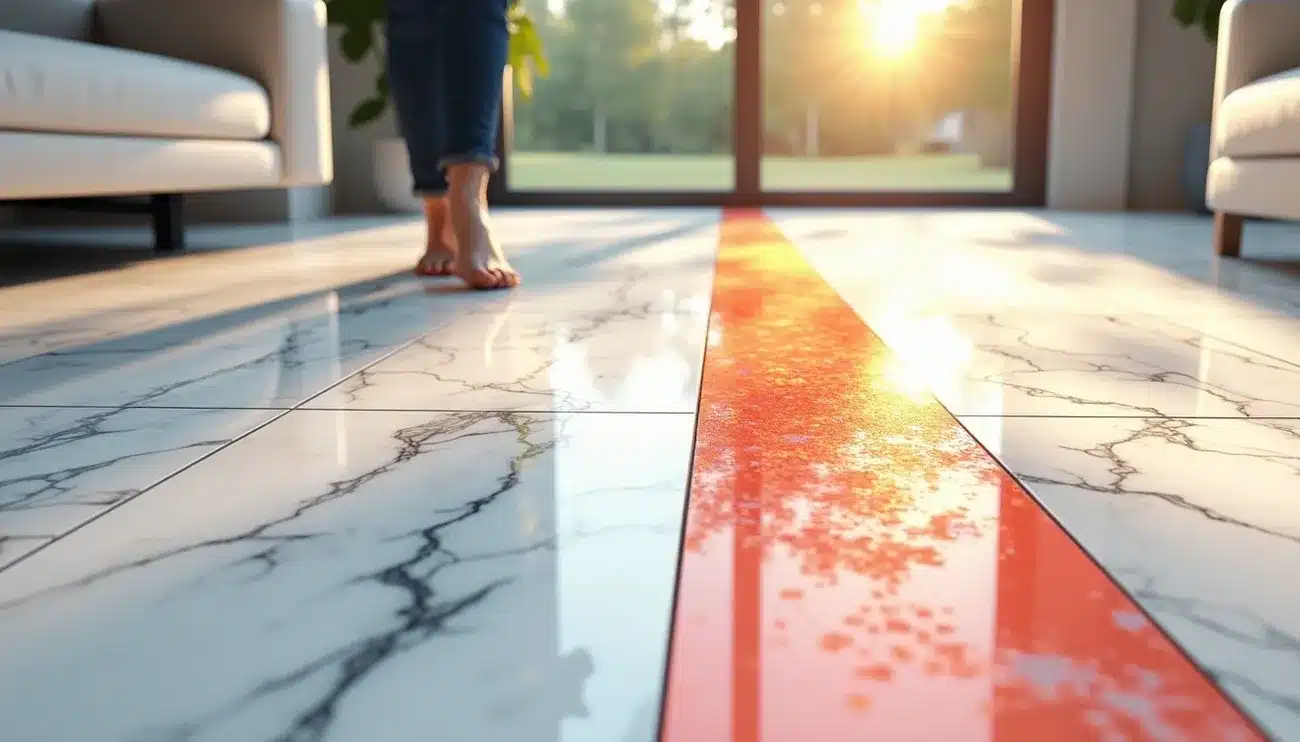
    Marble is compatible with underfloor heating, provided a few laying rules are followed. This compatibility is explained by thermal properties that deserve your attention.

    The main reason for this compatibility lies in marble’s good thermal conductivity: the material efficiently transmits heat from the system to the floor surface. It also has significant thermal inertia, which means it takes longer to heat up but then holds the heat well.

    In this article, you'll discover the specific thermal properties of marble, its advantages and limitations with underfloor heating, and the technical requirements for successful installation. We'll also compare marble with other compatible floor coverings to help you make the best choice for your needs.

    The thermal properties of marble for underfloor heating

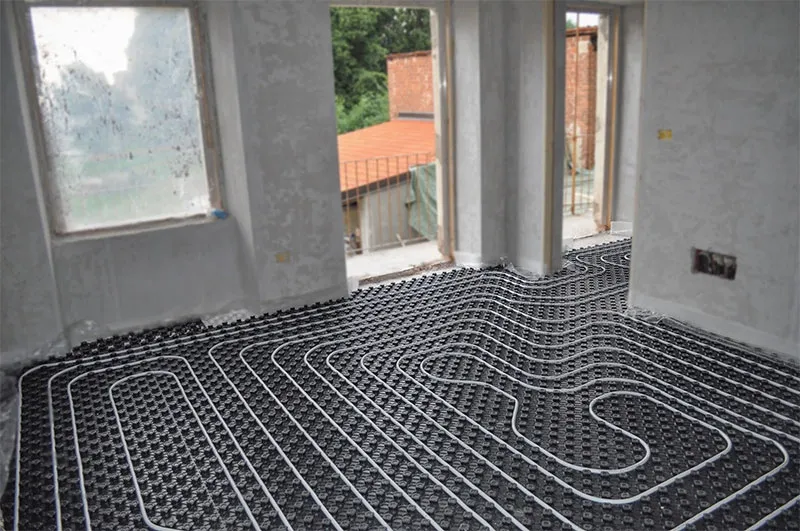
    Underfloor heating pipes laid on black insulation boards, in a room under construction

    To understand the compatibility of marble with underfloor heating, it is essential to examine its specific thermal properties. These characteristics determine how the material interacts with heat and why it is an appropriate choice for your underfloor heating system.

    Why is marble feels cold to the touch

    Marble feels cold to the touch, even at room temperature. This phenomenon is scientifically explained by its high thermal effusivity. When you place your hand on marble, it quickly absorbs the heat from your skin thanks to its high thermal conductivity. This ability to extract heat creates the impression of coldness, even though the material is at the same temperature as its surroundings.

    Thermal conductivity: definition and values for marble

    Thermal conductivity measures a material’s ability to transfer heat. It is expressed in watts per metre per kelvin (W/(m·K)). That of a stone is of the order of a few W/(m·K), whereas that of wood is only a fraction of a W/(m·K): this is what makes the two feel so different. The precise value varies with the stone and should be requested from the supplier.

    This property makes marble a good heat conductor compared with other building materials such as wood. It is this characteristic that allows marble and underfloor heating to work together, carrying heat from the system to the surface.

    The difference between conductivity and thermal inertia

    Although often confused, thermal conductivity and thermal inertia are two distinct properties. Conductivity determines the speed at which heat passes through the material, while thermal inertia defines its capacity to store and then gradually release this heat.

    Marble has a high bulk density, from 2,660 to 2,720 kg/m³ on the data sheets consulted under NF EN 1936, which gives it significant thermal inertia. The floor therefore takes longer to reach temperature, but then holds it.

    Advantages and limitations of marble with underfloor heating

    Combining marble with underfloor heating has considerable advantages, as well as certain limitations that should be carefully considered before opting for this solution.

    Even heat distribution

    Marble spreads heat evenly across the surface thanks to its conductivity. Given its inertia, this spreading is gradual rather than immediate.

    Ability to retain heat

    As well as spreading heat, marble stores it. Its mass gives it strong thermal inertia: it continues to release the stored heat for some time after the heating is switched off.

    Limits related to thickness and density

    Despite these advantages, there are some limits. The thicker the slab, the longer heat takes to pass through it. The thickness is therefore chosen with the heating engineer and according to the heating system manufacturer’s requirements.

    Risk of cracks and expansion

    Another point to watch is the risk of cracking. Differences in expansion between the screed and the floor covering can cause tiles to crack. To limit this, laying follows good practice, and bringing the screed up to temperature, before and after laying, follows the system manufacturer’s procedure and the applicable DTU.

    This resistance to temperature variations can be measured, and the existing test specifically targets marble: the NF EN 16306, “Determination of resistance of marble to thermal and moisture cycles”, April 2013, is among the test standards for natural stone listed by CTMNC. Granite has no equivalent standard on this point, which gives a simple question to ask the supplier: has the variety supplied been declared under this standard?

    Technical conditions for successful installation

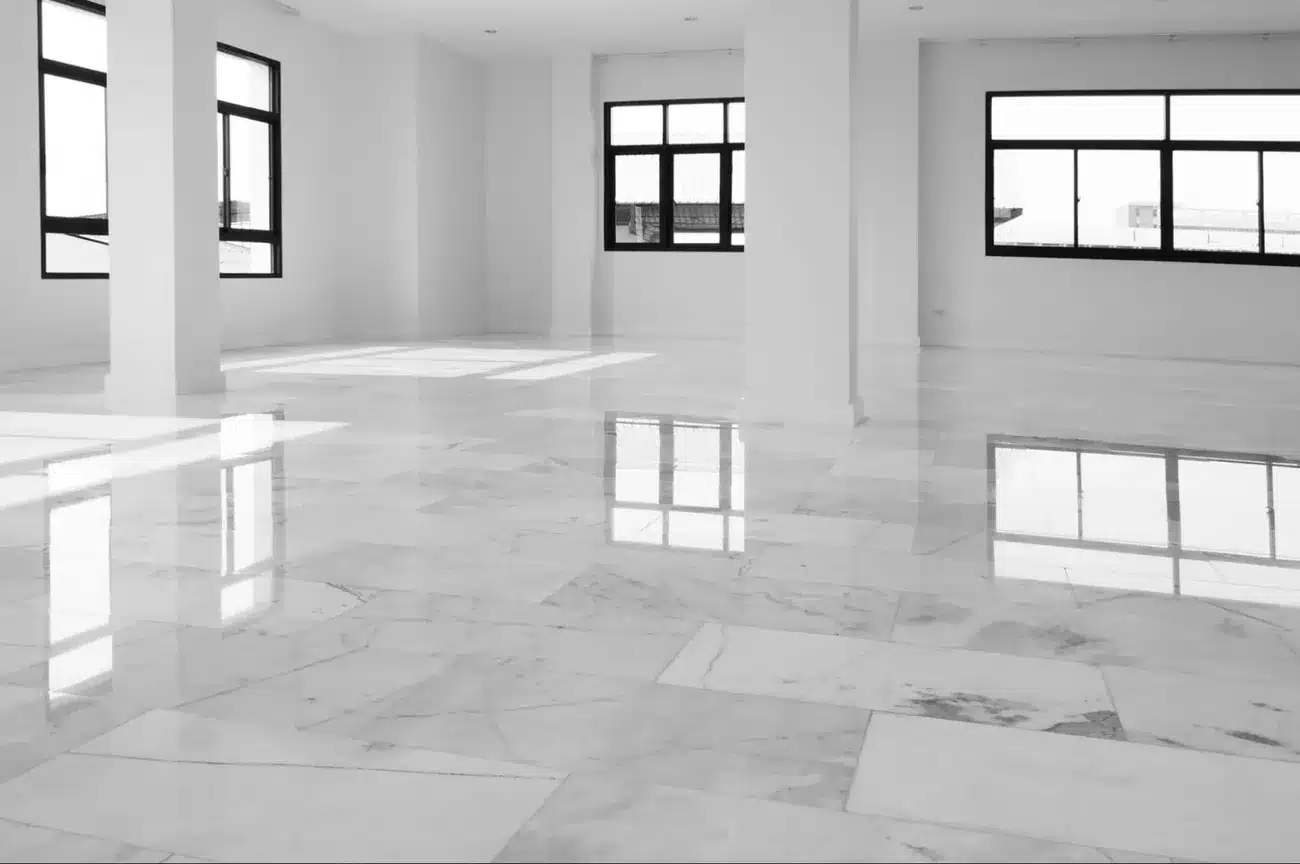
    Empty room with a polished white marble floor reflecting the tall windows and pillars

    To successfully install marble over underfloor heating, it is essential to comply with technical standards. These requirements guarantee not only the longevity of your floor covering, but also the efficiency of your heating system.

    Maximum recommended temperature for marble

    The surface temperature of a heated floor is limited to 28 °C by French regulations, the order of 23 June 1978, article 35. This limit is for the comfort and health of occupants; it was not set for the stone.

    Choosing the right adhesive and joints

    The use of a suitable adhesive is crucial to the longevity of the installation. Choose a flexible adhesive and a C2 S1 or C2 S2 deformable joint. These products effectively absorb slight thermal expansion of the substrate and prevent cracking. For large formats, an epoxy or resin-based adhesive offers superior adhesion.

    Adhesive fixing calls for one further check. Some stones change shape on contact with the mixing water of a cement-based tile adhesive, and Mapei’s technical bulletin on moisture-sensitive stones recommends a water-free laying product for these, such as a reactive resin.

    Drying time for screed before laying

    Respecting drying times is crucial. These times, for a cement or an anhydrite screed, are those of the DTU and of the screed manufacturer’s data sheet: measure the residual moisture before laying rather than counting weeks. On an anhydrite screed, sanding off the laitance before laying is a common step.

    Progressive ignition of the heating system

    Once the marble is laid, the heating is brought back up gradually, following the heating system manufacturer’s procedure, to avoid thermal shock.

    Compatible with electric and hydraulic heating

    Marble suits both main types of underfloor heating, electric and hydronic.

    Comparison of marble with other compatible coatings

    When considering an underfloor heating system, it's important to compare different floor coverings in order to choose the most efficient solution.

    Marble vs porcelain stoneware

    Porcelain stoneware, being thinner, transmits heat faster; marble, thicker and denser, stores more of it and takes longer to warm up. Both are compatible with underfloor heating.

    Marble vs parquet

    Marble warms up more slowly than some types of wooden flooring. Floorings compatible with underfloor heating are labelled as such by their manufacturer, with their own temperature limits.

    Marble vs vinyl and PVC

    Unlike marble, which holds heat for a long time, vinyl and PVC coverings heat up and cool down quickly, with temperature limits set by their manufacturers.

    Marble vs waxed concrete

    Polished concrete floors are highly conductive, allowing your space to heat up quickly. Marble, on the other hand, adds a touch of luxury to your decor, but takes longer to heat up. Waxed concrete shares good thermal conductivity with marble, but has the advantage of offering a multitude of finishes.

    Key facts about marble and underfloor heating

    In summary, marble is compatible with underfloor heating. Its conductivity allows heat to be transmitted efficiently to the floor surface, and its mass spreads it evenly, at the cost of a slower warm-up.

    Underfloor heating runs at low temperature, which makes it compatible with low-temperature heat sources such as heat pumps.

    Marble also retains a significant amount of heat thanks to its thermal inertia. This property means that the floor stays warm for longer, even after the system has been switched off. In practical terms, marble continues to radiate gentle, even heat for several hours after the heating system has been switched off.

    In terms of care, a heated marble floor is looked after like an ordinary marble floor. The longevity of the whole depends above all on following the laying instructions.

    Frequently asked questions

    Is marble a good choice for underfloor heating?

    Yes, marble is compatible with underfloor heating. Its thermal conductivity allows heat to spread evenly, and its mass lets it hold the heat, at the cost of a slower warm-up.

    What is the maximum recommended temperature for a heated marble floor?

    The surface temperature of a heated floor is limited to 28 °C by French regulations (order of 23 June 1978, article 35). This limit is for the comfort of occupants and applies to all floor coverings.

    How do you install marble correctly over underfloor heating?

    Use an adhesive and grout suited to heated substrates, of type C2 S1 or C2 S2, or a water-free adhesive for moisture-sensitive stones. Respect the screed drying times and the system manufacturer’s gradual heating procedure.

    Is marble more efficient than other floor coverings for underfloor heating?

    Marble is effective, and other coverings such as porcelain stoneware are too: being thinner, porcelain stoneware transmits heat faster, while marble stores more of it.

    What are the advantages of marble over other materials for underfloor heating?

    Marble offers good thermal conductivity, even heat distribution and a good capacity to hold heat. It also adds a touch of luxury to your interior.

  • Marble mosaic for showers: uses and precautions

    Marble mosaic for showers: uses and precautions

    Marble shower mosaics are a particularly popular decorative choice for homeowners who want to combine aesthetics and functionality in their bathrooms. In fact, mosaic is one of the most popular decorative elements for bathrooms, adding a timeless touch of elegance to your everyday space.

    Made of small pieces called tesserae, bathroom mosaic can be made of marble, ceramic, glass, mother-of-pearl or even metal. Installing a mosaic shower does, however, call for precautions, particularly for waterproofing, provided under the tiles by a liquid waterproofing system. In this article you will find out why to choose this covering for your shower, the precautions to take before laying, the right waterproofing products and care advice.

    Why choose marble mosaic for your shower?

    Marble, Marble mosaic has been used in art and architecture since ancient times, and is now the material of choice for contemporary showers. If you're still hesitating to take the plunge, find out why marble mosaics deserve your full attention.

    An aesthetic and timeless choice

    The power of attraction of marble shower mosaic lies above all in its refined aesthetic. Its polished or matt tesserae capture the light beautifully, creating a play of reflections that illuminate the space. Each piece of marble reveals unique veins and nuances, giving your shower unequalled visual depth. This natural uniqueness transforms a simple functional space into an exceptional and inspiring environment.

    Carrara white marble, in particular, is distinguished by its immaculate background and delicate grey veins, ideal for adding luminosity and elegance. This noble stone instantly evokes luxury and refinement, perfect for those seeking an uncompromisingly sophisticated atmosphere.

    Adaptable to modern and classic styles

    Far from being confined to a single style, marble mosaics blend harmoniously into a variety of decorative settings. Whether you're looking for a sleek modern interior or a classic bathroom, marble mosaics can be adapted to suit any setting.

    The variety of patterns available (herringbone, hexagons, borders) lets you personalise your shower to your taste. The range of formats, from star patterns to intricate weaves, also offers endless creative possibilities for your most ambitious projects.

    Functional advantages in humid environments

    Beyond its looks, marble mosaic has a practical advantage in a shower: the density of joints in small formats improves a floor’s grip, especially with a non-polished finish.

    The finish actually matters more than the size of the tesserae. Under NF EN 14231, the pendulum friction test, the Negro Marquina data sheet published by Levantina in March 2025 gives under 15 SRV for a wet polished finish, under 35 SRV for honed and over 45 SRV for bush-hammered: for a shower floor, that is the value to ask the supplier for.

    Marble mosaic stands up well to foot traffic and splashes, provided it is carefully laid and the stone is not water-sensitive.

    A good conductor of heat, marble is also compatible with underfloor heating systems, offering a pleasant feel to the touch. Its smooth texture makes it easy to clean and maintain, thanks in particular to the flat surface of the tesserae, which effectively removes water stains.

    Essential precautions before installation

    Contemporary shower, sea-green marble mosaic floor, white marble walls and gold fittings

    A successful mosaic installation marble shower is above all based on meticulous preparation. Careful application not only guarantees an attractive result, but one that lasts, whereas careless application can lead to visible peeling, cracking or deformation.

    Prepare a clean, dry surface

    Before laying any flooring, you need to pay particular attention to the condition of the subfloor. Start by checking that the surface is level with a spirit level. A perfectly flat surface is essential to avoid irregularities that will compromise the adhesion of the mosaic.

    Meticulously remove any dust, plaster residue or old mortar that could hinder adhesion. If you notice any roughness, don't hesitate to sand the surface. Similarly, any cracks or holes, however small, should be filled.

    For areas exposed to water splashes, which is obviously the case for a mosaic shower, prior waterproofing is essential. After cleaning, make sure the substrate is completely dry before continuing. This step prevents rising damp that would compromise the installation.

    Use a suitable primer

    Applying a primer is a fundamental step. This product significantly improves adhesion between the substrate and the coating, creating a strong, durable bond.

    Apply it with a roller, following the manufacturer's instructions precisely. The primer creates a homogeneous layer that helps the coating to spread and set better, considerably reducing the risk of delamination later on.

    For plasterboard surfaces in particular, this fixative is essential to ensure optimum adhesion of the tesserae. Allow to dry according to the manufacturer's recommendations before moving on to the next step.

    Choosing a mortar adhesive compatible with marble

    The choice of adhesive mortar is a critical point in the installation of a marble mosaic. Not all adhesives are suitable for this noble material. Ordinary cement powders risk causing discolouration that will permanently alter the decorative appearance.

    Choose an adhesive made for natural stone, white for light marbles. For moisture-sensitive stones, such as green marbles or Nero Marquina, an epoxy adhesive with no mixing water is recommended (Mapei, Natural Stone Institute).

    Adhesive manufacturers offer products specifically for natural stone, white for light or translucent stones, grey for opaque stones. Follow the manufacturer’s instructions when mixing.

    Waterproofing and grouting: the right products to use

    Marble shower floor and walls with epoxy joints, wooden stool and glass screen

    Waterproofing is a crucial element in guaranteeing the longevity of a marble shower mosaic. Specific products are needed to ensure this essential function.

    Liquid waterproofing membrane

    A liquid waterproofing membrane, applied by roller or brush under the tiles, forms a continuous barrier against water. Drying time, treatment of corners and compatibility with the adhesive are given on the data sheet of the chosen system.

    Why choose epoxy resin joints?

    Epoxy grouts offer several advantages for a marble mosaic: they are watertight, resistant to stains and mould, and their smooth surface attracts little dirt. Some allow you to bond and grout in a single operation.

    When to use a high-performance cement joint

    For some installations, a high-performance water-repellent, anti-mould cement grout may be suitable. It remains less resistant than epoxy to stains and moisture.

    Quantity of product required depending on surface

    The quantities needed depend on the size of the tesserae and the depth and width of the joints. Adhesive and grout manufacturers offer online calculators to estimate them.

    Maintenance and mistakes to avoid with marble mosaics

    To preserve the beauty of your marble shower mosaic over the years, proper care is essential. This natural stone requires special care to maintain its shine and durability in a damp environment like the bathroom.

    Gentle, regular cleaning of surfaces

    Weekly maintenance of your marble mosaic is essential to prevent the build-up of mould and other dirt. Choose a gentle pH-neutral cleanser specially designed for marble. Airing the shower after each use also helps to limit excessive moisture. For best results, always wipe surfaces with a microfibre cloth after each shower to remove soap and water residues.

    Products to be avoided at all costs (vinegar, acids)

    It is essential to avoid acidic cleaners (vinegar, lemon juice) and products containing chlorine, which attack the surface of marble. Abrasive sponges should also be avoided, as they scratch the stone beyond repair. Ordinary household products, even those labelled «all-purpose», often contain ingredients that gradually degrade the marble. Even diluted, white vinegar is too corrosive for this delicate stone.

    The Natural Stone Institute gives the same instruction and adds a second: products containing lemon, vinegar or other acids dull or etch calcareous stones, and scouring powders contain abrasives liable to scratch the stone. A neutral cleaner, stone soap or a mild washing-up liquid in warm water is enough.

    Water repellent: when and how to apply it

    Applying an impregnating sealer is crucial to protect marble from stains and moisture. To check whether new sealing is needed, carry out the “ water test ”: place a few drops of water on the surface, and if they are absorbed quickly, a new treatment is needed. The frequency is set by this test, not by a calendar: no technical source publishes one. Apply the product evenly with a soft cloth, leave it to penetrate for the time given on the product’s data sheet, then wipe off the excess.

    Preventing stains and mould in joints

    Joints are often the weak point of a mosaic shower. To prevent the formation of mould, ensure adequate ventilation and maintain a reasonable level of humidity. Clean the joints regularly with a soft toothbrush to remove any residue. For particularly exposed areas, consider applying a water-repellent product that permanently waterproofs the joints after thorough cleaning. This protective barrier effectively prevents soiling and extends the life of your installation.

    Not all white deposits along the joints are mould. The ICOMOS-ISCS illustrated glossary of stone deterioration patterns calls efflorescence this cluster of usually white, powdery, loosely bound crystals, which forms when water carrying salts from the stone’s pore network moves to the surface and evaporates: it is not deposited dirt, and treating it means treating the moisture that feeds it.

    Key points for a successful marble mosaic shower

    To install your marble shower mosaic perfectly, there are a few technical aspects that need special attention. Firstly, invest in quality tools: an electric tile cutter for precise cuts, a suitable notched trowel and a rubber mallet to gently adjust the tesserae without damaging them.

    Double buttering is recommended for the best bond: adhesive is applied to the substrate and to the back of the mosaic sheet. The fall of the shower floor towards the drain follows the rules of the applicable DTU.

    Wait for the adhesive to cure fully, for the time stated by its manufacturer, before grouting. Rushing this step can shift the tesserae.

    Don't forget to check alignment regularly with a level or laser during installation. In critical areas such as corners, systematically use sealing strips to prevent seepage.

    Finally, after laying is complete, apply a sealer made for marble. This sealer will protect your mosaic against stains over time and preserve its natural beauty despite daily exposure to water.

    Frequently asked questions

    Does a marble mosaic in a shower need sealing?

    Yes, waterproofing a marble mosaic in a shower is highly recommended. Because marble is naturally porous, it can absorb moisture and stains without adequate protection. A waterproofing treatment protects the stone from water infiltration and preserves its beauty over the long term.

    Which cleaning products should be avoided on a marble mosaic?

    Acidic products such as vinegar, lemon juice or cleaners containing chlorine should be avoided at all costs. These substances can attack and damage the marble surface. Instead, opt for gentle, pH-neutral cleaners specially designed for marble.

    How do you look after a marble mosaic shower properly?

    For best results, clean weekly with a mild product made for marble. Wipe the surface after each use to avoid soap and water residue. Ensure good ventilation and renew the sealer when the water-drop test calls for it.

    Is marble mosaic suitable for a shower floor?

    Yes, marble mosaic is suitable for a shower floor. The small tesserae and abundant joints improve grip, especially with a non-polished finish. Check before ordering that the stone is not water-sensitive.

    What is the best method for grouting a marble mosaic in a shower?

    To grout a marble mosaic in a shower, it's best to use an epoxy resin grout. This type of joint provides an excellent seal, resists stains and mould, and is more durable than traditional cement joints in a damp environment.

  • Marble or granite outdoors: frost, terraces and paving

    Marble or granite outdoors: frost, terraces and paving

    Outdoors, granite declares its frost resistance: French data sheets state 144 to 240 cycles under NF EN 12371. For marble, the same figure is either contradictory from one producer to another or not determined. For a terrace slab in a frost zone, that is the decisive difference.

    This page compares the two families on what is measured and published, with the test standard for each value. It draws no conclusion where the sources are silent, and there are more silences than you might think. To look at formats and finishes, see our marble tiles.

    Key points

    • French granite data sheets declare frost resistance of 144 to 240 cycles under NF EN 12371. On the marble side, one producer writes “resistant”, another declares the performance not determined.
    • The question to ask is not “does this marble withstand frost?” but “what does this batch’s data sheet declare under NF EN 12371?”.
    • Granite clearly outperforms marble in compression, 140 to 219 MPa against 96 to 145 MPa under NF EN 1926, and narrowly in abrasion.
    • Slip resistance depends on the finish, not on the rock family. A flamed granite measures 76 to 83 SRV on a wet floor, a polished marble 10 to 15 SRV: these are two different finishes.
    • Exposed to run-off, a limestone or a marble develops microkarst, a network of small depressions caused by dissolution of the surface. The silicates in granite resist it.

    Frost resistance is declared for granite, rarely for marble

    The decisive difference between the two families is not a performance but a declaration. Two of the three French granite data sheets consulted in the CTMNC database declare frost resistance, at 144 and 240 cycles, the third declaring nothing for this test; the family data sheet of the Association Granit et Pierres du Sidobre states 240 cycles. On the marble side, two producers contradict each other about the same stone: one writes “resistant”, the other declares NPD.

    Frost resistance is, in the sense of NF EN 12371, the behaviour of a stone subjected to successive freeze–thaw cycles in the laboratory. The standard provides for two types of test: an identification test, which takes the stone to failure, and a technological test, which applies a set number of cycles.

    NPD means No Performance Determined, performance not determined. This is not an admission of weakness: it is the right, provided for by the marking, not to declare a characteristic. But for outdoor paving in a frost zone, an NPD entry on the NF EN 12371 line amounts to no information at all.

    The number of cycles is read according to the use. According to Buildwise’s technical note, the technological test typically applies 48 cycles with a loss of mechanical strength limited to 20%. The recommended number then varies with the application: around 140 cycles for outdoor paving, against 14 cycles for a thin ventilated-façade element.

    A useful point for reading older data sheets: the 2010 revision of the standard reduced the maximum number of cycles from 240 to 168. A value of 240 cycles therefore refers to a test carried out under the previous version. It remains valid data, provided you know its date.

    The other measured differences that matter outdoors

    Two mechanical criteria genuinely separate the two families outdoors: compression and abrasion. For density and flexural strength the ranges overlap, which rules out any conclusion. That is why the table has a “test standard” column: without it, two figures cannot be compared.

    CriterionTest standardMarbleGraniteWhat can be concluded
    Frost resistanceNF EN 12371Contradictory sources: “resistant” for one producer, not determined for another144 to 240 cyclesAdvantage granite, and above all: the value is declared
    CompressionNF EN 192696 to 145 MPa140 to 219 MPaClear, consistent advantage to granite
    Abrasion wear (lower = better)NF EN 1415721.5 to 22 mm16.5 to 22.5 mmAdvantage granite, but the upper ends of the ranges meet
    Open porosityNF EN 19360.2 to 1% for a Spanish black marble, 16 to 17% for a limestone sold as marble0.2 to 0.5%Granite tightly grouped, marble spread over two orders of magnitude
    Bulk densityNF EN 19362,660 to 2,720 kg/m³2,650 to 2,710 kg/m³No difference: the ranges overlap
    Flexural strength under centre-point loadNF EN 1237213.7 to 20 MPa10 to 22.6 MPaWide overlap, no conclusion
    Slip resistance, flamed finish, wet floorNF EN 14231Finish does not exist in polished marble76 to 83 SRVNot comparable: depends on the finish
    Slip resistance, polished finish, wet floorNF EN 1423110 to 15 SRVNo published valueNot comparable: depends on the finish
    Breaking load at dowel holeNF EN 133641,750 to 2,200 N2,250 to 2,300 NSlight advantage to granite
    Sensitivity to common acidsNo standardised testYes: calcite dissolves in a weak acidNo: silicates resist acid etchingThe clearest difference, and it matters outdoors too

    The granite values come from three data sheets from the CTMNC Lithoscope, whose laboratory is COFRAC-accredited, from the Association Granit et Pierres du Sidobre and from Grupinex. All rights reserved to CTMNC, www.ctmnc.fr. The marble values come from five producer data sheets, including one stone declared as marble but made of 91.5% calcite and 8.5% quartz: it is this stone that widens the porosity range so much. The full comparison is in our standards-based comparison of marble and granite.

    Slip resistance depends on the finish, not the rock

    A flamed granite measures 76 to 83 SRV on a wet floor under NF EN 14231, a polished marble 10 to 15 SRV. These two figures cannot be compared directly, and setting them against each other would be dishonest: they concern two different finishes, not two rocks. No value was found for a polished granite, and none for a flamed marble.

    What these values do establish is nevertheless solid and actionable. A wet polished surface is very slippery, whatever the rock: 10 to 15 SRV is a level that rules out a polished finish for a terrace, a pool surround or outdoor steps. A wet flamed surface keeps its grip, at 76 SRV and above.

    The practical consequence is therefore a rule about finish, not about material. For outdoor paving, the finish is chosen first: flamed, bush-hammered, sandblasted or brushed rather than polished. On a black marble, the values published by one producer follow the same logic: under 15 SRV polished, under 35 honed and over 45 bush-hammered.

    A caveat applies to a very widespread argument. It is often said that a flamed finish, obtained by thermal shock, “closes the pores” and increases frost resistance. No technical source consulted establishes this link. Flaming changes surface roughness, and therefore the measured slip resistance: its effect on open porosity measured under NF EN 1936 is not documented.

    Microkarst: what run-off does to a limestone

    Frost is not the only mechanism that damages stone outdoors. Dissolution is a second one, slower and better defined than people think. The illustrated glossary of stone deterioration patterns, published by ICOMOS’s international scientific committee for stone, gives it a precise term.

    Microkarst is, according to this glossary, a network of small interconnected depressions at millimetre to centimetre scale, caused by partial or selective dissolution of the surface of calcareous stones exposed to water run-off. The glossary specifies that the surface then shows neither granular disintegration nor scaling: the material has been dissolved, not detached.

    The cause lies in mineralogy, and it is documented by a public geological body. TheU.S. Geological Survey writes that limestone and marble are mainly composed of calcite, a calcium carbonate “that dissolves easily in a weak acid”. On the same page it writes that granite is mainly composed of silicate minerals, feldspar and quartz, “resistant to acid attack”.

    Two nuances are needed, which the market generally skips. Granite weathers too, but through slow hydrolysis of its feldspars into clay minerals, on a geological timescale. And it is not “normal” rain that carves microkarst in a single season: the phenomenon comes from prolonged exposure to run-off, over years. The mechanism is no less real, and it applies only to carbonates.

    What to check before laying a slab outdoors

    Three documents are enough to secure outdoor paving, and none of them is a brochure: the batch data sheet with its test standards, the applicable product standard, and the French laying rule for the chosen method.

    • The batch data sheet, not the family’s. NF EN 12058, which governs natural stone floor and stair slabs, requires the manufacturer to declare the product’s characteristics. Ask explicitly for the NF EN 12371 line, and refuse a verbal answer.
    • Open porosity, measured under NF EN 1936. It determines the choice of adhesive mortar for bonded laying under NF DTU 52.2, with a threshold of 2%, and it is combined with the surface area of the element. A water absorption value under NF EN 13755 is no substitute: they are two separate tests.
    • The laying method. NF DTU 52.2 covers bonded laying, NF DTU 52.1 laying on a mortar bed. The French framework standard for the use of natural stone is NF B10-601.
    • The stone’s sensitivity to mixing water. Some stones change shape on contact with a water-based mortar. This point is dealt with just below.

    This last point deserves more detail, because it is costly. A Mapei technical bulletin dated 22 June 2015 describes a change of shape caused by a chemical reaction between water and certain minerals in the stone. The document calls it cupping, curling, doming or warping : the slab cups, comes away from the mortar bed and loses its bond.

    The same document states that a slab deformed in this way generally cannot be repaired or relaid. It is lost. The risk increases with thinness and with large formats. The stones listed by name include green marbles, Nero Marquina, Portoro, Rosso Levanto and Grigio Carnico, as well as agglomerates made with chips of these stones.

    The professional recommendation is a two-component reactive epoxy adhesive, with no mixing water, complying with the ANSI A118.3 specification. It appears in the Natural Stone Institute’s reference manual and with several adhesive manufacturers. No French text, neither NF DTU 52.2 nor NF B10-601, names these stones: the rule comes from the American professional reference, not from French standardisation. The only safe approach is therefore to ask the supplier whether the stone is water-sensitive before laying it.

    That leaves surface protection. An impregnating, water-repellent treatment for marble slows the penetration of water and greasy substances without making the stone waterproof, and without replacing a declared frost resistance. No renewal frequency is given here: no technical source publishes one, and the schedules in circulation, from twelve months to ten years, do not agree with one another.

    Frequently asked questions

    Does marble withstand frost?

    It depends on the batch, and the question cannot be settled at family level. For one and the same stone, one Spanish producer declares “resistant” under NF EN 12371 while another, a major industrial player, declares the performance not determined. A third, non-standardised document considers it unsuitable for freeze–thaw environments.

    The defensible conclusion is therefore this: the frost resistance of a marble is not a universal property of the stone, it is declared batch by batch. Insist on the declaration of performance for your batch before any outdoor use in a frost zone.

    Which finish for a granite terrace slab?

    A non-polished finish. The only quantified criterion available is slip resistance measured with the pendulum under NF EN 14231: a flamed granite comes in at 76 to 83 SRV on a wet floor, against 10 to 15 SRV for a wet polished stone. Bush-hammered, sandblasted and brushed finishes follow the same roughness logic.

    Can marble be laid on a terrace?

    Yes, under three verifiable conditions: a frost resistance declared under NF EN 12371 on the batch data sheet, a non-polished finish for slip resistance, and acceptance of microkarst, the slow surface dissolution that run-off produces on a carbonate. On an area heavily exposed to run-off, granite remains the more predictable choice.

    Does an outdoor granite slab need a water-repellent treatment?

    It is useful, because granite is not waterproof. Its open porosity lies between 0.2 and 0.5% under NF EN 1936, and one family data sheet declares up to 0.7% water absorption under NF EN 13755. An impregnating sealer slows the penetration of staining liquids and greasy substances, without eliminating porosity and without replacing a declared frost resistance.

    Which stone for a pool surround?

    The dominant criterion is slip resistance, and therefore the finish, before the choice of rock. Rule out polished finishes, whose measured value falls to 10 to 15 SRV on a wet floor. By the sea, add a question to the supplier about behaviour with salts: the ICOMOS glossary describes efflorescence of soluble salts coming from the stone’s pore network, which can also crystallise beneath the surface and cause scaling.

    In summary

    Outdoors, granite wins less through its performance than through its publication: 144 to 240 cycles declared under NF EN 12371, against a line that is often empty for marble. Add a clear advantage in compression, a slight advantage in abrasion, and an insensitivity to acids that calcite does not share. Marble can still be laid outdoors, provided you choose a non-polished finish and obtain the batch’s frost declaration. To decide on a finish and a format for your project, contact us.


  • Marble bathroom tiles: slipperiness, joints and moisture

    Marble bathroom tiles: slipperiness, joints and moisture

    Close-up of white marble bathroom tiles, visible joints and water droplets on the surface Your marble bathroom tiles offers undeniable elegance, but also presents specific challenges in a wet environment. This noble material is characterised by a surface that can become particularly slippery when wet. Without regular maintenance, traces of limescale, soap and even mould can gradually build up and become difficult to remove.

    Large marble bathroom tiles, particularly popular for their clean lines, require special attention when it comes to the joints, which are vulnerable to constant damp. On the other hand, black marble bathroom tiles, although visually spectacular, reveal more traces of water and limescale. As for expensive marble bathroom tiles, they represent a substantial investment that deserves to be protected with appropriate care. The irregular surface of non-slip versions, while safe, also poses an additional maintenance challenge because of its roughness.

    Understanding the specific features of marble bathroom tiles

    Contemporary bathroom, marble feature wall, white freestanding bath and grey tiled floor

    Marble tiles bring a special dimension to wet areas. This natural material, formed by the metamorphosis of limestone rocks subjected to high temperatures and pressures, has unique characteristics that deserve attention before installation.

    Why marble is ideal for damp rooms

    Marble is prized for its natural veining, which creates unique, inimitable patterns. Its behaviour with moisture, however, depends on the stone: Mapei classes several very popular stones, including Nero Marquina, Rosso Levanto and green marbles, as moisture-sensitive. The question should therefore be put to the supplier before choosing, not after laying.

    However, certain chemical cleaning products, particularly those containing acids, can damage marble surfaces. What's more, contrary to popular belief, real marble is naturally porous and requires regular water-repellent and stain-resistant treatment to prolong its life in damp areas.

    Types of marble tiles: polished, honed, textured

    Marble finishes have a considerable influence on its appearance and technical properties:

    • Polished finish A perfectly smooth, glossy surface that reveals the depth of the colours and veining. This finish reduces the natural roughness of the stone, making it easier to maintain.

    • Honed finish Matt or slightly satin surface, smooth to the touch but without excessive shine. It offers a softer, more subtle appearance while retaining its natural look.

    • Textured finish Sandblasted finish: Includes sandblasted, flamed or brushed finishes that create an anti-slip surface. The sandblasted finish, obtained by high-pressure sandblasting, is particularly recommended for damp areas.

    Risks of slipping on wet surfaces

    Slipperiness is a major risk with marble tiles in bathrooms. Polished stone becomes significantly more slippery when wet, increasing the risk of falls. Standards have been established to assess this risk:

    This slipperiness can be measured. Under NF EN 14231, the pendulum friction test, the Negro Marquina data sheet published by Levantina gives under 15 SRV for a wet polished finish, under 35 SRV for honed and over 45 SRV for bush-hammered. On a wet floor, the finish therefore matters more than the name of the stone.

    • German standards DIN 51097 and DIN 51130 They assess slip resistance using the inclined plane method.

    • R classifications From R9 (less adhesive) to R13 (more adhesive), tiles graded R10 are generally recommended for bathrooms.

    • A/B/C classifications For slip resistance in bare feet, an A classification is suitable for standard bathroom tiles, but A+B+C is required for a walk-in shower.

    To reconcile aesthetics and safety, opt for matt or non-slip finishes specifically designed for wet areas, or consider an anti-slip treatment during installation.

    The challenges posed by damp and joints in a marble bathroom

    In the constantly damp environment of a bathroom, marble tiles have particular vulnerabilities that require special attention to preserve their beauty and functionality.

    The impact of humidity on the porosity of marble

    Contrary to appearances, marble has a porous structure that absorbs moisture. The difference between stones is considerable: on the same NF EN 1936 test, the data sheets consulted give 0.2% to 17% open porosity depending on the variety. Without protection, water penetrates this pore network, along with whatever it carries.

    To counter this phenomenon, applying a water-repellent impregnator proves essential, particularly for black bathroom marble tiles, which show damp-related changes more clearly. This treatment is renewed when a drop of water placed on the surface no longer beads: no technical source publishes a frequency.

    Frequent problems with joints: mould, cracks, etc.

    Joints are often the weak link in marble bathroom tiles. Their porous nature makes them ideal breeding grounds for blackish or greenish mould, particularly in poorly ventilated areas. What's more, temperature variations between the hot water in the shower and the ambient air cause the joints to expand and eventually become brittle.

    This problem is exacerbated with large marble bathroom tiles, where the fewer joints are subject to greater mechanical stress. The use of epoxy joints rather than cementitious joints offers superior resistance, albeit at a higher price for marble bathroom tiles.

    How damp affects the durability of tiles

    Prolonged exposure to humidity can trigger a number of phenomena that affect marble:

    • A dull film caused by limescale and soap deposits
    • Efflorescence, that is, salts drawn up from the stone’s pore network and crystallised on the surface (ICOMOS-ISCS glossary)
    • On moisture-sensitive stones, warping of the slab, which comes away from its bed (Mapei)

    This damage worsens if its cause, moisture, is not dealt with. Dulling can be removed by repolishing; a warped slab, on the other hand, is generally lost.

    Recommended methods and products for maintaining marble tiles

    Regular maintenance of marble bathroom tiles requires specific methods to preserve their beauty without damaging them.

    Natural products compatible with marble

    Since marble is sensitive to acids, clean with a neutral detergent, with a pH of 7 to 10: stone soap or mild washing-up liquid in lukewarm water, as the Natural Stone Institute recommends. Avoid bicarbonate of soda and clay stone, which scratch a stone rated 3 on the Mohs scale, as well as vinegar, lemon and any acidic cleaner.

    Cleaning techniques without damaging the surface

    For daily care, use a slightly damp microfibre cloth. For a deeper clean, apply your solution without rubbing hard, then rinse with clean water and dry with a soft cloth to avoid marks. On black marble, an area that has gone matt is not dirt: it is dulling, which can be removed by repolishing.

    Using a steam cleaner: precautions to take

    Although practical, steam cleaners should be used sparingly. Set it to minimum pressure and maintain a safe distance. Never use it on large untreated or weak bathroom marble tiles.

    Ideal cleaning frequency to prevent clogging

    Daily wiping of water splashes, light weekly cleaning and monthly in-depth maintenance are the ideal rhythm. This regularity avoids the need for intensive treatments, which would have a long-term impact on the expensive marble bathroom tiles.

    Choosing the right marble tiles to limit the risks

    Light bathroom with white units, marble floor with a non-slip finish and glazed shower

    To limit the problems associated with marble tiling in your bathroom, it's essential to make the right choice from the outset, in terms of both aesthetics and practicality.

    Advantages of black marble bathroom tiles

    Black marble turns a bathroom into a striking space, especially alongside light-coloured elements. It does, however, show limescale marks more readily and dulling: the ICOMOS glossary notes that dark marbles often show visible discolouration through loss of polish. Its grip depends on the finish, not the colour: under NF EN 14231, a wet polished Nero Marquina falls below 15 SRV.

    Why opt for large marble bathroom tiles?

    Large-format slabs reduce the number of joints, which are often a weak point in wet areas. They are also heavier and more exposed to warping with water-sensitive stones, so they should be discussed with the installer before ordering.

    What you need to know about marble bathroom tiles - prices

    No prices are published here: the price depends on the stone, thickness, finish and format, and is set by quote. Marble-effect porcelain stoneware tiles generally cost less than natural stone, without its reparability.

    Anti-slip and water-repellent treatments on installation

    Slip-resistant treatments exist for mineral surfaces; some create micro-roughness that improves grip. Their effect and compatibility with a limestone can be checked on the product data sheet, and a test on an offcut of the same stone is essential before treating a floor.

    Constant moisture also comes into play at the laying stage. Some stones change shape on contact with the mixing water of a cement-based adhesive, and Mapei’s technical bulletin on moisture-sensitive stones recommends a water-free laying product for these, such as a reactive resin. So ask the supplier whether the stone delivered is among the water-sensitive stones before bonding it.

    Key points for safe, durable marble tiles

    To make your marble bathroom tiles last, a few basic principles must be followed. A water-repellent treatment is useful, because marble is porous, particularly in wet areas.

    Avoid “shine” products that leave a film on the surface: the ICOMOS glossary notes that a film can lose its transparency as it ages. A dulled marble is restored by repolishing, not by adding a layer.

    When it comes to safety, choose the level of slip resistance wisely. For a standard bathroom, tiles rated R10 in accordance with DIN 51130 offer adequate grip, while a walk-in shower will require an A+B+C coating in accordance with DIN 51097.

    Strictly avoid acidic cleaners and bleach, which attack the surface. Use a detergent with pH 7 to 10, and avoid bicarbonate and clay stone, which are abrasive on marble.

    When faced with daily splashes of water, wipe them up immediately to prevent stains from forming. For large marble bathroom tiles, regularly check the condition of the joints, which are weak points in the face of persistent damp.

    An impregnating sealer is renewed when a drop of water placed on the surface no longer beads: no technical source publishes a frequency.

    Frequently asked questions

    Are marble tiles suitable for bathrooms?

    Yes, provided you choose a non-polished finish for the floor and a stone that is not water-sensitive. Marble is porous: a water-repellent treatment and regular wiping preserve its appearance in this wet environment.

    How can marble bathroom tiles be made less slippery?

    To reduce the risk of slipping, opt for matt or textured finishes rather than polished ones. You can also apply an anti-slip treatment when you lay the tiles, or choose tiles with an R10 slip rating for a grip suitable for bathrooms.

    What are the best products for cleaning marble tiles?

    A neutral detergent with a pH between 7 and 10: stone soap or a mild washing-up liquid in warm water. Avoid vinegar, lemon and acidic cleaners, as well as bicarbonate and powders, which scratch the stone.

    How often should marble bathroom tiles be maintained?

    Optimum maintenance includes daily wiping of water splashes, weekly light cleaning and monthly in-depth maintenance. This routine helps to preserve the beauty of the marble and prevent clogging.

    Are marble-effect tiles a good alternative to real marble?

    Imitation marble tiles offer an economical alternative while retaining the luxurious look of natural marble. It is generally less expensive, easier to maintain and can offer better resistance to moisture, making it an attractive option for bathrooms.

  • Calacatta vs Carrara: the differences for your project

    Calacatta vs Carrara: the differences for your project

    Two marble slabs side by side, one veined in grey, the other in grey and golden ochreIn the marble basins of the Apuan Alps, geologists identify 7 commercial varieties for more than fifty local names (Massa & Pieruccioni, Geoheritage, 2020). Calacatta and Bianco Carrara are two of these varieties, quarried in the same territory: what separates them is the structure of the rock, not a ranking of rarity.
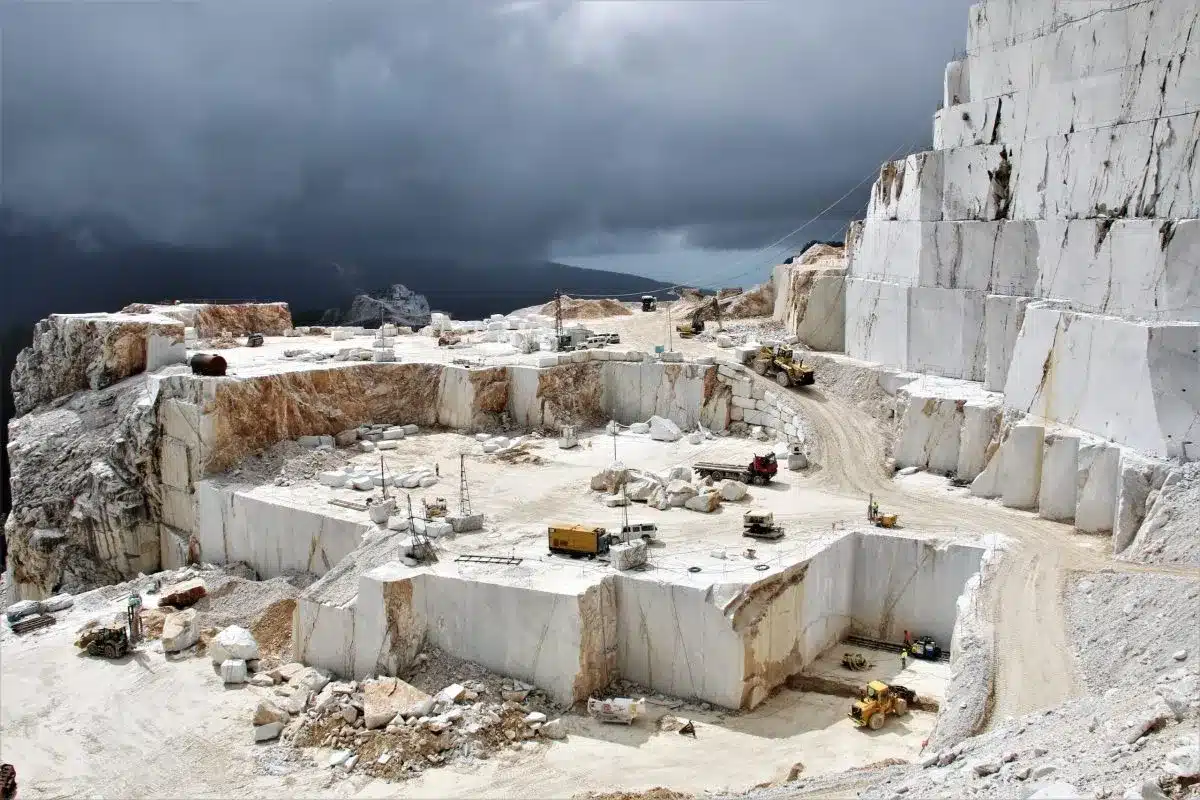
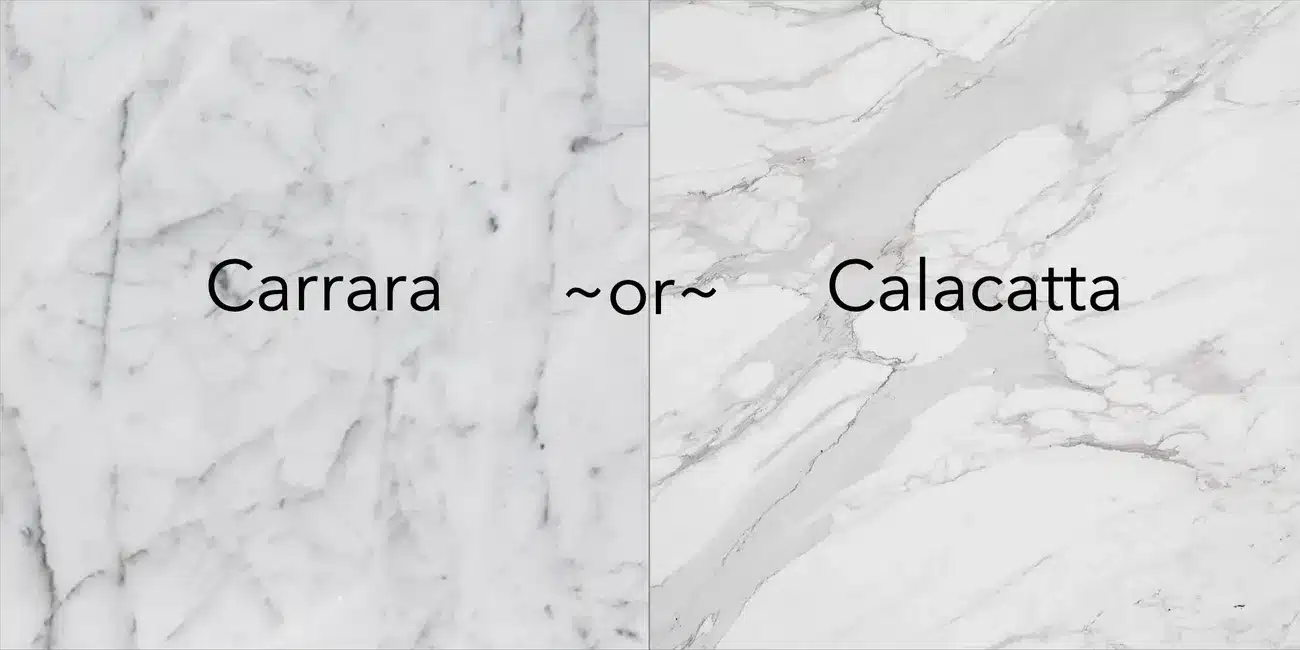
    Carrara marble and Calacatta both come from the Carrara region of Italy, but their visual characteristics are quite distinct. Carrara can be recognised by its soft grey background with darker grey veins, while Calacatta is distinguished by its immaculate white with bold, spectacular veins running through it. To put it simply: «Calacatta = large, contrasting veins. Carrara = fine, softer veins».

    The choice between these two types of marble matters for your project. On the one hand, Carrara marble can be seen as a generic term covering several varieties, including Calacatta, Bianco di Carrara and Statuario, described one by one by the geologist Piero Primavori. On the other hand, Calacatta is regarded as a luxury Italian marble, which naturally affects its price and use. In this article you will find all the nuances that separate these two stones, so you can make the right choice for your interior.

    Origin and extraction: two emblematic Italian marbles

    Carrara marble quarry, squared white blocks, site machinery and overcast sky

    In the heart of the Apuan Alps in Tuscany lies one of the world's most beautiful regions.’marble extraction the most famous in the world. The Carrara mountains are home to quarries that have been in operation since Roman times, providing materials for some of the most iconic works of architecture and art in history.

    The Carrara quarries: cradle of the two stones

    The Carrara region is home to over 650 marble quarrying sites, making it the most prolific source of marble in the world. These quarries, which have been in operation since ancient times, have provided the raw material for countless masterpieces. Extraction techniques have evolved considerably over time, moving from traditional methods to the diamond wire cutting, introduced in the 1970s. This development made the work less arduous and safer, while enabling more precise cuts to be made.

    Geographical differences between Calacatta and Carrara

    Although Calacatta and Carrara marbles both come from the Carrara region, their precise geographical origins differ. Carrara marble is extracted specifically from the province of Massa Carrara, while Calacatta comes from the Apuan mountains. Contrary to popular belief, Calacatta does not come from a specific mountain or quarry, but rather from a series of quarries scattered across this vast mountain range.

    Some quarries produce better quality Calacatta than others. For example, the Borghini quarry, one of the oldest still operating in the region, produces cuts dating back to Roman times.

    Why their origin influences their rarity

    The rarity of Calacatta marble is mainly due to the specific geological conditions in which it was formed. It is formed under specific and limited conditions, which considerably limits its availability. In addition, the number of sites where it can be extracted is extremely limited, unlike Carrara marble, which is available from numerous quarries.

    The laborious and time-consuming process of extracting Calacatta also contributes to its rarity. These factors combined explain why Calacatta is considered one of the most exclusive and sought-after marbles in the world, while Carrara, although prestigious, remains more accessible and widely available.

    Visual differences between Calacatta and Carrara

    Two marbles compared: Carrara with diffuse grey veining, Calacatta with bold, contrasting veining

    To distinguish Calacatta from Carrara, careful observation of their visual characteristics is essential. These two types of marble have marked aesthetic differences that have a considerable influence on their use in interior design.

    Background colour: pure white vs. bluish grey

    The fundamental difference between these two marbles lies in their basic colour. Calacatta has a dazzling, almost luminous white background, which serves as a backdrop for its spectacular veins. In comparison Carrara marble has a light grey base with subtle bluish tones. This softer, less pure tone gives Carrara a more discreet, but just as elegant look.

    Veining: fine and diffuse or wide and contrasting

    The veining is the most distinctive feature of these two natural stones. Calacatta has bold, thick and dramatic veins that can vary from grey to golden to brown. These patterns are generally more widely spaced, creating a strong contrast with the pristine white background.

    Carrara is also characterised by its fine, delicate veins, creating a subtle, feathery effect. These light grey lines blend harmoniously with the greyish base, giving a more homogenous, less contrasting appearance.

    Aesthetic impact on the interior

    These visual differences determine the impact of each marble in a space. Calacatta, with its luxurious appearance and striking contrasts, naturally becomes the focal point of a room. It is ideal for installations designed to impress: kitchen islands, feature walls or majestic fireplaces.

    Carrara, by contrast, offers a more understated elegance that blends into the overall design. Its subtlety makes it an excellent choice for larger applications such as floors, worktops or entire bathrooms, where its less dominant character helps create a calm atmosphere.

    In short, choose Calacatta if you want an eye-catching centrepiece, and Carrara for a more subtle beauty that complements rather than dominates your space.

    Applications and uses by room

    Each type of marble finds its ideal place in different areas of your home, their distinctive visual characteristics determining their optimum application.

    Kitchen: credenzas and worktops

    Carrara worktops offer a timeless sophistication suited to any style of design, while those in Calacatta create spectacular focal points that will impress your guests. For credenzas, Carrara marble fits perfectly into kitchens where you want elegance without the stone stealing the show from your beautiful, colourful cabinets. Calacatta also stands up better in the kitchen, thanks to its darker veins that hide coffee, wine and food stains more effectively.

    Bathroom: elegance and moisture resistance

    In the bathroom, Calacatta illuminates the space with its large formats that give an impression of openness. The 18x18 Carrara tiles laid diagonally create a classic look reminiscent of the entrances to homes of yesteryear. For the showers, Calacatta offers a spa-like experience thanks to its bold veining, while Carrara brings a more subtle elegance with its more pronounced grey look.

    Living room and offices: wall and floor coverings

    Calacatta naturally becomes a central element in fireplaces, immediately capturing attention with its bold visual impact. Carrara, on the other hand, with its softer tones, is ideally suited to large surfaces such as floors, where its consistency creates a calm, balanced ambience.

    What kind of marble for commercial spaces?

    Calacatta, with its dramatic veining, is often used to create focal points in high-end lobbies, reception areas and exclusive commercial environments. Carrara, on the other hand, is more versatile with its subtle veining, making it ideal for wall coverings in offices and commercial spaces, where functionality and aesthetics must go hand in hand.

    Price, maintenance and durability: what you need to know

    As well as aesthetic considerations, the economic factor and maintenance have a considerable influence on your choice between these two natural stones. These practical aspects often determine the final decision for your landscaping project.

    Carrara marble: more accessible

    Carrara marble, being more widely available, is the basin’s standard production: Bianco Carrara is the ordinary variety of these basins, and from about 70 active quarries the municipality of Carrara extracted 656,000 tonnes of blocks in 2023, a historic low. This availability affects the price, as do the varied formats of standard slabs, which make large projects easier.

    Le Calacatta: a top-of-the-range choice

    Calacatta, regarded as a luxury marble, sells for considerably more. The rarity of the variety, which Piero Primavori stresses for the Calacattas, partly explains this; however, no public breakdown of Carrara production by variety makes it possible to quantify it. The selection of slabs with golden veining also plays a part. No prices are published here: the price is set by the batch, the thickness and the finish, not by the name.

    Routine maintenance and precautions

    Both marbles require similar care. Daily cleaning with a soft cloth and lukewarm water is generally sufficient. Absolutely avoid acidic or abrasive products that attack the stone. A impregnating water-repellent made for marble slows absorption and limits staining; it is renewed when a drop of water no longer beads, not according to a calendar. For spills, particularly of coloured or acidic substances, immediate cleaning is essential.

    Durability and impact resistance

    Calacatta and Carrara have exactly the same hardness: their dominant mineral is calcite, the reference for grade 3 on the Mohs scale which, as the University of Waterloo Earth Sciences Museum, scratches with a simple knife blade. Neither is therefore harder or more resistant than the other, and both remain sensitive to impacts. Both types require the same precautions in use. Their durability is proven by historic monuments that have lasted for centuries. In domestic use, a dulled or etched surface is restored by repolishing, as needed rather than to a schedule.

    Key factors in making the right choice

    To finalise your decision between Calacatta and Carrara, there are several key factors to consider. First and foremost, assess the desired visual impact in your space: Calacatta naturally stands out as a focal point with its bold veins, while Carrara provides an elegant backdrop that complements the whole without dominating.

    Your budget plays a crucial role in this choice. Calacatta generally costs two to three times more than Carrara, reflecting its exceptional rarity and luxurious status.

    Also consider the intended use. For rooms where you want to create a lasting impression, such as reception rooms or guest bathrooms, Calacatta excels. Carrara, on the other hand, is perfect for larger spaces that require a subtle, consistent elegance.

    The size of your project will also influence your selection. The more affordable Carrara can cover large surfaces without compromising your budget, while Calacatta is ideal for kitchen islands or feature walls where its visual impact can be fully appreciated.

    Ultimately, these two Italian marbles offer timeless beauty with distinct characters. Your choice will depend mainly on your personal aesthetic preferences, combined with the practical and budgetary constraints of your project.

    Frequently asked questions

    What is the main difference between Carrara and Calacatta marble?

    The main difference lies in their appearance. Carrara has a light grey background with fine, subtle veins, while Calacatta has a bright white background with larger, contrasting veins.

    Is Calacatta more expensive than Carrara?

    Yes, Calacatta is generally more expensive than Carrara. Its rarity and luxurious appearance make it a more exclusive marble, which is reflected in its higher price.

    Which type of marble is best for a kitchen worktop?

    Both types are suitable, but Calacatta is more resistant to stains thanks to its darker veins. Carrara, however, is a more affordable option for larger surfaces.

    How should these marbles be looked after day to day?

    Daily cleaning with a soft cloth and warm water is generally enough. Avoid acidic or abrasive products, and renew the sealer when a drop of water placed on the surface no longer beads.

    Which one to choose for a strong visual impact in a room?

    Calacatta, with its bold, contrasting grain, is ideal for creating an impressive focal point in a room. It's perfect for eye-catching installations such as kitchen islands or fireplaces.

    See also: Calacatta marble: real Carrara marble or a finish name?