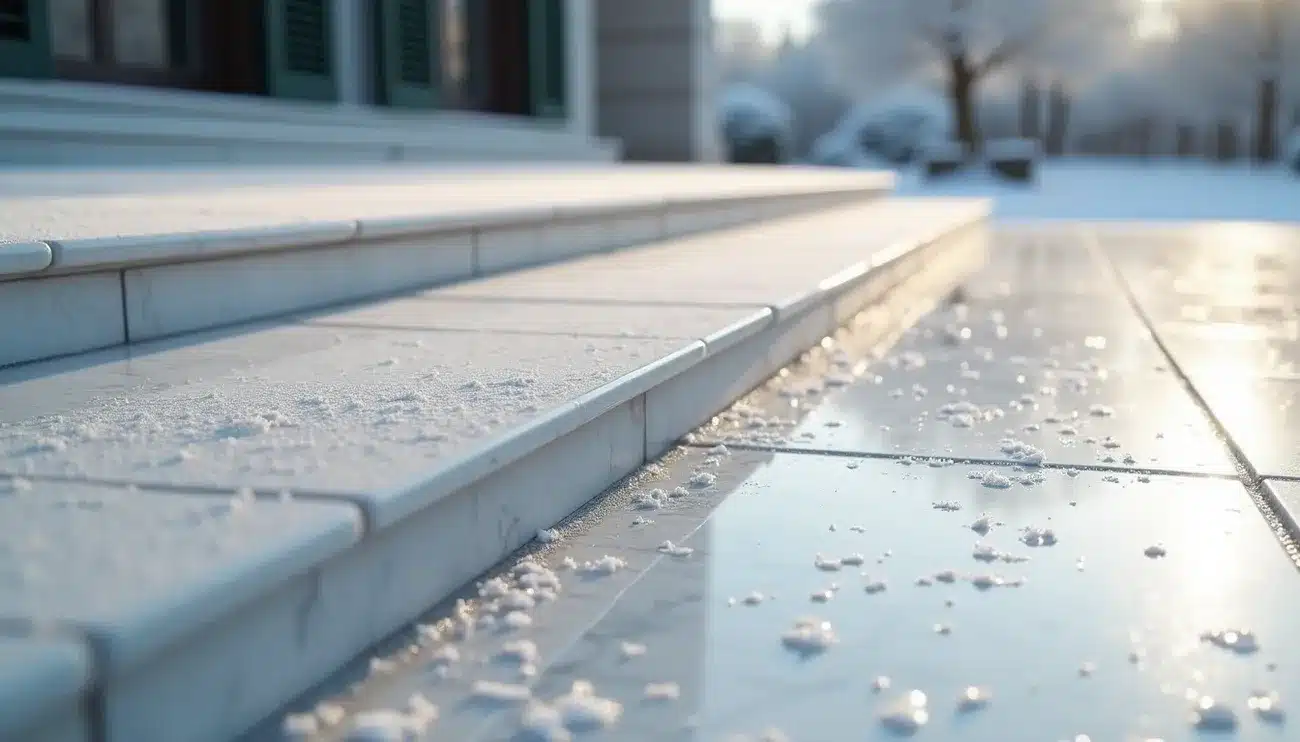
Outdoors, granite declares its frost resistance: French data sheets state 144 to 240 cycles under NF EN 12371. For marble, the same figure is either contradictory from one producer to another or not determined. For a terrace slab in a frost zone, that is the decisive difference.
This page compares the two families on what is measured and published, with the test standard for each value. It draws no conclusion where the sources are silent, and there are more silences than you might think. To look at formats and finishes, see our marble tiles.
Key points
- French granite data sheets declare frost resistance of 144 to 240 cycles under NF EN 12371. On the marble side, one producer writes “resistant”, another declares the performance not determined.
- The question to ask is not “does this marble withstand frost?” but “what does this batch’s data sheet declare under NF EN 12371?”.
- Granite clearly outperforms marble in compression, 140 to 219 MPa against 96 to 145 MPa under NF EN 1926, and narrowly in abrasion.
- Slip resistance depends on the finish, not on the rock family. A flamed granite measures 76 to 83 SRV on a wet floor, a polished marble 10 to 15 SRV: these are two different finishes.
- Exposed to run-off, a limestone or a marble develops microkarst, a network of small depressions caused by dissolution of the surface. The silicates in granite resist it.
Frost resistance is declared for granite, rarely for marble
The decisive difference between the two families is not a performance but a declaration. Two of the three French granite data sheets consulted in the CTMNC database declare frost resistance, at 144 and 240 cycles, the third declaring nothing for this test; the family data sheet of the Association Granit et Pierres du Sidobre states 240 cycles. On the marble side, two producers contradict each other about the same stone: one writes “resistant”, the other declares NPD.
Frost resistance is, in the sense of NF EN 12371, the behaviour of a stone subjected to successive freeze–thaw cycles in the laboratory. The standard provides for two types of test: an identification test, which takes the stone to failure, and a technological test, which applies a set number of cycles.
NPD means No Performance Determined, performance not determined. This is not an admission of weakness: it is the right, provided for by the marking, not to declare a characteristic. But for outdoor paving in a frost zone, an NPD entry on the NF EN 12371 line amounts to no information at all.
The number of cycles is read according to the use. According to Buildwise’s technical note, the technological test typically applies 48 cycles with a loss of mechanical strength limited to 20%. The recommended number then varies with the application: around 140 cycles for outdoor paving, against 14 cycles for a thin ventilated-façade element.
A useful point for reading older data sheets: the 2010 revision of the standard reduced the maximum number of cycles from 240 to 168. A value of 240 cycles therefore refers to a test carried out under the previous version. It remains valid data, provided you know its date.
The other measured differences that matter outdoors
Two mechanical criteria genuinely separate the two families outdoors: compression and abrasion. For density and flexural strength the ranges overlap, which rules out any conclusion. That is why the table has a “test standard” column: without it, two figures cannot be compared.
| Criterion | Test standard | Marble | Granite | What can be concluded |
|---|---|---|---|---|
| Frost resistance | NF EN 12371 | Contradictory sources: “resistant” for one producer, not determined for another | 144 to 240 cycles | Advantage granite, and above all: the value is declared |
| Compression | NF EN 1926 | 96 to 145 MPa | 140 to 219 MPa | Clear, consistent advantage to granite |
| Abrasion wear (lower = better) | NF EN 14157 | 21.5 to 22 mm | 16.5 to 22.5 mm | Advantage granite, but the upper ends of the ranges meet |
| Open porosity | NF EN 1936 | 0.2 to 1% for a Spanish black marble, 16 to 17% for a limestone sold as marble | 0.2 to 0.5% | Granite tightly grouped, marble spread over two orders of magnitude |
| Bulk density | NF EN 1936 | 2,660 to 2,720 kg/m³ | 2,650 to 2,710 kg/m³ | No difference: the ranges overlap |
| Flexural strength under centre-point load | NF EN 12372 | 13.7 to 20 MPa | 10 to 22.6 MPa | Wide overlap, no conclusion |
| Slip resistance, flamed finish, wet floor | NF EN 14231 | Finish does not exist in polished marble | 76 to 83 SRV | Not comparable: depends on the finish |
| Slip resistance, polished finish, wet floor | NF EN 14231 | 10 to 15 SRV | No published value | Not comparable: depends on the finish |
| Breaking load at dowel hole | NF EN 13364 | 1,750 to 2,200 N | 2,250 to 2,300 N | Slight advantage to granite |
| Sensitivity to common acids | No standardised test | Yes: calcite dissolves in a weak acid | No: silicates resist acid etching | The clearest difference, and it matters outdoors too |
The granite values come from three data sheets from the CTMNC Lithoscope, whose laboratory is COFRAC-accredited, from the Association Granit et Pierres du Sidobre and from Grupinex. All rights reserved to CTMNC, www.ctmnc.fr. The marble values come from five producer data sheets, including one stone declared as marble but made of 91.5% calcite and 8.5% quartz: it is this stone that widens the porosity range so much. The full comparison is in our standards-based comparison of marble and granite.
Slip resistance depends on the finish, not the rock
A flamed granite measures 76 to 83 SRV on a wet floor under NF EN 14231, a polished marble 10 to 15 SRV. These two figures cannot be compared directly, and setting them against each other would be dishonest: they concern two different finishes, not two rocks. No value was found for a polished granite, and none for a flamed marble.
What these values do establish is nevertheless solid and actionable. A wet polished surface is very slippery, whatever the rock: 10 to 15 SRV is a level that rules out a polished finish for a terrace, a pool surround or outdoor steps. A wet flamed surface keeps its grip, at 76 SRV and above.
The practical consequence is therefore a rule about finish, not about material. For outdoor paving, the finish is chosen first: flamed, bush-hammered, sandblasted or brushed rather than polished. On a black marble, the values published by one producer follow the same logic: under 15 SRV polished, under 35 honed and over 45 bush-hammered.
A caveat applies to a very widespread argument. It is often said that a flamed finish, obtained by thermal shock, “closes the pores” and increases frost resistance. No technical source consulted establishes this link. Flaming changes surface roughness, and therefore the measured slip resistance: its effect on open porosity measured under NF EN 1936 is not documented.
Microkarst: what run-off does to a limestone
Frost is not the only mechanism that damages stone outdoors. Dissolution is a second one, slower and better defined than people think. The illustrated glossary of stone deterioration patterns, published by ICOMOS’s international scientific committee for stone, gives it a precise term.
Microkarst is, according to this glossary, a network of small interconnected depressions at millimetre to centimetre scale, caused by partial or selective dissolution of the surface of calcareous stones exposed to water run-off. The glossary specifies that the surface then shows neither granular disintegration nor scaling: the material has been dissolved, not detached.
The cause lies in mineralogy, and it is documented by a public geological body. TheU.S. Geological Survey writes that limestone and marble are mainly composed of calcite, a calcium carbonate “that dissolves easily in a weak acid”. On the same page it writes that granite is mainly composed of silicate minerals, feldspar and quartz, “resistant to acid attack”.
Two nuances are needed, which the market generally skips. Granite weathers too, but through slow hydrolysis of its feldspars into clay minerals, on a geological timescale. And it is not “normal” rain that carves microkarst in a single season: the phenomenon comes from prolonged exposure to run-off, over years. The mechanism is no less real, and it applies only to carbonates.
What to check before laying a slab outdoors
Three documents are enough to secure outdoor paving, and none of them is a brochure: the batch data sheet with its test standards, the applicable product standard, and the French laying rule for the chosen method.
- The batch data sheet, not the family’s. NF EN 12058, which governs natural stone floor and stair slabs, requires the manufacturer to declare the product’s characteristics. Ask explicitly for the NF EN 12371 line, and refuse a verbal answer.
- Open porosity, measured under NF EN 1936. It determines the choice of adhesive mortar for bonded laying under NF DTU 52.2, with a threshold of 2%, and it is combined with the surface area of the element. A water absorption value under NF EN 13755 is no substitute: they are two separate tests.
- The laying method. NF DTU 52.2 covers bonded laying, NF DTU 52.1 laying on a mortar bed. The French framework standard for the use of natural stone is NF B10-601.
- The stone’s sensitivity to mixing water. Some stones change shape on contact with a water-based mortar. This point is dealt with just below.
This last point deserves more detail, because it is costly. A Mapei technical bulletin dated 22 June 2015 describes a change of shape caused by a chemical reaction between water and certain minerals in the stone. The document calls it cupping, curling, doming or warping : the slab cups, comes away from the mortar bed and loses its bond.
The same document states that a slab deformed in this way generally cannot be repaired or relaid. It is lost. The risk increases with thinness and with large formats. The stones listed by name include green marbles, Nero Marquina, Portoro, Rosso Levanto and Grigio Carnico, as well as agglomerates made with chips of these stones.
The professional recommendation is a two-component reactive epoxy adhesive, with no mixing water, complying with the ANSI A118.3 specification. It appears in the Natural Stone Institute’s reference manual and with several adhesive manufacturers. No French text, neither NF DTU 52.2 nor NF B10-601, names these stones: the rule comes from the American professional reference, not from French standardisation. The only safe approach is therefore to ask the supplier whether the stone is water-sensitive before laying it.
That leaves surface protection. An impregnating, water-repellent treatment for marble slows the penetration of water and greasy substances without making the stone waterproof, and without replacing a declared frost resistance. No renewal frequency is given here: no technical source publishes one, and the schedules in circulation, from twelve months to ten years, do not agree with one another.
Frequently asked questions
Does marble withstand frost?
It depends on the batch, and the question cannot be settled at family level. For one and the same stone, one Spanish producer declares “resistant” under NF EN 12371 while another, a major industrial player, declares the performance not determined. A third, non-standardised document considers it unsuitable for freeze–thaw environments.
The defensible conclusion is therefore this: the frost resistance of a marble is not a universal property of the stone, it is declared batch by batch. Insist on the declaration of performance for your batch before any outdoor use in a frost zone.
Which finish for a granite terrace slab?
A non-polished finish. The only quantified criterion available is slip resistance measured with the pendulum under NF EN 14231: a flamed granite comes in at 76 to 83 SRV on a wet floor, against 10 to 15 SRV for a wet polished stone. Bush-hammered, sandblasted and brushed finishes follow the same roughness logic.
Can marble be laid on a terrace?
Yes, under three verifiable conditions: a frost resistance declared under NF EN 12371 on the batch data sheet, a non-polished finish for slip resistance, and acceptance of microkarst, the slow surface dissolution that run-off produces on a carbonate. On an area heavily exposed to run-off, granite remains the more predictable choice.
Does an outdoor granite slab need a water-repellent treatment?
It is useful, because granite is not waterproof. Its open porosity lies between 0.2 and 0.5% under NF EN 1936, and one family data sheet declares up to 0.7% water absorption under NF EN 13755. An impregnating sealer slows the penetration of staining liquids and greasy substances, without eliminating porosity and without replacing a declared frost resistance.
Which stone for a pool surround?
The dominant criterion is slip resistance, and therefore the finish, before the choice of rock. Rule out polished finishes, whose measured value falls to 10 to 15 SRV on a wet floor. By the sea, add a question to the supplier about behaviour with salts: the ICOMOS glossary describes efflorescence of soluble salts coming from the stone’s pore network, which can also crystallise beneath the surface and cause scaling.
In summary
Outdoors, granite wins less through its performance than through its publication: 144 to 240 cycles declared under NF EN 12371, against a line that is often empty for marble. Add a clear advantage in compression, a slight advantage in abrasion, and an insensitivity to acids that calcite does not share. Marble can still be laid outdoors, provided you choose a non-polished finish and obtain the batch’s frost declaration. To decide on a finish and a format for your project, contact us.