A “type of marble” almost always refers to a trade name, not a rock. The European standard NF EN 12440, “Natural stone, denomination criteria” (November 2017) requires that name to be accompanied by a petrographic name, a colour and a place of origin. Without these three pieces of information, “black marble” says nothing about the stone.
This page serves as the index to our materials library: it classes the stones sold as marble according to their real nature, then points to the guide for each family. For formats, see our marble tiles.
Key points
- A marble, in the geological sense, is a metamorphosed limestone. Many commercial “marbles” are non-metamorphosed limestones, serpentinites or breccias.
- Nero Marquina is declared “limestone” under NF EN 12407 by its own producer. Belgian petit granit is a limestone. Nero Assoluto is a gabbro.
- “Guatemala green marble” is a serpentinite, and it comes from India. “Verde Alpi” covers two deposits, one French and closed, the other Italian and active.
- Three separate bodies of standards carry the same names: natural stone (NF EN 1469, 12057, 12058), agglomerated stone (NF EN 14618, 14617, 15285, 15286), ceramics (NF EN 14411).
- Three requests settle the matter with a supplier: the NF EN 12407 petrographic name, the batch declaration of performance, and the NF EN 16301 staining test.
Marble in the geological sense, marble in the commercial sense
The two meanings do not coincide. A marble is, in the petrographic sense, a metamorphic carbonate rock: a limestone recrystallised by heat and pressure, whose original fossils and bedding have disappeared in favour of interlocking calcite grains. The description is that of theEarth Sciences Museum at the University of Waterloo.
In the commercial sense, “marble” means anything that takes a polish and is sold as a slab. Nero Marquina is the clear case: its data sheet declares the name “limestone” under NF EN 12407, and its rudist fossils are intact. A rock that has kept its fossils has not been metamorphosed. It therefore behaves like a limestone: calcite dissolves in a weak acid, whereas the silicates of a gabbro or a granite resist it. That is the difference detailed in our comparison marble or granite.
Three families of standards behind the same names
The same trade name can fall under three separate bodies of standards. A single question settles it: under which standard is the product declared?
- Natural stone : NF EN 1469 (walls), NF EN 12057 (modular tiles), NF EN 12058 (floors and stairs), April 2015. These standards explicitly exclude artificially agglomerated stone materials. It is written in them.
- Agglomerated stone : NF EN 14618 (terminology, October 2009), NF EN 14617 (tests), NF EN 15285 and 15286 (products). An agglomerated stone is an industrial product based on hydraulic cement, resin or both, and stone fragments.
- Ceramic : NF EN 14411, “Ceramic tiles, definitions, classification, characteristics, assessment and verification of constancy of performance and marking”, November 2016. A body of standards separate from those for natural stone and agglomerated stone.
The petrographic name is the scientific name of the rock, established by microscopic examination to NF EN 12407; it is what NF EN 12440 requires alongside the trade name. An agglomerate and a porcelain stoneware tile have none. Asking for it therefore separates the stone from its imitation, right down to marble mosaic.
Trade name, real nature, origin
Here are the most common cases on the French market, with the petrographic nature established by source and the consequence in use. Several rows are documented by the producer itself.
| Trade name | Real nature | Origin | Consequence in use |
|---|---|---|---|
| Nero Marquina | Limestone (biomicrite), named “limestone” under NF EN 12407 | Biscay, Spain | Sensitive to acids. Wet polished at 10 to 15 SRV under NF EN 14231 |
| Nero Portoro | Limestone black with golden veins (not re-checked) | Liguria, Italy | Sensitive to acids. Listed as a moisture-sensitive stone by Mapei |
| Petit granit, Belgian black | Limestone compact crinoidal, about 96% CaCO₃ | Soignies, Hainaut, Belgium | The name says granite, the behaviour is that of a limestone |
| Nero Assoluto, Nero Zimbabwe | Gabbro, basic igneous rock, 45 to 52% silica | Zimbabwe, India | Neither marble nor granite. Silicates, so unaffected by common acids |
| Guatemala green marble | Serpentinite | India, Rajasthan | Water-sensitive: lay with epoxy adhesive, not cement-based adhesive |
| Vert des Alpes, Verde Alpi, vert de Maurin | Ophicalcite, serpentinite breccia veined with calcite | Saint-Paul-sur-Ubaye (04), abandoned around 1950; Aosta Valley, active | Two deposits under one name. The one on the market is from the Aosta Valley |
| Calacatta | Brecciated marble, light clasts and a muscovite-chlorite matrix | Calacata, north of Torano, Carrara | No protected designation. The name is also used for porcelain stoneware |
| Bianco Carrara, Statuario | Marble calcitic, Marmi formation | Apuan Alps, Tuscany | Calcite, Mohs 3, like Calacatta: neither is harder |
Three of the four black stones in the table bear a name that contradicts their nature. Petit granit is a compact limestone with 96% calcium carbonate according to the Belgian trade federation, and Nero Zimbabwe is a gabbro, writes an Italian processor. On a marble worktop, the distinction determines tolerance to acids.
The main colour families
White: the Carrara basin
These are true marbles, and the only ones whose metamorphism is documented: a Lower Lias limestone, metamorphosed in the greenschist facies. Bianco Carrara is homogeneous, pearl grey with smoky-grey veining. Statuario, purer, is ivory white with rare veining. See also quarry extraction.
Black: four stones, four natures
“Black marble” is the most misleading name on the market: two limestones, a limestone called granite, and a gabbro. The first three react to acids, the last does not. On a polished black, a light mark is rarely a deposit; it is a loss of polish: see white stain on black marble.
Green: serpentinites, not marbles
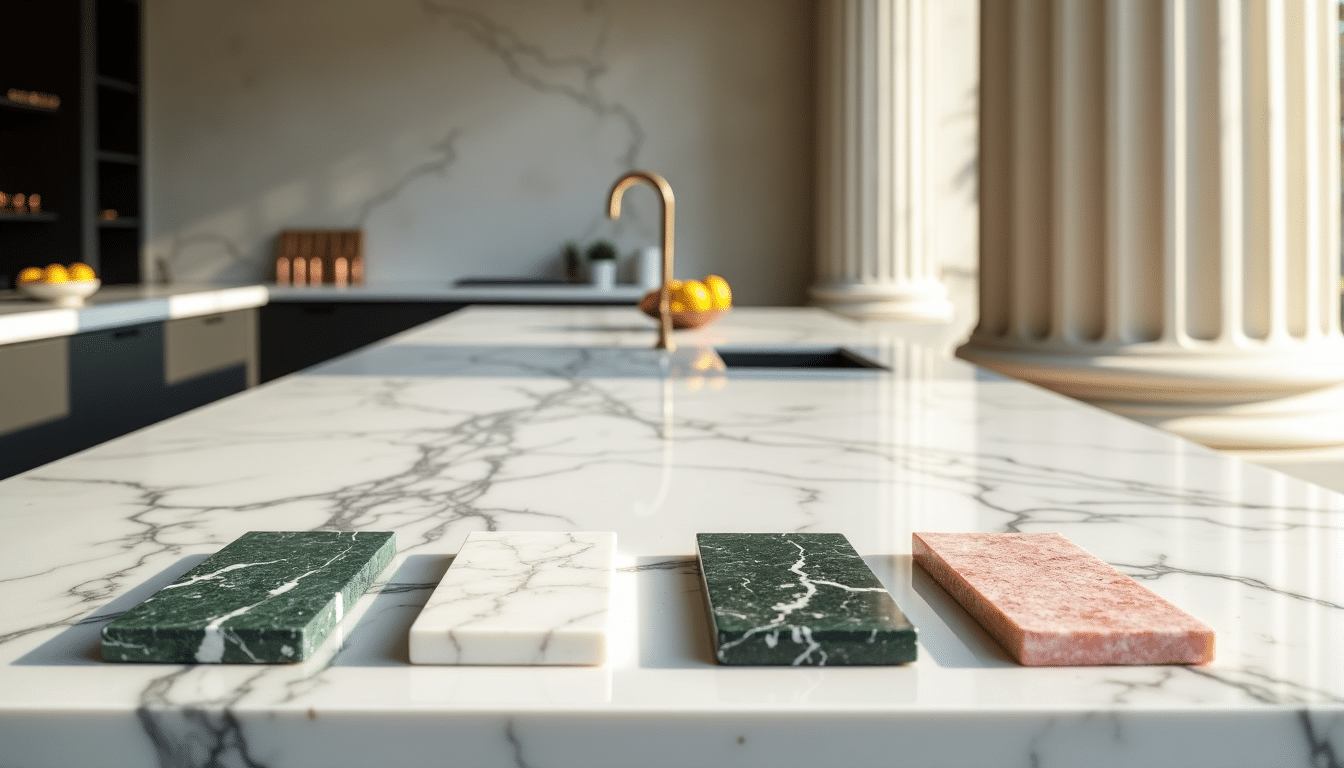
No green sold as marble is a marble: they are serpentinites and ophicalcites, for which one university publication lists more than sixty trade names. The mixing water of an adhesive mortar reacts with the serpentine minerals, the slab curves, debonds and cannot be relaid. They are laid with a two-component epoxy adhesive complying with ANSI A118.3.
Calacatta: a breccia, not a designation
Calacatta is distinguished from Bianco Carrara by the structure of the rock, not by taste: it is a breccia, whose muscovite-chlorite matrix gives the bold, gold to ochre veining. Nine basins in the Frigido valley yield only seven geological varieties for more than fifty local names. Details in Calacatta or Carrara.
Beige and grey: ask for the petrographic name
The Apuan grey is called Bardiglio, alongside Cremo, Paonazzo and Arabescato. The beiges on the market, for their part, are documented by no source verified to date, and their name indicates neither metamorphism nor deposit. Insist on the petrographic name before ordering a made-to-measure marble floor.
What to ask a supplier for
Three documents are enough, and they all exist.
- The petrographic name under NF EN 12407. Microscopic examination tells you whether the stone is a marble, a limestone, a serpentinite or a gabbro.
- The batch declaration of performance : porosity and density under NF EN 1936, water absorption under NF EN 13755, frost resistance under NF EN 12371. Frost resistance is not a property of the variety. For Nero Marquina, one producer declares it resistant, another does not determine it.
- The NF EN 16301 staining test, resistance to accidental staining, March 2021. It has existed for five years and no data sheet consulted publishes it.
These three documents dictate care. A carbonate stone is cleaned with a neutral detergent, never with vinegar, and a water repellent slows penetration without making the surface waterproof. For accidents, see removing stains and the case of rust stain.
Frequently asked questions
What are the main types of marble?
The market classes them by colour: Carrara whites, Spanish, Italian and Belgian blacks, greens, brecciated Calacattas, greys and beiges. This grid is commercial, not geological. Among the blacks and greens, most of the stones are limestones, serpentinites or gabbros.
Is green marble a real marble?
No, in almost every case. NF EN 12670 treats serpentinite as a distinct rock, with an explicit cross-reference to the entry “green marble”. The consequence is practical: these stones are sensitive to mixing water and are laid with reactive adhesive.
How can you tell a marble slab from a marble-effect porcelain stoneware tile?
By the repetition of the pattern and by the thickness. One manufacturer states that its “Calacatta Gold” reference exists in four designs in 6 mm and two in 12 mm: the pattern comes round again after a few slabs. A natural stone never repeats, and it is not cut to 3 mm.
Is Calacatta a protected designation?
No. In 2026, no specification defines a “Calacatta Gold” or a “Calacatta Borghini”. A “Marmo di Carrara” certification mark has been in the making since the Osservatorio del Marmo agreement of 4 August 2026. It covers Carrara marble, not the sub-names.
In summary
Types of marble are read on a data sheet, not on a label. NF EN 12440 already requires a petrographic name, a colour and an origin: asking for them rules out most misunderstandings, from limestone sold as marble to porcelain stoneware named after a quarry. To check a name for your project, contact us.
See also: Green marbles: Guatemala, Alps, Maurin, verde mare