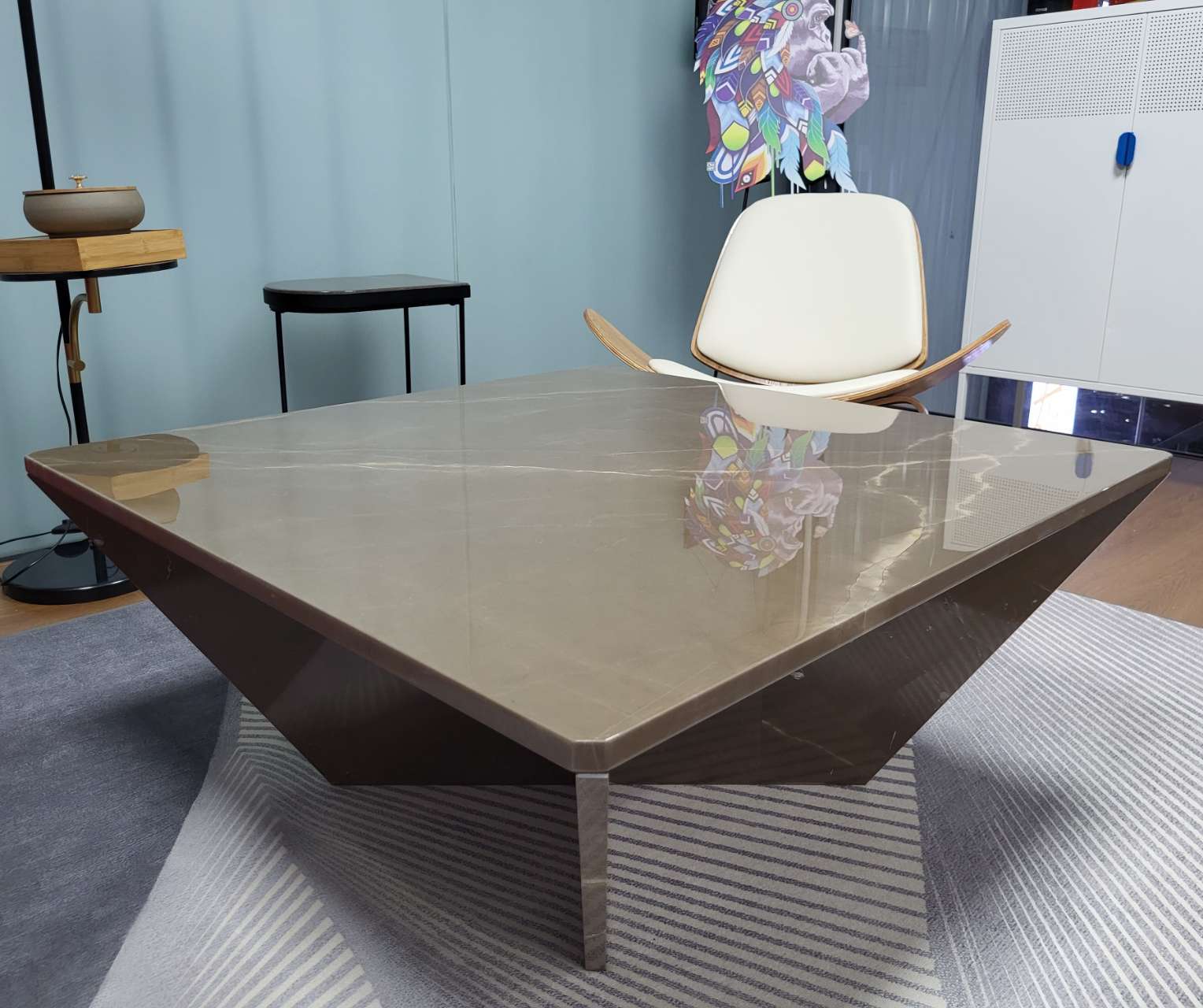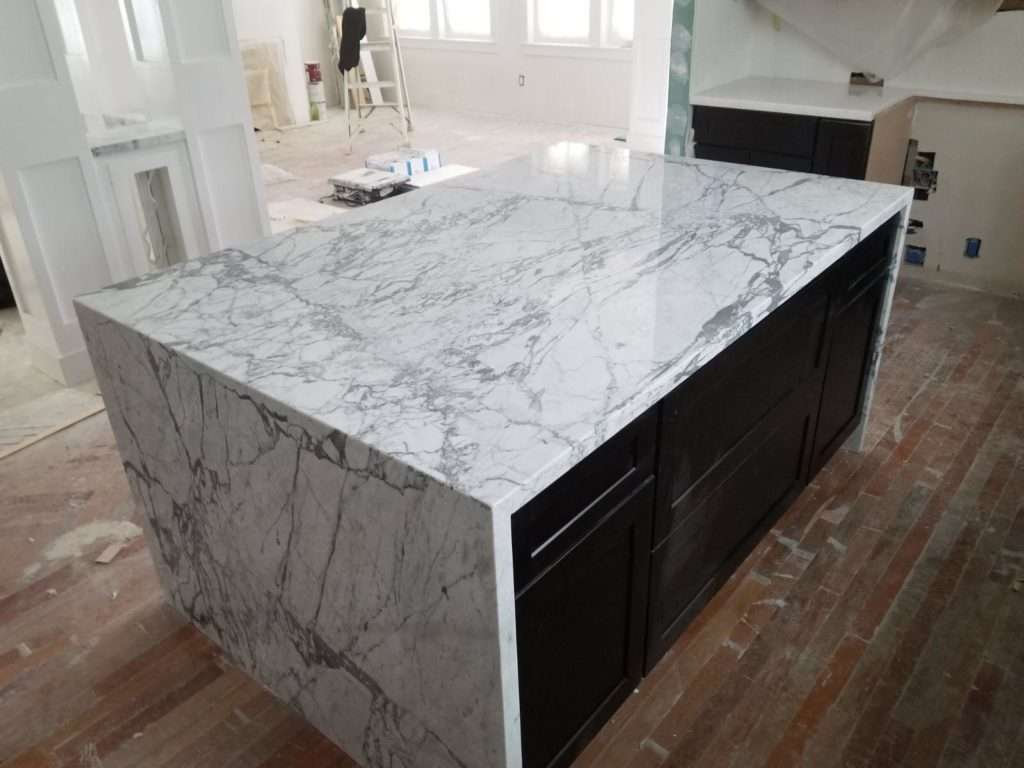


A water-repellent treatment reduces the speed at which marble absorbs liquids, and nothing more. It does not prevent acid etching: on a treated slab, a forgotten drop of lemon juice will still dull the surface. All of marble’s protection rests within that limit.
These products are sometimes called “scellants” in French, a calque of the English sealer ; the French market says hydrofuge or imperméabilisant. That leaves the real question, the one generic guides skip: should your stone be treated, and which stone is it? The open porosity of a marble ranges from under 1% to over 16% depending on the variety, on one and the same standardised test. In other words, there is no valid answer for “marble” as such.
Key points
- A water repellent slows the absorption of liquids. It does not protect calcite from an acid: dulling remains possible on a treated stone, and that is a loss of material, not a stain.
- Some water-repellent treatments are films in the sense of the ICOMOS glossary: they do not penetrate the stone, they alter its appearance and permeability, and they can lose their transparency as they age. That is where many whitish hazes come from.
- The open porosity measured under NF EN 1936 ranges from 0.2 to 1% for a Nero Marquina to 16 or 17% for a Vratza. The need for treatment is decided on the technical data sheet of the batch, not on the word “marble”.
- No re-application schedule is backed by a technical source. The check is done with a drop of water, stone by stone and exposure by exposure.
- A standardised test measures a stone’s susceptibility to staining, NF EN 16301. It is the figure to ask a supplier for, and almost nobody does.
Water-repellent, impregnating sealer: what are we talking about?
A water repellent is a product applied to a stone to reduce its ability to absorb water and aqueous liquids. An impregnating sealer is the most common trade name for the same family of products on the French market, the two terms being used interchangeably by manufacturers. Some ranges distinguish the water-repellent action, against water, from the oil-repellent action, against grease: a kitchen worktop needs both, and a single product can provide both.
The real mechanism depends on the product, and that is where caution is needed. The idea that a water-repellent “repels liquid water while letting the stone breathe” is a commonplace in the trade, but no institutional source consulted establishes it as a general property. The only reliable information is the data sheet of the chosen product, and in particular its water vapour permeability, expressed as an Sd value. A manufacturer that does not publish it gives you no way of checking that promise.
A water-repellent does not prevent acid etching
This is the central misunderstanding of the subject. A water-repellent acts on absorption: it delays the penetration of a liquid into the pore network. Acid etching is not a matter of absorption but of surface chemistry: the calcite in marble, a calcium carbonate, dissolves on contact with an acid. Vinegar is in fact the reagent geologists use to identify a limestone, as the University of Waterloo’s Earth Sciences Museum writes. No surface treatment makes calcite insensitive to this reaction.
The standardised vocabulary exists, and it is illuminating. Dulling is, in the ICOMOS-ISCS illustrated glossary of stone deterioration patterns, the increase in roughness of an originally polished surface. The glossary classes it among the features induced by loss of material, not among the chromatic alterations where stains belong. Two distinct families in the international classification: it is not a deposit to be removed, it is stone that has gone.
Le Natural Stone Institute puts it differently, and the distinction is the same: some products attack the finish without leaving a stain, others attack and stain. In practice, a water-repellent buys you time with coffee and wine, not with lemon or descaler. An acid mark, for its part, is corrected by repolishing, which restores the original finish.
Some water-repellents are films, and a film can turn white
Not all water-repellents penetrate the stone. The ICOMOS glossary says so explicitly: “paint layers, limewashes, some kinds of water-repellents or anti-graffiti coatings, and adhesives are films”. A film is defined there as a thin, homogeneous covering, often transparent, that follows the surface and adheres without penetrating. In some cases it changes the stone’s surface properties: appearance, colour, permeability.
The glossary’s next sentence explains a phenomenon that homeowners describe without naming: “a film may, as it ages, lose its transparency or detach from the substrate”. The milky haze that appears months after a treatment is therefore neither a stain, nor a salt, nor an etch: it is the product itself ageing. And it is the only one of these cases that can be removed with a suitable stripper without touching the stone.
Two questions are therefore enough before buying. Does the product penetrate the pore network or form a layer on the surface? And does it change the colour, which shows above all on dark marbles and honed finishes? Test it on an offcut of the same stone and the same finish before treating a visible surface.
Is marble porous? The answer depends on the stone
Yes, marble is porous, but the difference between varieties is such that the word “marble” tells you nothing. On the same test, the NF EN 1936, two stones sold as marbles differ by a factor of more than 15.
| Stone | Open porosity (NF EN 1936) | Water absorption (NF EN 13755) | Documents consulted |
|---|---|---|---|
| Nero Marquina | 0.2 to 1% | 0.1 to 0.18% | 4 producer data sheets |
| Vratza | 16 to 17% | 4.5 to 5% | 1 merchant data sheet, 2014 |
One point guides the whole decision. Even within a single name, the four data sheets consulted for Nero Marquina give 0.2 to 1% open porosity, a factor of 5 from one batch to another. Each value comes from a test on a given batch, not from a universal property of the stone. A garden centre will therefore sell you a product “for marble” without knowing which stone it is, which is exactly the missing information. Ask for the data sheet of the batch you are buying: it should normally be in the file for your marble worktops as well as your slabs.
There is even something better than porosity to decide the matter. The NF EN 16301 is the European test for “determination of resistance to accidental staining”. It is the measurement that directly answers the question, and none of the data sheets consulted for this article declares it. Ask for it: an answer, even a negative one, will tell you a great deal about your supplier.
How often should a water-repellent be renewed?
No technical source gives an interval, and the schedules in circulation, every 3 to 6 months, every 6 to 12 months, every 2 to 3 years, rest on no published measurement. They also vary from one page to another for the same use. The frequency depends on three things: the porosity of the batch laid, the actual exposure of the surface and the nature of the product applied. In other words, it is observed, not scheduled.
The useful check is the water-drop test, carried out on a discreet, representative area.
- Place a drop of clean water on the surface, in several places, including a heavily used one.
- Leave it in place for a few minutes. (not verified): no standardised duration was found for this check, and the values of 10 to 30 minutes in circulation are not sourced.
- Wipe, then look at the stone in raking light.
- If the drop stayed beaded on the surface and the stone has not changed colour, the treatment is still working. If a dark ring formed and then lightens as it dries, the water has penetrated: the treatment needs redoing.
This test is an observation method, not a standardised test, and it says nothing about behaviour with grease. On a worktop, the areas that give way first are the edges, around the sink and the chopping area. Check them separately from the rest.
What a water-repellent does not treat
A surface treatment acts on what enters through the surface. That excludes three common situations. First, moisture already present in the masonry, and rising damp. The trade considers that a water-repellent changes nothing here and may even make things worse by trapping water. This claim could not, however, be supported by a readable institutional source. The French reference document exists, the note by the Laboratoire de recherche des monuments historiques on the consolidation and water-repellent treatment of stone, and it has yet to be studied.
Next iron stains arising from the stone itself. When a marble contains inclusions of iron sulphides, siderite or ferromagnesian silicates, the iron is already inside: no product applied to the surface removes a pyrite inclusion. This kind of brown halo develops after laying, within 8 to 12 months according to the work of Bams and Dewaele published in Materials Characterization in 2007. At best, a water-repellent can limit the water that carries this iron to the surface; that reasoning is not a quotation, it is a deduction from the mechanism described.
The only experimental study found on this point deserves to be cited with its limitation. Rivas and co-authors treated stones with sulphide inclusions using silane-siloxanes. Their work appeared in Materiales de Construcción in 2011, a journal of the Spanish National Research Council. The products significantly increased the sulphides’ resistance to oxidation, without significant colour change. Two caveats apply. The result concerns ornamental slates, not a limestone or a marble, so it is indicative but proves nothing here. And the source speaks of increased resistance, never of eliminating the phenomenon.
Caring for a treated marble
The treatment does not change the care instructions; it exempts you from nothing. One producer data sheet is explicit on this point: use only neutral detergents, with a pH between 7 and 10, and avoid bleach, ammonia and descalers. Metal utensils should also be avoided, as calcite sits at 3 on the Mohs scale and scratches with a knife blade. The Natural Stone Institute adds scouring powders, which contain abrasives, and recommends a neutral cleaner or a mild washing-up liquid in warm water.
The habit that counts remains immediate wiping. A water-repellent gives you minutes, not immunity, and it does nothing against an acid. On the other hand, the good news is that a damaged surface is not lost: the same data sheet states that natural stone can be restored by repolishing, which brings back the original finish. The limit is the available thickness, which makes the operation tricky on a thin tile.
Frequently asked questions
Is marble porous?
Yes, but to very different degrees. Open porosity measured under NF EN 1936 ranges from 0.2 to 1% on the data sheets for a Nero Marquina, and reaches 16 to 17% on the data sheet for a Vratza. Water absorption under NF EN 13755 shows the same spread, from 0.1% to around 5%. A stone at 0.3% and a stone at 16% call for neither the same treatment nor the same use.
Does a marble table need a water-repellent treatment?
It helps against staining liquids and grease, wine, coffee and oil, which are the most frequent hazards on a table top. It will not protect against a spilt glass of vinaigrette or a wedge of lemon, which dull the surface. To protect a marble table, coasters and quick wiping matter as much as the product applied.
How do you protect marble outdoors?
A water-repellent does not replace the right question, which is frost resistance. It is declared under NF EN 12371, and producers do not agree: for the same stone, one states “resistant” while another declares a performance not determined. Before any outdoor project in a frost zone, ask for the declaration of performance for your batch. To protect outdoor marble, exposure to run-off also matters: the ICOMOS glossary describes, under the term microkarst, the progressive dissolution of limestone surfaces subjected to flowing water.
Water-repellent or impregnating sealer: do you have to choose?
The two words refer to the same family of products at French manufacturers, and the choice does not depend on the label. It depends on three points on the data sheet: does the product penetrate or form a film, does it treat grease as well as water, and what vapour permeability does it state. A product without a readable data sheet cannot be compared with another.
In summary
A water-repellent is worth applying, provided you know what to expect from it: less absorption, and so more time to wipe, and nothing more. The decision is not made on the word “marble” but on two documents, the data sheet of the stone delivered and that of the product. To look at a material, obtain the data sheet for a batch and decide on a finish for your project, contact us.