

 Your marble bathroom tiles offers undeniable elegance, but also presents specific challenges in a wet environment. This noble material is characterised by a surface that can become particularly slippery when wet. Without regular maintenance, traces of limescale, soap and even mould can gradually build up and become difficult to remove.
Large marble bathroom tiles, particularly popular for their clean lines, require special attention when it comes to the joints, which are vulnerable to constant damp. On the other hand, black marble bathroom tiles, although visually spectacular, reveal more traces of water and limescale. As for expensive marble bathroom tiles, they represent a substantial investment that deserves to be protected with appropriate care. The irregular surface of non-slip versions, while safe, also poses an additional maintenance challenge because of its roughness.
Understanding the specific features of marble bathroom tiles
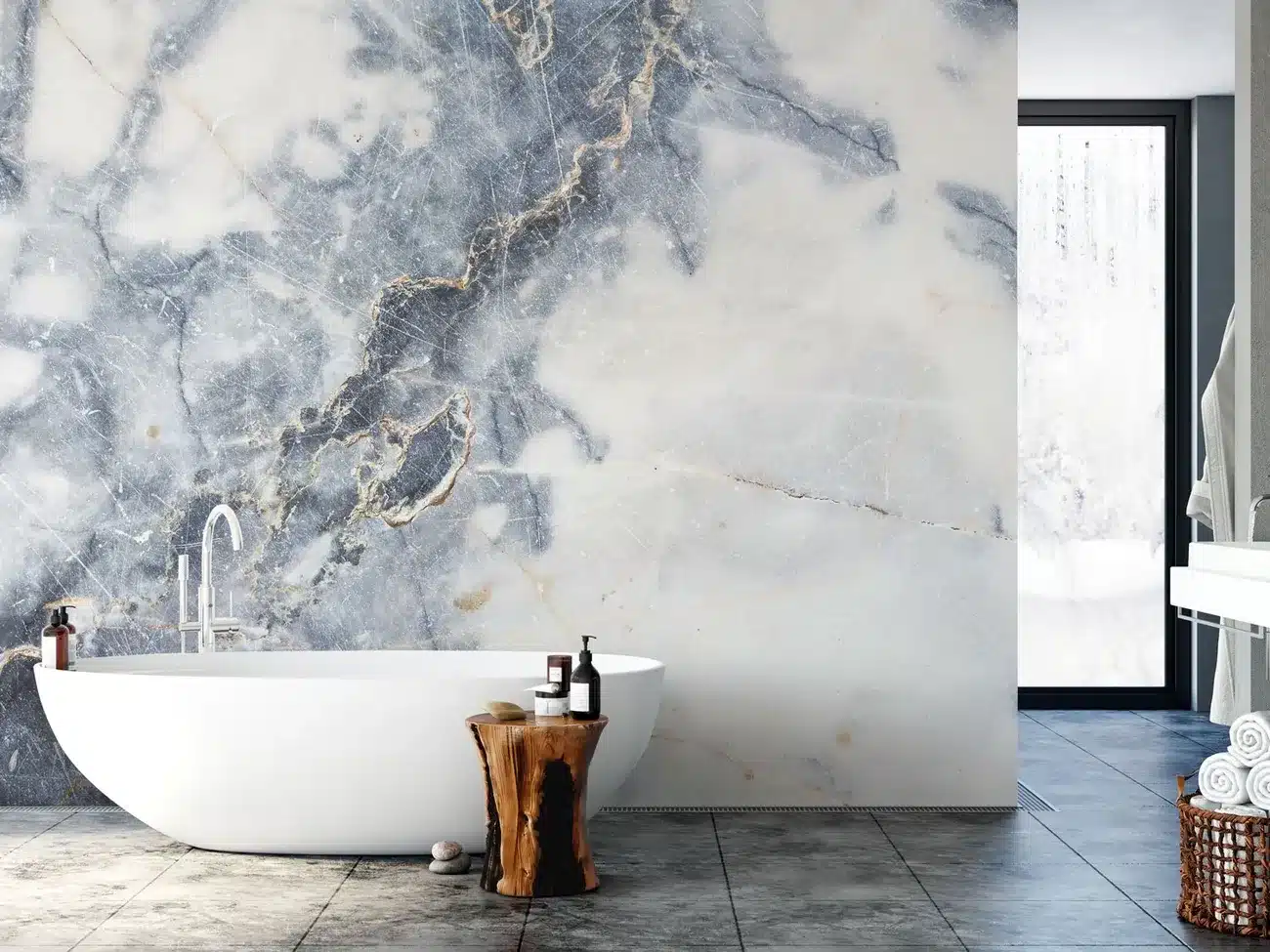
Marble tiles bring a special dimension to wet areas. This natural material, formed by the metamorphosis of limestone rocks subjected to high temperatures and pressures, has unique characteristics that deserve attention before installation.
Why marble is ideal for damp rooms
Marble is prized for its natural veining, which creates unique, inimitable patterns. Its behaviour with moisture, however, depends on the stone: Mapei classes several very popular stones, including Nero Marquina, Rosso Levanto and green marbles, as moisture-sensitive. The question should therefore be put to the supplier before choosing, not after laying.
However, certain chemical cleaning products, particularly those containing acids, can damage marble surfaces. What's more, contrary to popular belief, real marble is naturally porous and requires regular water-repellent and stain-resistant treatment to prolong its life in damp areas.
Types of marble tiles: polished, honed, textured
Marble finishes have a considerable influence on its appearance and technical properties:
Polished finish A perfectly smooth, glossy surface that reveals the depth of the colours and veining. This finish reduces the natural roughness of the stone, making it easier to maintain.
Honed finish Matt or slightly satin surface, smooth to the touch but without excessive shine. It offers a softer, more subtle appearance while retaining its natural look.
Textured finish Sandblasted finish: Includes sandblasted, flamed or brushed finishes that create an anti-slip surface. The sandblasted finish, obtained by high-pressure sandblasting, is particularly recommended for damp areas.
Risks of slipping on wet surfaces
Slipperiness is a major risk with marble tiles in bathrooms. Polished stone becomes significantly more slippery when wet, increasing the risk of falls. Standards have been established to assess this risk:
This slipperiness can be measured. Under NF EN 14231, the pendulum friction test, the Negro Marquina data sheet published by Levantina gives under 15 SRV for a wet polished finish, under 35 SRV for honed and over 45 SRV for bush-hammered. On a wet floor, the finish therefore matters more than the name of the stone.
German standards DIN 51097 and DIN 51130 They assess slip resistance using the inclined plane method.
R classifications From R9 (less adhesive) to R13 (more adhesive), tiles graded R10 are generally recommended for bathrooms.
A/B/C classifications For slip resistance in bare feet, an A classification is suitable for standard bathroom tiles, but A+B+C is required for a walk-in shower.
To reconcile aesthetics and safety, opt for matt or non-slip finishes specifically designed for wet areas, or consider an anti-slip treatment during installation.
The challenges posed by damp and joints in a marble bathroom
In the constantly damp environment of a bathroom, marble tiles have particular vulnerabilities that require special attention to preserve their beauty and functionality.
The impact of humidity on the porosity of marble
Contrary to appearances, marble has a porous structure that absorbs moisture. The difference between stones is considerable: on the same NF EN 1936 test, the data sheets consulted give 0.2% to 17% open porosity depending on the variety. Without protection, water penetrates this pore network, along with whatever it carries.
To counter this phenomenon, applying a water-repellent impregnator proves essential, particularly for black bathroom marble tiles, which show damp-related changes more clearly. This treatment is renewed when a drop of water placed on the surface no longer beads: no technical source publishes a frequency.
Frequent problems with joints: mould, cracks, etc.
Joints are often the weak link in marble bathroom tiles. Their porous nature makes them ideal breeding grounds for blackish or greenish mould, particularly in poorly ventilated areas. What's more, temperature variations between the hot water in the shower and the ambient air cause the joints to expand and eventually become brittle.
This problem is exacerbated with large marble bathroom tiles, where the fewer joints are subject to greater mechanical stress. The use of epoxy joints rather than cementitious joints offers superior resistance, albeit at a higher price for marble bathroom tiles.
How damp affects the durability of tiles
Prolonged exposure to humidity can trigger a number of phenomena that affect marble:
- A dull film caused by limescale and soap deposits
- Efflorescence, that is, salts drawn up from the stone’s pore network and crystallised on the surface (ICOMOS-ISCS glossary)
- On moisture-sensitive stones, warping of the slab, which comes away from its bed (Mapei)
This damage worsens if its cause, moisture, is not dealt with. Dulling can be removed by repolishing; a warped slab, on the other hand, is generally lost.
Recommended methods and products for maintaining marble tiles
Regular maintenance of marble bathroom tiles requires specific methods to preserve their beauty without damaging them.
Natural products compatible with marble
Since marble is sensitive to acids, clean with a neutral detergent, with a pH of 7 to 10: stone soap or mild washing-up liquid in lukewarm water, as the Natural Stone Institute recommends. Avoid bicarbonate of soda and clay stone, which scratch a stone rated 3 on the Mohs scale, as well as vinegar, lemon and any acidic cleaner.
Cleaning techniques without damaging the surface
For daily care, use a slightly damp microfibre cloth. For a deeper clean, apply your solution without rubbing hard, then rinse with clean water and dry with a soft cloth to avoid marks. On black marble, an area that has gone matt is not dirt: it is dulling, which can be removed by repolishing.
Using a steam cleaner: precautions to take
Although practical, steam cleaners should be used sparingly. Set it to minimum pressure and maintain a safe distance. Never use it on large untreated or weak bathroom marble tiles.
Ideal cleaning frequency to prevent clogging
Daily wiping of water splashes, light weekly cleaning and monthly in-depth maintenance are the ideal rhythm. This regularity avoids the need for intensive treatments, which would have a long-term impact on the expensive marble bathroom tiles.
Choosing the right marble tiles to limit the risks
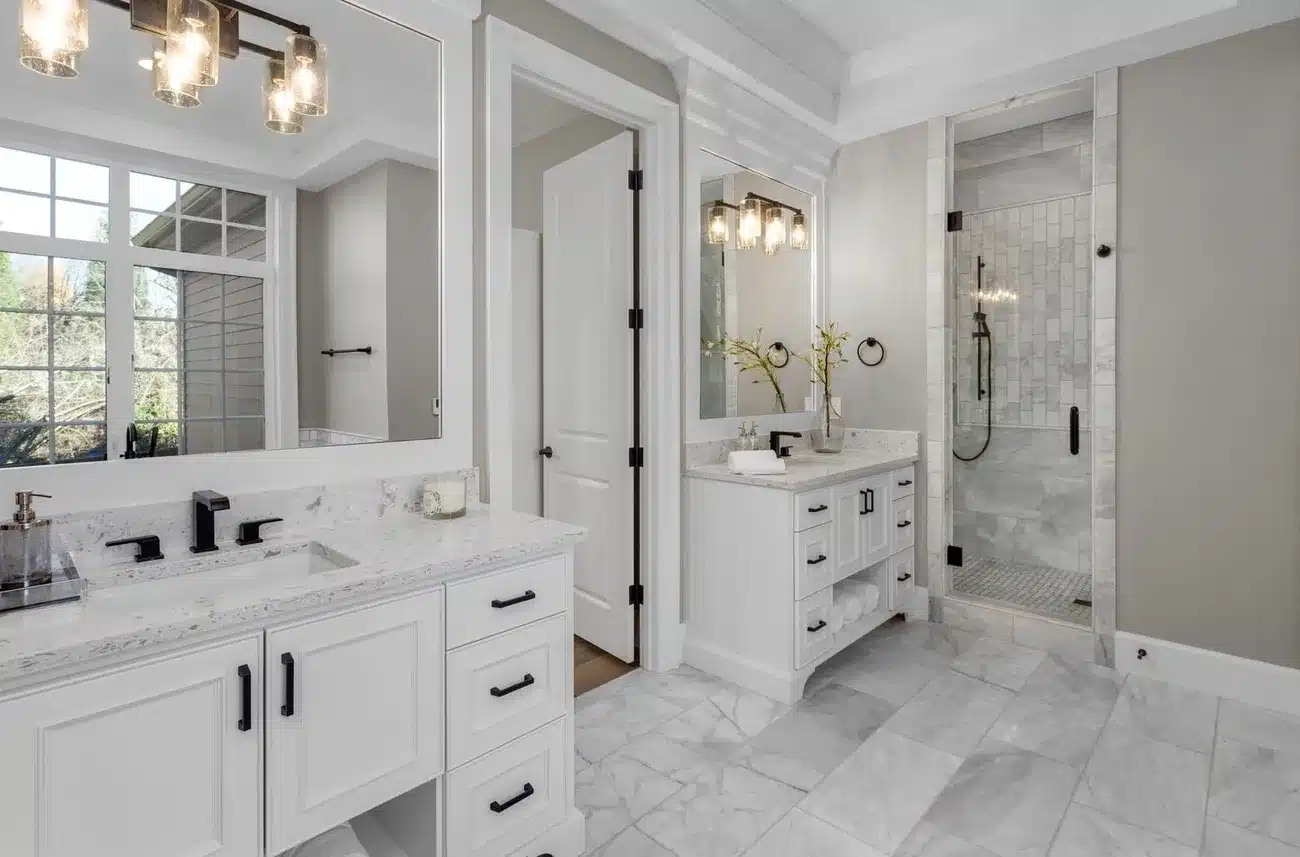
To limit the problems associated with marble tiling in your bathroom, it's essential to make the right choice from the outset, in terms of both aesthetics and practicality.
Advantages of black marble bathroom tiles
Black marble turns a bathroom into a striking space, especially alongside light-coloured elements. It does, however, show limescale marks more readily and dulling: the ICOMOS glossary notes that dark marbles often show visible discolouration through loss of polish. Its grip depends on the finish, not the colour: under NF EN 14231, a wet polished Nero Marquina falls below 15 SRV.
Why opt for large marble bathroom tiles?
Large-format slabs reduce the number of joints, which are often a weak point in wet areas. They are also heavier and more exposed to warping with water-sensitive stones, so they should be discussed with the installer before ordering.
What you need to know about marble bathroom tiles - prices
No prices are published here: the price depends on the stone, thickness, finish and format, and is set by quote. Marble-effect porcelain stoneware tiles generally cost less than natural stone, without its reparability.
Anti-slip and water-repellent treatments on installation
Slip-resistant treatments exist for mineral surfaces; some create micro-roughness that improves grip. Their effect and compatibility with a limestone can be checked on the product data sheet, and a test on an offcut of the same stone is essential before treating a floor.
Constant moisture also comes into play at the laying stage. Some stones change shape on contact with the mixing water of a cement-based adhesive, and Mapei’s technical bulletin on moisture-sensitive stones recommends a water-free laying product for these, such as a reactive resin. So ask the supplier whether the stone delivered is among the water-sensitive stones before bonding it.
Key points for safe, durable marble tiles
To make your marble bathroom tiles last, a few basic principles must be followed. A water-repellent treatment is useful, because marble is porous, particularly in wet areas.
Avoid “shine” products that leave a film on the surface: the ICOMOS glossary notes that a film can lose its transparency as it ages. A dulled marble is restored by repolishing, not by adding a layer.
When it comes to safety, choose the level of slip resistance wisely. For a standard bathroom, tiles rated R10 in accordance with DIN 51130 offer adequate grip, while a walk-in shower will require an A+B+C coating in accordance with DIN 51097.
Strictly avoid acidic cleaners and bleach, which attack the surface. Use a detergent with pH 7 to 10, and avoid bicarbonate and clay stone, which are abrasive on marble.
When faced with daily splashes of water, wipe them up immediately to prevent stains from forming. For large marble bathroom tiles, regularly check the condition of the joints, which are weak points in the face of persistent damp.
An impregnating sealer is renewed when a drop of water placed on the surface no longer beads: no technical source publishes a frequency.
Frequently asked questions
Are marble tiles suitable for bathrooms?
Yes, provided you choose a non-polished finish for the floor and a stone that is not water-sensitive. Marble is porous: a water-repellent treatment and regular wiping preserve its appearance in this wet environment.
How can marble bathroom tiles be made less slippery?
To reduce the risk of slipping, opt for matt or textured finishes rather than polished ones. You can also apply an anti-slip treatment when you lay the tiles, or choose tiles with an R10 slip rating for a grip suitable for bathrooms.
What are the best products for cleaning marble tiles?
A neutral detergent with a pH between 7 and 10: stone soap or a mild washing-up liquid in warm water. Avoid vinegar, lemon and acidic cleaners, as well as bicarbonate and powders, which scratch the stone.
How often should marble bathroom tiles be maintained?
Optimum maintenance includes daily wiping of water splashes, weekly light cleaning and monthly in-depth maintenance. This routine helps to preserve the beauty of the marble and prevent clogging.
Are marble-effect tiles a good alternative to real marble?
Imitation marble tiles offer an economical alternative while retaining the luxurious look of natural marble. It is generally less expensive, easier to maintain and can offer better resistance to moisture, making it an attractive option for bathrooms.