

Marble care is not a matter of a single product but of the surface. A floor, a table, a kitchen worktop and an outdoor slab do not face the same stresses: foot traffic and slipperiness, contact with food, kitchen acids, frost and run-off. The routine and the finish are therefore chosen use by use.
This page deals with one subject only: the routine, surface by surface. Three neighbouring questions are dealt with elsewhere, and the links below mark the boundary. For the cleaning method, product by product, for remedial treatment, stain by stain, and for protection with a water-repellent, see the three dedicated pages.
Key points
- On a wet floor, the finish matters more than the product. Measured to NF EN 14231, a polished Nero Marquina drops to 10 to 15 SRV in wet conditions, against under 35 honed and over 45 bush-hammered.
- On a table and a worktop, the risk is not dirt but food acid. Producers’ data sheets allow only detergents with pH 7 to 10 and rule out bleach, ammonia and descalers.
- Some stones react chemically with water. Mapei lists Nero Marquina, green marbles, Portoro and Rosso Levanto by name, and states that a deformed slab cannot be relaid.
- Outdoors, the surface dissolution of a limestone subjected to run-off has a name in the ICOMOS-ISCS glossary: microkarst. No routine stops it; only draining the water slows it down.
- There is no universal routine: from one stone to another, open porosity measured to NF EN 1936 ranges from about 0.2% to 17% across the data sheets consulted.
The routine, surface by surface, in one table
Four surfaces, four routines. The table below sums up the trade-offs detailed in the following sections. It contains no durations or schedules: these values depend on the batch of stone and its actual exposure, and no technical source consulted publishes them.
| Surface | Wiping | Product | Recommended finish | Pitfalls |
|---|---|---|---|---|
| Floor | Regular dry dusting; spills wiped up at once | Warm water, detergent with pH 7 to 10, microfibre cloth or well-wrung mop | Honed or bush-hammered in wet areas, polished in dry rooms only | Standing water, descaling products, de-icing salt brought in on shoes |
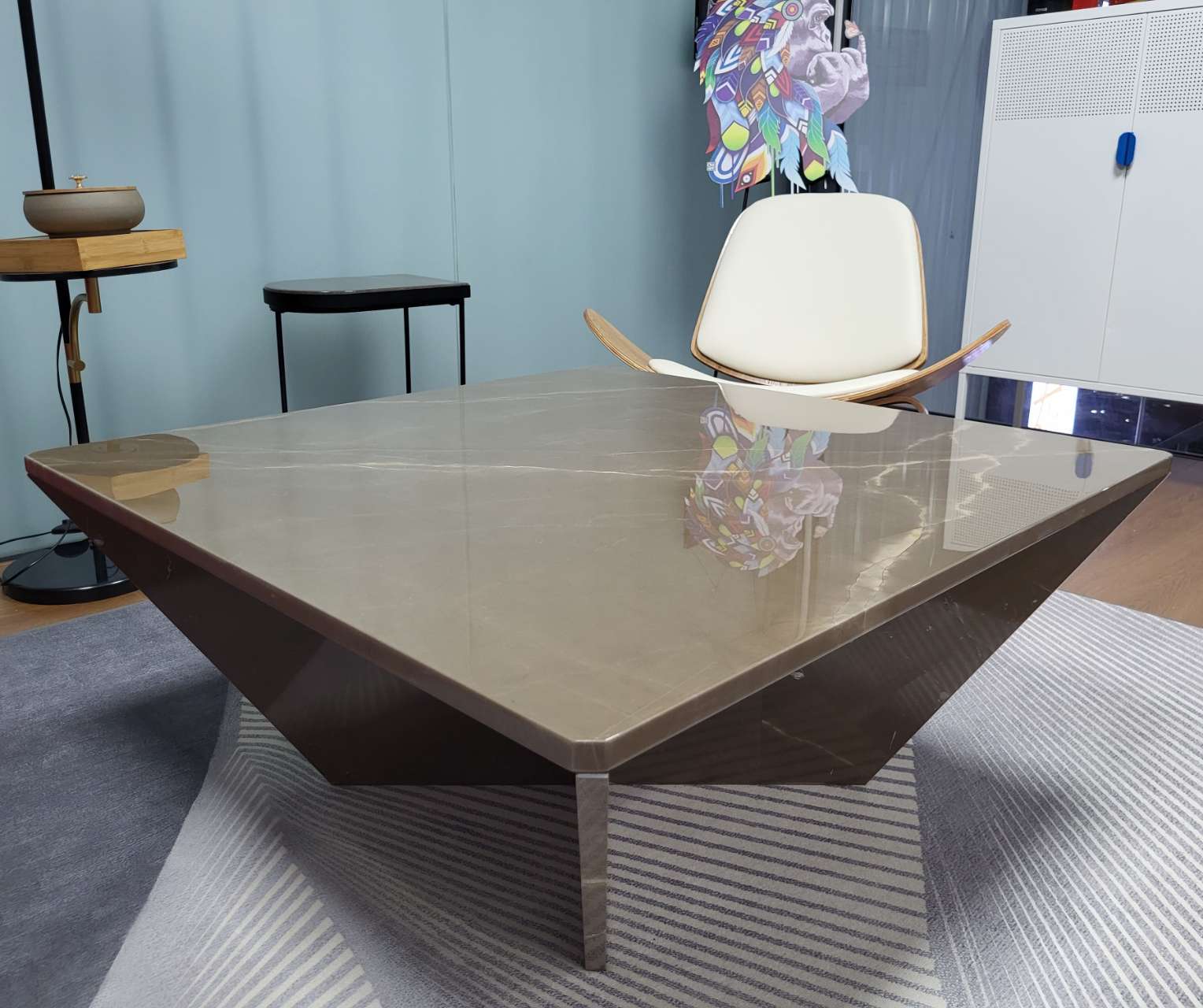
| Table | Immediately, as soon as the meal is over | Warm water and detergent with pH 7 to 10 | Honed, which makes acid etching less visible than on a polished finish | Lemon, vinegar, wine, no coasters or trivets |
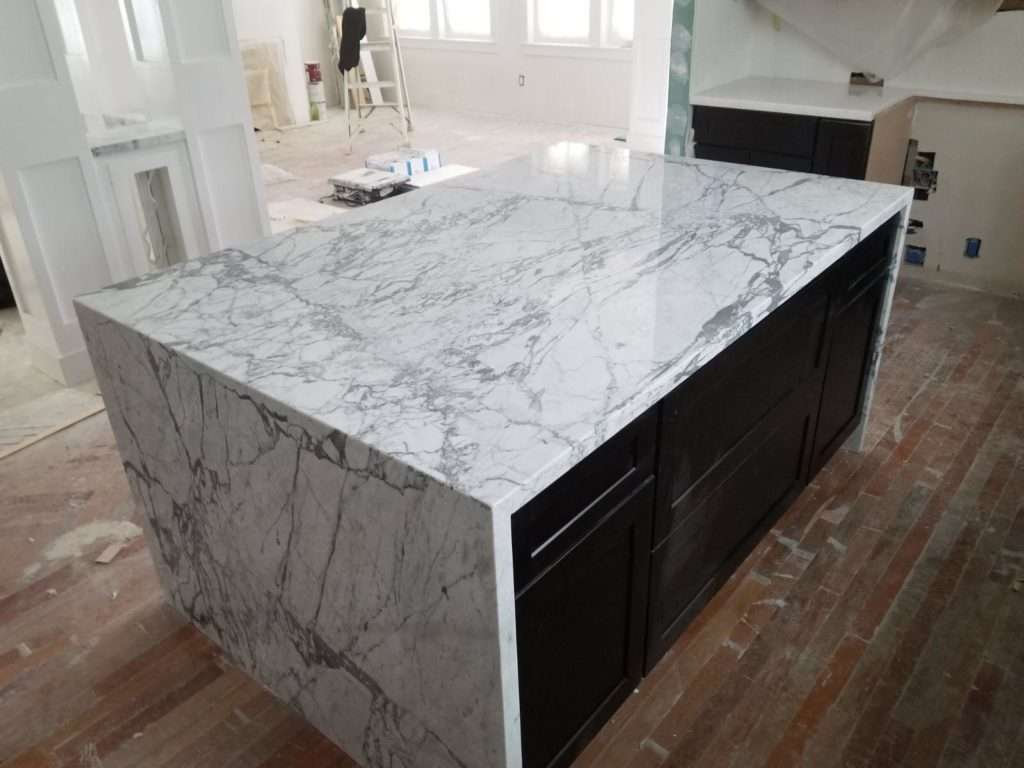
| Worktop | Immediately, at every splash | Warm water and detergent with pH 7 to 10; rinse, then dry | Honed, 20 to 30 mm thick | Cutting directly on the stone, metal utensils, descaler on the splashback |
| Exterior | No wiping: clear away water and leaves | Gentle brushing with clean water | Bush-hammered or sandblasted for slip resistance | Frost resistance not declared by the supplier, concentrated run-off, damp wall base |
This table is a framework, not a batch-specific prescription. Open porosity, which governs the absorption of liquids, varies widely from one marble to another on an identical test. There is also a standardised staining test, NF EN 16301, whose result should be requested from the supplier for the stone actually delivered.
Caring for marble floors: the finish determines safety
On a floor, the first care issue is not cleanliness but grip, and it is settled when ordering, not with the broom. The SRV is the slip resistance value measured with the pendulum friction tester under NF EN 14231: the higher the value, the less slippery the surface.
Nero Marquina data sheets show considerable differences from one finish to another. Levantina declares under 15 SRV polished and wet, under 35 honed and over 45 bush-hammered; TINO publishes 10 SRV polished and wet, and Canteras Olaspe 70 SRV dry. The same stone therefore goes from very slippery to clearly grippy depending on the finish alone.
A second point governs floor care, and it is decided at the laying stage. A moisture-sensitive stone is a stone whose minerals react chemically with water, which deforms the slab: it cups, comes away from its bed and loses its bond. The Mapei technical bulletin 010403-TB, edition of 22 June 2015, lists Nero Marquina, green marbles, Portoro and Rosso Levanto by name, and states that a deformed slab generally can be neither repaired nor relaid. The risk increases with the thinness of the slab and with large formats.
Two points of honesty are needed here. No French standard, neither NF DTU 52.2 nor NF B10-601, names these stones: the rule comes from the Natural Stone Institute’s reference manual and from adhesive manufacturers. And the mechanism described concerns the mixing water of the mortar, so the laying stage. Its consequence for care is simple: on these stones, a well-wrung mop is better than washing with lots of water, and any leak should be dealt with at once. To decide on a finish before ordering, see our made-to-measure marble floors.
Caring for a marble table: contact with food comes first
On a table, the dominant risk is food acid, not wear. Marble and ornamental limestones are overwhelmingly composed of calcite, a carbonate that acids dissolve. The Natural Stone Institute writes that products containing lemon, vinegar or other acids may dull or etch calcareous stones.
The practical consequence comes down to three habits. A coaster and a trivet under every container, wiping as soon as the meal is over, and a single type of product. That product is warm water with a detergent of pH between 7 and 10, as the producers’ data sheets instruct. Bleach, ammonia, descalers and metal utensils are explicitly ruled out.
A point of vocabulary then avoids a costly mistake. An area that has gone matt after a glass of white wine is not a stain: the ICOMOS-ISCS glossary of stone deterioration patterns classes it among losses of material, under the term dulling, not among chromatic alterations. It will not come off with cleaning, whatever the product. It is repolished, and producers’ data sheets point out that natural stone can be restored by repolishing its surface.
Marble worktops: the most exposed surface
A worktop combines all the stresses of the other surfaces, on a horizontal surface used several times a day. It receives kitchen acids, grease, knocks from utensils and water, often in the same places: the chopping area, around the sink and the upstand.
Three habits deliver most of the benefit. Work on a board and never directly on the stone, since calcite is at grade 3 on the Mohs scale and scratches with a knife blade. Wipe each splash as you go while preparing food, without waiting until the end. Rinse and dry after washing, so that detergent residue does not leave a film.
The upstand deserves a separate instruction. It is where water dries on its own and deposits carbonates, which the ICOMOS-ISCS glossary calls encrustation: a compact, hard and strongly adherent layer. The glossary warns that removing it may be accompanied by detachment of stone, which rules out both scraping and descaler. For the thicknesses and finishes available, see our marble worktops.
Marble outdoors: frost, run-off and microkarst
Outdoors, care is no longer about cleaning but about managing water. microkarst is, according to the ICOMOS-ISCS glossary, a network of small interconnected depressions at millimetre to centimetre scale, caused by partial or selective dissolution of the surface of calcareous stones exposed to run-off. The stone shows no trace of granular disintegration.
This phenomenon cannot be cleaned: it is slowed down by eliminating concentrated run-off. A downpipe discharging at the same point, a slope that holds a puddle or a heap of wet leaves create exactly the condition the glossary describes. Useful care therefore consists of clearing, letting water run off widely and never letting it stand.
Frost resistance, for its part, is checked before purchase, not after. The data sheets for the same stone may disagree on the NF EN 12371 test: for Nero Marquina, Levantina declares a performance not determined, the NPD entry, while Canteras Olaspe declares the stone resistant. Frost resistance is therefore not a property of the variety but a batch figure. Ask for the declaration of performance for your batch before any outdoor use in a frost zone, and consult our marble tiles to frame the choice.
Three technical cases dealt with separately
Some surfaces raise a question that goes beyond routine care. The bathroom combines constant moisture, joints and the slipperiness of a wet floor. Underfloor heating means checking the compatibility of marble with underfloor heating before laying, not after. And a shower tiled in small formats calls for the precautions specific to mosaic, where the density of joints changes everything.
Frequently asked questions
Is polished marble suitable for a bathroom floor?
The standardised values suggest ruling it out. For Nero Marquina, the NF EN 14231 test gives 10 to 15 SRV polished and wet, against over 45 bush-hammered. A shower or bathroom floor calls for a slip-resistant finish, and the question is settled when ordering rather than with a cleaning product.
Is caring for black marble any different?
The product stays the same; the vigilance changes. The ICOMOS-ISCS glossary notes that dark marbles often show visible discolouration through very superficial loss of polish. Dulling goes unnoticed on a light stone and stands out on a polished black background. Several black marbles also appear among the moisture-sensitive stones listed by Mapei.
Do different surfaces need different products?
No. The product is the same everywhere, a detergent with pH 7 to 10 in warm water. What changes from one surface to another is how often you wipe, how much water is acceptable and the finish suited to the use.
In summary
Remember the order of decisions: the finish first, then the use, the product last. A floor is chosen for its slip resistance, a table and a worktop are protected from acids and wiped at once, an outdoor slab is judged on its declared frost resistance and on how water drains away. To check the finish and declaration of performance suited to your project, contact us.
See also: Renovating marble: sanding, polishing and knowing when to stop