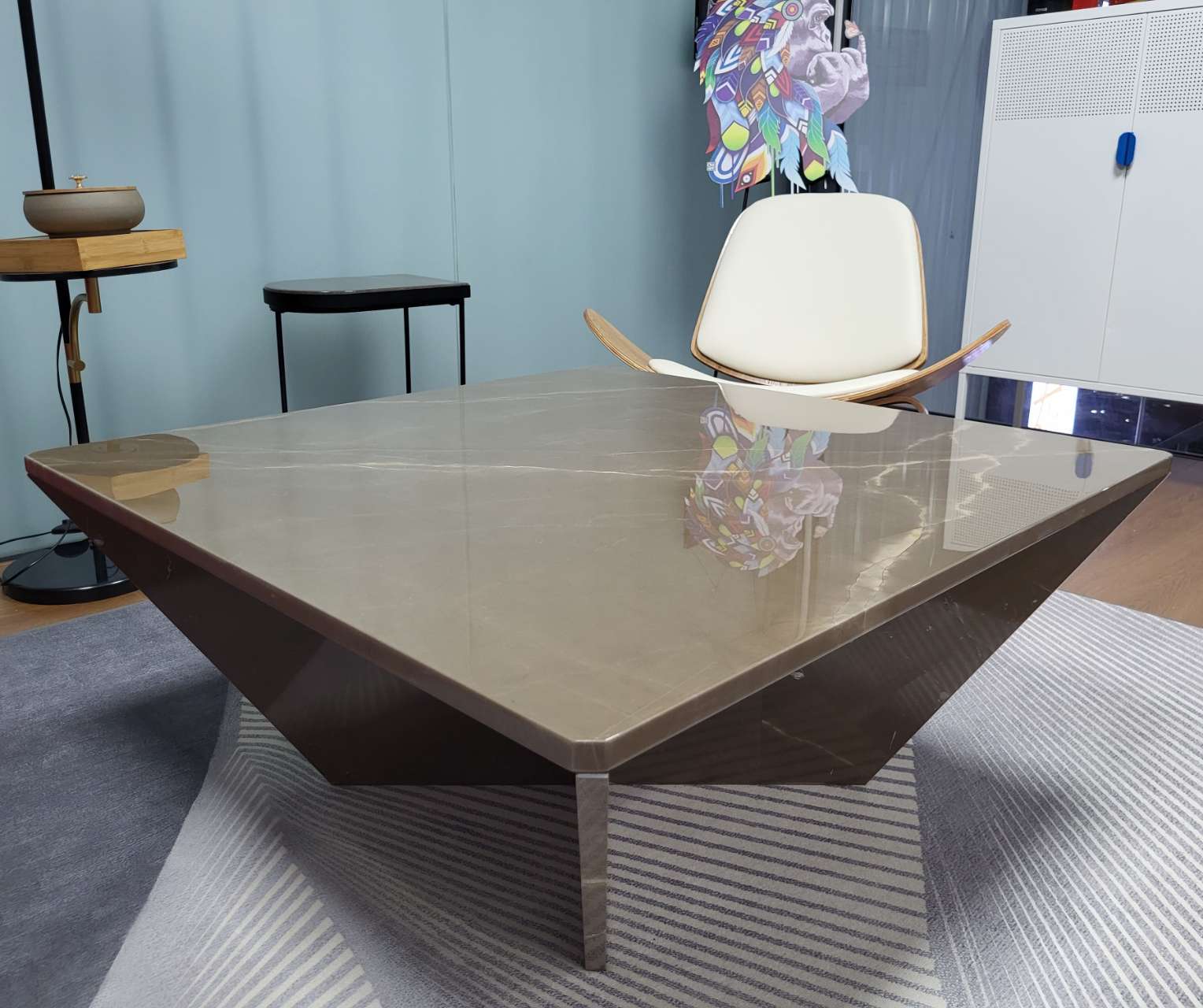

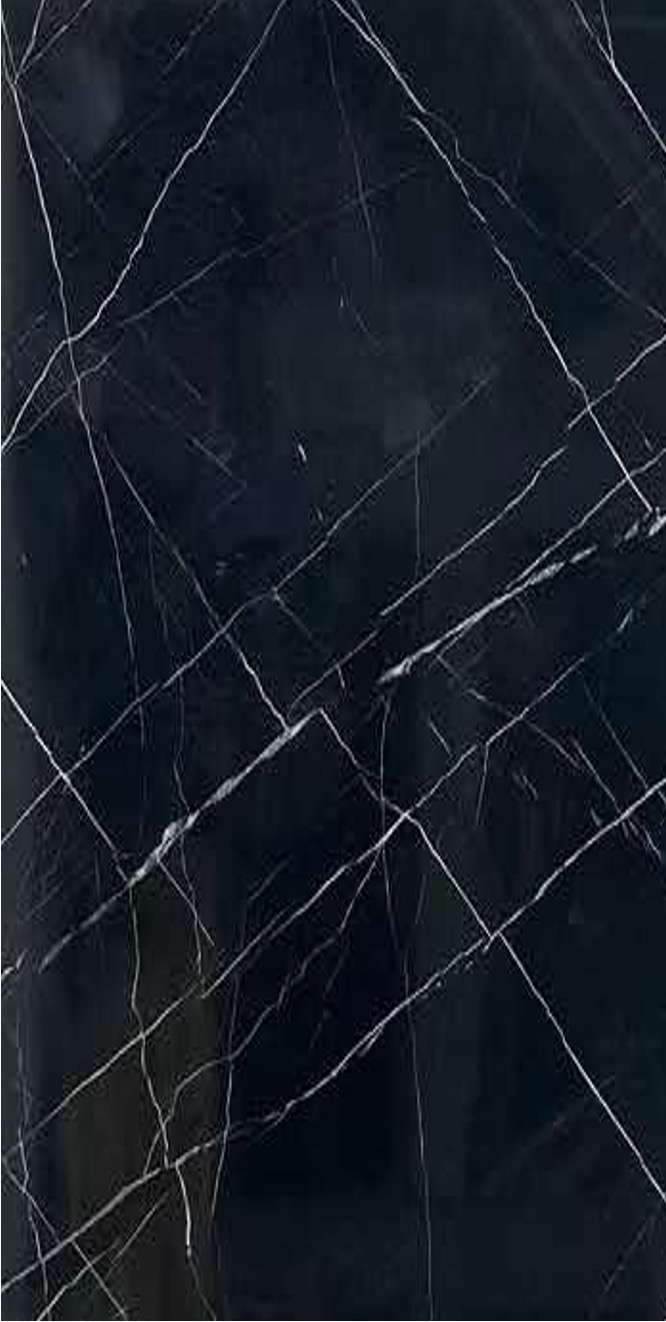
Nero Marquina is a black fossil-bearing limestone quarried at Markina-Xemein, in Biscay, in the Spanish Basque Country, and sold as marble. Its black background carries fine white calcite veins and fossils visible to the naked eye. Its petrographic name, established by examination under NF EN 12407, is “limestone”.
Key points
– Geologically, it is not a marble but a limestone : named “caliza” under NF EN 12407, as written by the producer Levantina itself.
– A single origin: the limestone band between Markina-Xemein and Aulesti, in Biscay.
– The fossils are the mark of authenticity: rudists and Chondrodonta, named by the University of the Basque Country.
– Values vary from one batch to another: compression from 96 to 145 MPa across the four quarry data sheets consulted.
– Two risks to manage before laying: slip resistance of 10 to 15 SRV when polished and wet, and stone classed as moisture-sensitive by Mapei, a warped slab being lost.
A single origin, in Biscay
The deposit is confined to the slopes separating Markina-Xemein from Aulesti, in an area worked without interruption for more than a century (University of the Basque Country, Tierra y Tecnología, 2013). Canteras Olaspe has worked two open-pit faces there since 1964. Marnemar works three and states that its two main ones, Lekoitz and Jaime, account for more than half of total production.
The point deserves to be made firmly: the first search result for this query presents the stone as “famous in China”. That is wrong. The deposit is Basque, and it is unique.
Trade names, meanwhile, multiply: Negro Marquina, Negro Markina in Basque spelling, Marquina Black, Black Marquina, and Negro Markina Florido for batches with pronounced white veining. A European standard does, however, govern them: NF EN 12440.
On the origin of the black colour, a reservation. Google’s knowledge panel, sourced from English Wikipedia for lack of a French page, describes a “bituminous limestone” whose colour is said to come from natural bitumen. None of the four quarry data sheets consulted documents this mechanism.
A limestone, not a marble, and what that changes
The argument comes from the producer, which makes it hard to dispute. On its Negro Marquina data sheet (March 2025), Levantina enters as the petrographic name, under the NF EN 12407 test, “caliza”, that is limestone. The declared lithology is a biomicrite; at TINO, calcite makes up 98% of the rock.
Now a marble is, in the geological sense, a metamorphosedlimestone, in which the original fossils and bedding have disappeared in favour of interlocking calcite grains (University of Waterloo, Earth Sciences Museum). Nero Marquina has kept its fossils: it has not been metamorphosed.
Calcite is the reference for grade 3 on the Mohs scale and scratches with a knife blade (Waterloo). This figure comes from the mineralogy of the mineral, not from a standardised test on the stone: NF EN 14205, Knoop hardness, was withdrawn in 2013.
Calcite also dissolves on contact with an acid, releasing carbon dioxide. Pouring vinegar is the test by which geologists identify a limestone: it is not a cleaner for this stone, it is its reagent. Acid etching therefore cannot be cleaned off, only repolished.
Named fossils, the mark of authenticity
No French page names the species, yet a university source gives them. The team of Damas Mollá, Aranburu, García Garmilla and Fano (University of the Basque Country, 2013) identifies in the stone:
- of the polyconitid rudists, valves of the order of 150 × 50 mm;
- of the monopleurid rudists, in clusters, up to 15 mm in diameter;
- of the requieniid rudists, with a characteristic black shell;
- Chondrodonta sp., bivalves with paddle-shaped shells;
- of the corals, massive and branching.
The rock belongs to the “Urgonian Complex”, Lower Aptian to Upper Albian, about 115 million years ago. One detail separates it from another black stone: no stem sections here. Crinoid ossicles are the signature of Belgian petit granit, not of Marquina.
Natural stone or porcelain stoneware sold under the name “Nero Marquina”?
Three of the first eight results for this query are porcelain stoneware bearing this decor name. Two tests settle it in front of a slab. The pattern: a printed decor repeats from one tile to the next, calcite veining never does. The edge: on stone, the veining runs through the thickness; on porcelain stoneware the decor stops at the surface, unless it is through-body. A quotation that simply says “Nero Marquina” does not say what material it is.
Technical values: four data sheets, ranges
These values come from four independent data sheets, four laboratories and four batches: Levantina, Canteras Olaspe, TINO Stone & Surfaces and Natural Stone Spain. They differ, sometimes considerably.
| Features | Test standard | Range recorded |
|---|---|---|
| Petrographic name | NF EN 12407 | Limestone |
| Bulk density | NF EN 1936 | 2,660 to 2,720 kg/m³ |
| Open porosity | NF EN 1936 | 0.2 to 1% |
| Water absorption | NF EN 13755 | 0.1 to 0.18% |
| Flexural strength under centre-point load | NF EN 12372 | 13.7 to 15.2 MPa |
| Compressive strength | NF EN 1926 | 96 to 145 MPa |
| Abrasion resistance | NF EN 14157 | about 21.5 to 22 mm |
| Breaking load at dowel hole | NF EN 13364 | 1,750 to 2,200 N |
| Reaction to fire | EN 13501 | Class A1 |
| Hardness | no EN standard in force | Mohs 3, mineralogy of calcite |
Two differences matter: compression varies from 96 to 145 MPa, open porosity by a factor of 5. That is not a weakness; it is the reality of a sedimentary rock. The conclusion is simple: the data sheet for the batch delivered is worth more than the generic data sheet for the variety.
The catalogue thicknesses found at producers are 10 mm for tiles, 20 and 30 mm for slabs, with a maximum stated format of 2,400 × 1,400 mm. These are producers’ dimensions; those of the stock available should be requested.
Frost resistance: a figure to demand batch by batch
The sources contradict each other, and that is the useful information. Olaspe declares the stone “resistant” under UNE-EN 12371. Levantina declares NPD, performance not determined, under the same standard. Natural Stone Spain, citing no standard, considers it poorly suited to freeze–thaw.
Frost resistance is therefore not a property of the variety, but a performance to be declared batch by batch under NF EN 12371, « Détermination de la résistance au gel ». The technological test typically covers 48 cycles, with mechanical strength loss limited to 20% in class F1 (Buildwise, NIT 228). Before any exterior use in a frost zone, require the declaration of performance for the batch.
Slip resistance: 10 to 15 SRV when polished and wet
Nobody publishes this figure, and it is standardised. The SRV value is the measure of slip resistance obtained with the pendulum friction tester under NF EN 14231. On a wet surface, it comes out below 15 for polished at Levantina, at 10 at TINO. Honed stays under 35, bush-hammered exceeds 45.
A polished finish should therefore be ruled out for shower floors, bathroom floors and any regularly wet surface. Prefer honed or bush-hammered, including on a made-to-measure marble floor. Polished remains worthwhile for walls, splashbacks, table tops and mosaic.
Laying: a stone named as moisture-sensitive
This is the information with the heaviest consequences in this guide. Mapei explicitly classes Nero Marquina among moisture-sensitive stones, in its technical bulletin 010403-TB “Installing moisture-sensitive stone” (22 June 2015). The same list includes Portoro, Rosso Levanto, Grigio Carnico, Pietra Serena, Ardesia Liguria and green marbles.
The mechanism described: water reacts chemically with the minerals in the stone, the slab changes shape (cupping, curling, doming, warping), comes away from its bed, until the bond fails. The crux fits in one sentence of the bulletin: a slab that has changed shape generally can be neither repaired nor relaid. It is lost. Explicit aggravating factor: the thinner and larger the slab, the greater the risk.
Hence the recommendation of a water-free laying bed, reactive resin or epoxy, rather than a cement-based adhesive whose mixing water triggers the reaction. The Natural Stone Institute prescribes it in its Dimension Stone Design Manual version VIII, § 3.1.4.1; Laticrete offers an epoxy complying with ANSI A118.3.
One reservation, which strengthens the advice rather than weakening it: no French standard says this. Neither NF DTU 52.2, nor NF B10-601, nor the CTMNC documents name these stones as water-sensitive. The rule comes from the American reference manual and from adhesive manufacturers. The practical conclusion is the same as for frost: ask the supplier whether the batch is water-sensitive before laying, and pass the answer on to the installer. Not to be confused with bowing of white marble cladding panels on façades, which stems from the anisotropic thermal expansion of calcite: a different stone, a different mechanism.
Maintenance
Levantina specifies neutral detergents of pH 7 to 10, prohibits bleach, ammonia and descalers, and advises against metal utensils. The Natural Stone Institute adds that products containing lemon, vinegar or other acids can dull or attack limestone-based stones, and that scouring powders often contain abrasives likely to scratch some stones. A water repellent or impregnator reduces absorption without making the stone impermeable. For thicknesses and edge finishes, see the marble tiles and the marble worktops.
Frequently asked questions
What is the origin of black marble?
There is no single black marble, but several black stones of different origins. Nero Marquina comes from Biscay, Nero Portoro from Liguria, petit granit or blue stone from the Soignies area in Belgium, and Nero Assoluto from Zimbabwe and India.
What is black marble called?
It depends on the stone. The four common names are Nero Marquina (a Spanish limestone), Nero Portoro (an Italian limestone), petit granit (a limestone, despite its name) and Nero Assoluto (a gabbro, despite its name of “absolute black granite”). Three of these four names contradict the real nature of the rock.
What is the black and gold marble called?
Nero Portoro, quarried in Liguria, is the best-known black stone with yellow to golden veining. It is also a limestone, and therefore sensitive to acids. Note: the geological stage and the mechanism of its veining have not been checked against a primary source.
What is black marble worth?
It is judged on the batch, not on the name. Four parameters count: the real nature of the rock (natural stone or porcelain stoneware with the same name), the density and regularity of the veining, the format and thickness available, and the finish. The batch’s technical values, porosity and frost resistance in particular, are part of it.
In summary
A Basque black limestone, hard to the eye and soft to vinegar, whose fossils are both its aesthetic appeal and its proof of authenticity. The choice comes down to two documents: the batch data sheet and the laying method. To look at the batches available, contact us.