
The Carrara marble quarries work the Marmi formation in the Apuan Alps, Tuscany. The original rock is a Lower Lias platform limestone, transformed into marble by greenschist-facies metamorphism with a peak temperature between 350 and 450 °C.
This page starts from geology rather than quarry imagery, because geology is what explains the differences between Bianco Carrara, Statuario and Calacatta. It also gives the production figures actually published by the municipality of Carrara, which contradict several ratios widely repeated online. For choosing a material, see our marble tiles.
Key points
- The protolith of Carrara marble is a Lower Lias carbonate platform limestone, dated to the Hettangian, about 210 to 200 million years ago.
- Bianco Carrara, Statuario and Calacatta are distinguished not by taste but by the structure of the rock: Calacatta is a breccia, the other two are not.
- The Apuan Alps are a UNESCO Global Geopark, with more than 250 geosites and about 200 recorded mineral species.
- The municipality of Carrara extracted 656,000 tonnes of marble blocks in 2023, from about 70 active quarries. That is a historic low.
- Academics have identified only seven geological varieties in one valley of the basin, for more than fifty local names. Trade nomenclature is not a classification.
Where the Carrara basin lies
The quarries are in the Apuan Alps, a Tuscan massif shared between the provinces of Massa-Carrara and Lucca. The marble belongs to the Apuan Alps metamorphic complex, and more precisely to the Marmi formation. The Carrara basin in the strict sense is therefore only part of a wider area that extends towards Versilia and Garfagnana.
This geographical distinction has a direct commercial consequence. Calacatta Vagli, for example, is quarried in Garfagnana, at Vagli, not in the Carrara basin. A trade name containing “Calacatta” therefore does not guarantee a Carrara origin.
The massif also holds the status ofUNESCO Global Geopark. UNESCO lists more than 250 geosites and about 200 mineral species there, 18 of which were discovered on site. The territory is thus both an industrial district and a recognised geological heritage site.
The origin of Carrara marble: a Lias limestone
Carrara marble is a recrystallised limestone, not a rock born as marble. A protolith is the starting rock from which a metamorphic rock derives. Here, the protolith is a massive Lower Lias carbonate platform limestone, attributed to the Hettangian, about 210 to 200 million years ago.
Metamorphism is the transformation of a rock in the solid state under the effect of temperature and pressure. In the Apuan Alps it took place in the greenschist facies, with a peak temperature estimated between 350 and 450 °C. The calcite of the limestone recrystallised into a mosaic of interlocking crystals, which erased the original fossils and sedimentary structures.
The present arrangement is more recent than the metamorphism itself. It results from multi-phase deformation linked to the building of the Apennine chain in the Tertiary, between about 28 and 12 million years ago. These folds and faults now determine the orientation of the beds and the fracturing, and therefore the size of extractable blocks.
There is a practical consequence for the buyer. The dominant mineral remains calcite, at 3 on the Mohs scale. A Statuario and a Calacatta therefore have the same mineralogical hardness: the price difference between them reflects no difference in resistance.
Bianco Carrara, Statuario, Calacatta: three rock structures
The difference between these three families is petrographic, not aesthetic. The definitions below are those of Piero Primavori, who nominated Carrara marble as a Global Heritage Stone Resource with the Geological Society of London.
| Variety | Structure | Described appearance | Origin of the name |
|---|---|---|---|
| Bianco Carrara | Homogeneous marble | White to pearl-grey background, bright grain, diffuse smoky-grey veining. Sub-varieties C, C/D, D, plus a vein-free P variant | Common variety in the basin, known as “ordinary white” |
| Statuario | Very pure homogeneous marble | Ivory-white to light cream background, crystalline structure, rare or very light grey veining | Suited to the sculptor’s chisel; production markedly lower than ordinary whites |
| Calacatta | Breccia | Clasts of yellowish-white marble separated by a carbonate matrix rich in muscovite and chlorite, greener and more ochre than the clasts | Calacata locality, north of the village of Torano |
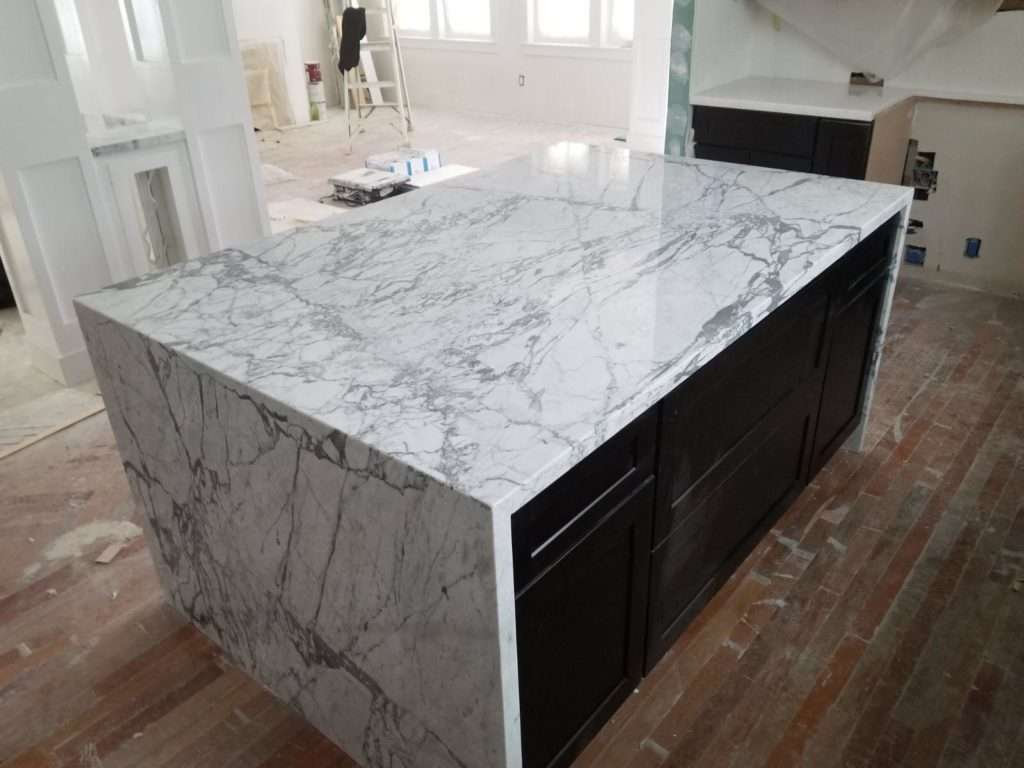
The bold, contrasting veining of a Calacatta is therefore not a vein in the sense of a Bianco Carrara. It is the matrix that separates the fragments of the breccia. Primavori also notes that this variety is rare, and heavily copied by makers of engineered stone. To choose between the two families for a project, see the differences between Calacatta and Carrara.
The Apuan basin produces many other varieties: Paonazzo, Marmo Venato, Bardiglio, Marmo Nuvolato, Arabescato, Zebrino, Cremo, Seravezza breccias and cipollini. Yet a study published in Geoheritage in 2020 examined nine basins in the Frigido valley. Its authors identified only seven distinct commercial varieties there, corresponding to more than fifty local names.
This is the key point of the whole Carrara nomenclature. Seven geological types, more than fifty names: trade names do not form a taxonomy, and two different names can refer to the same rock.
What actually comes out of the Carrara quarries
The municipality of Carrara extracted 656,000 tonnes of marble blocks in 2023, described by the local press as a historic low, from about 70 active quarries. This figure shows the real order of magnitude of a basin often presented as inexhaustible.
The long series is even more telling. A Legambiente Carrara report, based on records of the Comune di Carrara, totals 16,507,978 tonnes of blocks between 2005 and 2023, an average of 868,841 tonnes a year. The same work states that across 76 quarries, between 2005 and 2022, more than 68 million tonnes of material were extracted, only 22.8% of it as blocks.
In other words, the slab is not the main product of a Carrara quarry. Most of the volume leaves as scaglia, the fragmented rock used for aggregates and mineral fillers. Before the third standing advisory committee on marble policy, a report presented in 2026 put 2025 at just over 600,000 tonnes of blocks, against 873,000 tonnes of white scaglia and 1.2 million tonnes of dark scaglia.
A very widespread ratio must go here, because it does not stand up to scrutiny. It is often said that “Carrara accounts for 95% of what comes out of Italian quarries and Calacatta 5%”. This sentence comes from a commercial page that cites no source. It adds a territory to a variety, and applies a basin ratio to the whole of Italian stone production, granites and travertines included.
No public breakdown of Carrara production by variety could be found. The Osservatorio del Marmo has published an annual report since December 2024, but without a breakdown by trade name. Any share of production attributed to Calacatta or Statuario should therefore be regarded as unverifiable.
A “Marmo di Carrara” mark in the making
In 2026 there is no protected designation for Carrara marble, nor any specification defining a “Calacatta Gold” or a “Calacatta Michelangelo”. These names are names of quarries, beds, blocks or companies.
A process has, however, been launched. On 4 August 2026, the partners of the Osservatorio del Marmo signed a three-year agreement for 2026–2028 that formally commits to creating a “Marmo di Carrara” mark certifying quality and origin across the whole supply chain. It brings together the Comune di Carrara, the Camera di Commercio Toscana Nord-Ovest and, as a new member, the Agenzia delle Dogane e dei Monopoli.
Two limitations should be stated straight away. The mark would cover Carrara marble, not commercial sub-names. And to date, the only quarry-to-name attributions actually documented in the Calacatta family are Crestola, linked to the quarry of the same name in the Torano basin, Franchi, linked to the Bettogli quarries, and Macchia Oro, cited by Primavori.
In the meantime, only one document settles the matter: the supplier’s data sheet. The NF EN 12440 standard requires the trade name to be accompanied by a petrographic name, a colour and a place of origin. Asking for these three items is worth more than trusting a name.
Frequently asked questions
Can you visit a marble quarry in Carrara?
The basin’s quarries are working industrial sites, about 70 according to Legambiente’s survey, not sites open to visitors. The massif is, however, a UNESCO Global Geopark with more than 250 geosites, and Geoparks have an explicit mission of geological outreach to the public.
Practical arrangements therefore depend on each operator and on the bodies that run the Geopark. They are not given here because no primary source publishes them in consolidated form. The two contacts to approach are the Parco Regionale delle Alpi Apuane, which manages the Geopark, and the Carrara tourist office.
What is the origin of Carrara marble?
A marine limestone. The protolith is a massive Lower Lias carbonate platform limestone, attributed to the Hettangian, about 210 to 200 million years ago. It became marble through greenschist-facies metamorphism, with a peak temperature estimated between 350 and 450 °C, and was then deformed during the building of the Apennines in the Tertiary.
Does Calacatta account for 5% of Carrara’s production?
Nothing supports that claim. The ratio has spread from an unsourced commercial page, and no public breakdown of the basin’s production by variety exists. What is documented is the total volume: 656,000 tonnes of blocks in 2023 in the municipality of Carrara, a historic low.
Is Carrara marble always white?
No. The Apuan basin also produces greys, violets and breccias: Bardiglio, Paonazzo, Arabescato, Zebrino, Nuvolato, Cremo, Seravezza breccias, cipollini. White dominates Carrara’s image because it dominates demand, not because it is the massif’s only rock.
Is Carrara marble suitable for a worktop?
Mechanically yes, chemically with a reservation. Its dominant mineral is calcite, at 3 on the Mohs scale, which dissolves in a weak acid: vinegar, lemon, wine. The detailed comparison is on our page marble or granite for a worktop.
In summary
Carrara marble is better understood through its geology than through its sales names. A Lias limestone, moderate metamorphism, recent Apennine deformation: that is where the homogeneity of a Bianco Carrara and the brecciated structure of a Calacatta come from. The figures, for their part, describe a shrinking basin, where less than a quarter of the volume extracted leaves as blocks. To look at materials and check the petrographic name on a batch, contact us.