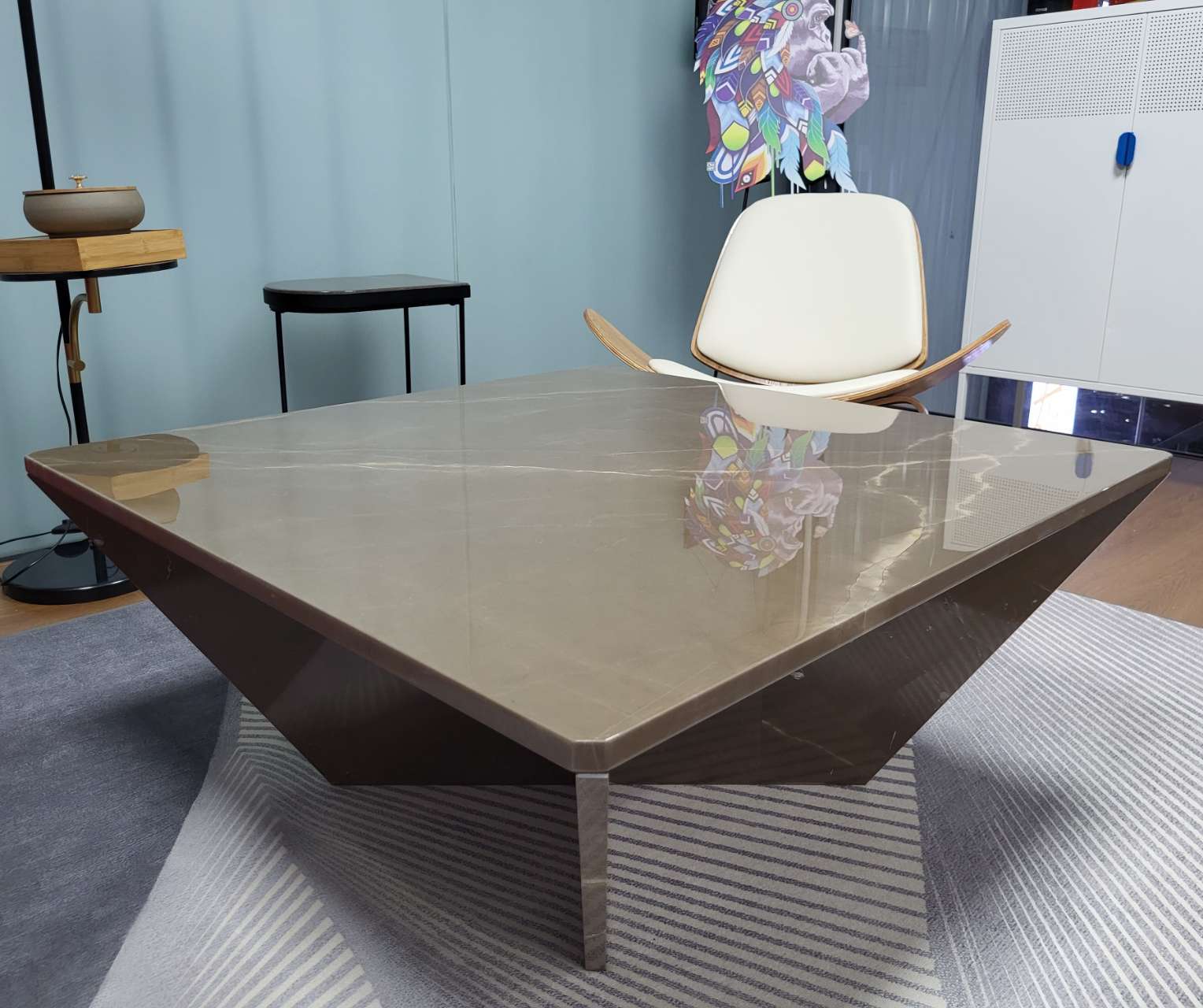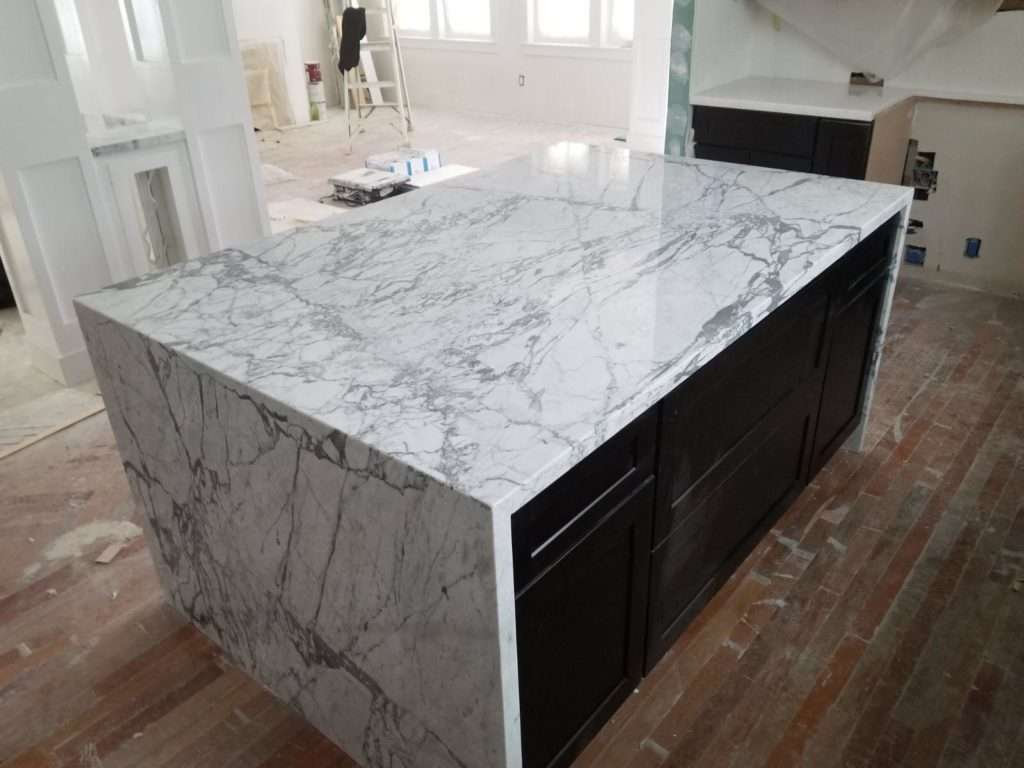

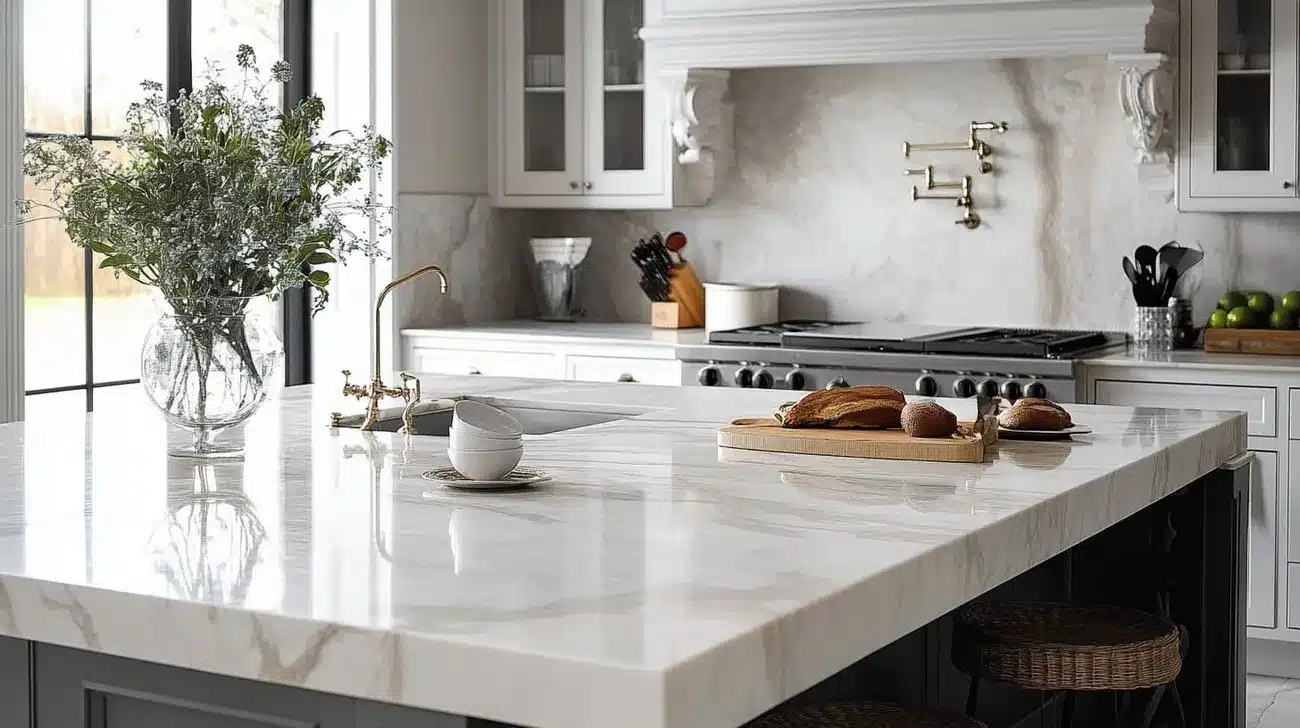
A marble worktop scratches with a knife blade and loses its polish on contact with vinegar, lemon or wine. That mark is not a stain: it is a loss of material that only repolishing removes. That is the limitation to accept before buying.
This page does not defend marble. It documents what damages it, with the source and the test standard for each claim, because that is the information missing when you look for an opinion before ordering. The materials, formats and finishes available are presented on our page marble worktops.
Key points
- The key mineral in marble is calcite, at 3 on the Mohs scale. A university source writes that it “is easily scratched with a knife blade”.
- Vinegar, lemon and wine do not stain marble; they dissolve its surface. The ICOMOS glossary classes this loss of material in a different family from stains.
- An acid mark is corrected by repolishing, and by nothing else. No cleaner and no water-repellent removes it.
- Open porosity varies from 0.2% to 17% from one stone to another on the same NF EN 1936 test. Susceptibility to staining must therefore be asked about batch by batch, not family by family.
- No maximum temperature is published for marble, either by a standard or by a technical body. The values in degrees that circulate are commercial and contradict each other.
Calcite scratches with a knife blade
Le the Earth Sciences Museum at the University of Waterloo writes that calcite is number 3 on the Mohs scale, and that it is easily scratched with a knife blade or a geologist’s hammer. As calcite is the key mineral in marble, this property carries over to the finished stone.
A point of method needs making, because the market almost always misses it. This figure of 3 does not come from a standardised test on the stone: it is a property of the mineral. There is no longer a European standard in force for the hardness of natural stone, NF EN 14205 on Knoop hardness having been withdrawn in September 2013.
Any data sheet stating “Mohs 3 to 4” or “Mohs 3 to 5” for a marble is therefore putting forward a range with no frame of reference. Calcite defines grade 3; it does not bracket it. The only wear property actually measured on a stone is abrasion under NF EN 14157, expressed in millimetres: the marbles consulted sit at around 21.5 to 22 mm, granites between 16.5 and 22.5 mm.
The consequence in the kitchen is mundane and permanent. Cutting directly on the worktop leaves marks, and a chopping board is not a nicety but a necessity. Scouring powders are to be avoided for the same reason: they contain abrasives, and the surface is softer than they are.
Acid etching is not a stain
This is the most misunderstood limitation of marble in the kitchen, and the most decisive. Acid etching is the dissolution of surface calcite by a weak acid. The U.S. Geological Survey writes that limestone and marble are mainly composed of calcite, a calcium carbonate “that dissolves easily in a weak acid”.
Dulling is the exact French term for what this attack produces on a polished surface. The illustrated glossary of stone deterioration patterns, published by ICOMOS’s international scientific committee for stone, defines it as the increase in roughness of an originally polished surface, through selective loss of small particles from a still sound substrate.
The international classification places this pattern and the stain in two distinct families. Dulling belongs to the features induced by loss of material. A stain belongs to chromatic alterations. This is not a nuance of vocabulary: it determines what can correct it.
The same glossary also explains why the mark looks lighter than the rest. It defines discolouration as an increase in lightness due, among other things, to a generally very superficial loss of polish, and specifies that dark marbles and brightly coloured marbles often undergo it. The etched area diffuses light instead of reflecting it: it contains nothing white.
On the acidity threshold, the honest answer is that there is none. Calcite dissolves as soon as the solution is undersaturated, and it is the speed that varies with pH. A Penn State University course states that below about pH 3.5 the dissolution rate becomes proportional to acidity and is limited only by diffusion. The pH values of commercial vinegar and lemon juice are not given here: no technical source consulted publishes them.
One fact is enough to settle the vinegar question, and it comes from a university. Vinegar is one of the reagents geologists use to identify a limestone: poured on cold, it releases bubbles of carbon dioxide. So it is not a cleaning product advised against as a precaution; it is the identification test for the rock.
Relatively good news: the mark is reversible. One producer writes that natural stone can always be restored by repolishing the surface, which brings back the original finish, and the Natural Stone Institute refers to professional repolishing of etched areas. The trade-off is that repolishing removes material, so it is limited by thickness. No threshold beyond which it no longer suffices is published. For routine cleaning, see how to clean marble without dulling it.
Porosity varies from 0.2 to 17% depending on the stone
“Marble is porous” means nothing until the stone has been named. On the same test, the determination of open and total porosity under NF EN 1936, the data sheets consulted give 0.2 to 1% for a Spanish black marble and 16 to 17% for a stone sold as marble and made of 91.5% calcite. Two orders of magnitude apart.
The practical consequence is direct: susceptibility to staining varies in the same proportions. A stone with 16% open porosity absorbs grease in a way that bears no comparison with a stone at 0.3%. It is not the rock family that decides; it is the batch.
A reading trap comes with this figure. Many comparisons set a water absorption measured under NF EN 13755 against an open porosity measured under NF EN 1936. These are two different tests, and the two values cannot be compared. Ask for the same standard on both sides before deciding.
Two corollaries are worth knowing. The finish does not change the porosity of the material: a polished marble is no less porous than a honed one, and polishing does not “close” the pores. And an impregnating, water-repellent treatment slows the penetration of liquids without eliminating porosity, or preventing acid etching, which acts on the surface and not in the pore network.
Some stains, finally, have nothing to do with porosity but with a chemical reaction in the stone. That is the case with rust stains on marble, which are treated differently from organic or grease stains.
A standardised staining test exists, and nobody publishes it
Resistance to accidental staining is the subject of a European test standard, NF EN 16301, in its March 2021 version. It is listed among the test methods applicable to natural stone by the Centre technique de matériaux naturels de construction.
Yet none of the data sheets consulted for this article, marble or granite, declares it. The test exists, and nobody publishes the result. It is the most useful blind spot to know about before ordering, because it concerns precisely the risk that worries a worktop buyer.
The request to make of the supplier is therefore simple and verifiable. Ask for the batch data sheet, with the NF EN 1936 line for open porosity, and ask explicitly whether an NF EN 16301 value exists. A negative answer is information: it tells you nobody has measured it.
Some stones move on contact with water
A less well-known limitation concerns laying, not use, and it ends with a lost slab. A Mapei technical bulletin dated 22 June 2015 describes a change of shape caused by a chemical reaction between water and certain minerals in the stone. The document calls it cupping, curling, doming or warping.
The mechanism described is as follows. The stone curves, pulls away from the mortar bed and debonds, and the same document states that a slab deformed in this way generally can be neither repaired nor relaid. The risk increases with the thinness of the slab and with large formats.
The stones listed by name include all green marbles, Nero Marquina, Portoro, Rosso Levanto and Grigio Carnico, as well as agglomerates made with chips of these stones. In other words, several materials in high demand for kitchens are on the list.
To be fair, it is worth being precise about where the risk lies. A worktop rests on cabinets; it is not bonded to a cement mortar bed, so it is not directly affected. The matching splashback, the floor of the same room or a bonded island end panel are. If you choose one of these stones for the whole kitchen, the question of water sensitivity applies to everything that is bonded.
The professional recommendation is a two-component reactive epoxy adhesive with no mixing water, complying with the ANSI A118.3 specification. It comes from the Natural Stone Institute’s reference manual and from several adhesive manufacturers. No French standard names these stones: the rule is not written in NF DTU 52.2. Asking the supplier whether the stone is water-sensitive before laying it remains the only safe approach.
Heat: the most widespread argument, and the least sourced
No maximum temperature is published for marble by any technical body. The figures in circulation, from 180 °C to 650 °C depending on the page, have neither source nor protocol, and they do not agree with one another. Comparisons such as “180 °C against 150 °C for quartz” suffer from the same problem.
What does exist is more interesting than an invented figure. There is a European test for resistance to ageing by thermal shock, NF EN 14066, and a standard dedicated to marble alone for its behaviour under thermal and moisture cycles, NF EN 16306 of April 2013. No equivalent standard exists for granite.
On the two data sheets consulted that actually declare the NF EN 14066 test, the marbles tested lose no mass, one reporting zero change after twenty cycles. That is not permission to put a hot pan down without a trivet, but it rules out writing that marble cannot take heat. The question remains open, both ways.
Frequently asked questions
What are the drawbacks of a marble worktop?
Three drawbacks can be measured. Calcite, at 3 on the Mohs scale, scratches with a knife blade. It dissolves in a weak acid, so vinegar, lemon and wine dull the surface. And porosity varies from 0.2% to 17% depending on the stone, on the same NF EN 1936 test, which makes susceptibility to staining unpredictable without the batch data sheet.
Is an acid mark permanent?
No, but it cannot be cleaned off. As it is a loss of material and not a deposit, no cleaner or sealer removes it. Only repolishing restores the original finish, an operation that removes material and should be left to a stone professional. On a thin tile, the available thickness margin is small.
How can you tell acid etching from a stain?
In raking light and by touch. Acid etching appears as a matt area on a shiny background, recessed or flush, following the outline of the spilt liquid: the material has gone. A stain is a change of colour with no loss of relief. A salt deposit stands proud and is powdery, crumbling under a fingernail.
Does a water-repellent protect against acids?
No. A water-repellent or impregnating sealer slows the penetration of liquids into the stone’s pore network. Acid etching dissolves the surface itself. The two phenomena are distinct, and the second is not covered by the first. No renewal frequency is given here: the schedules in circulation, from three months to five years, do not agree and are not sourced.
Should marble be ruled out in the kitchen?
That depends on your tolerance for patina, not on the quality of the stone. If dulled areas will bother you, keep marble for a splashback, a display island or a bathroom, and use a silicate rock for the preparation area. The details of the trade-off are in our comparison of marble and granite.
In summary
Marble as a worktop involves only one real decision: whether or not to accept that a spilt acid leaves a matt area until it is repolished. Everything else can be read on a data sheet, porosity under NF EN 1936 and, if it exists, staining resistance under NF EN 16301. Hardness, for its part, is that of a mineral, not of a product: it does not vary from one variety to another. To look at materials and check a data sheet before deciding, contact us.
See also: Marble-effect worktop or real marble: a four-material comparison