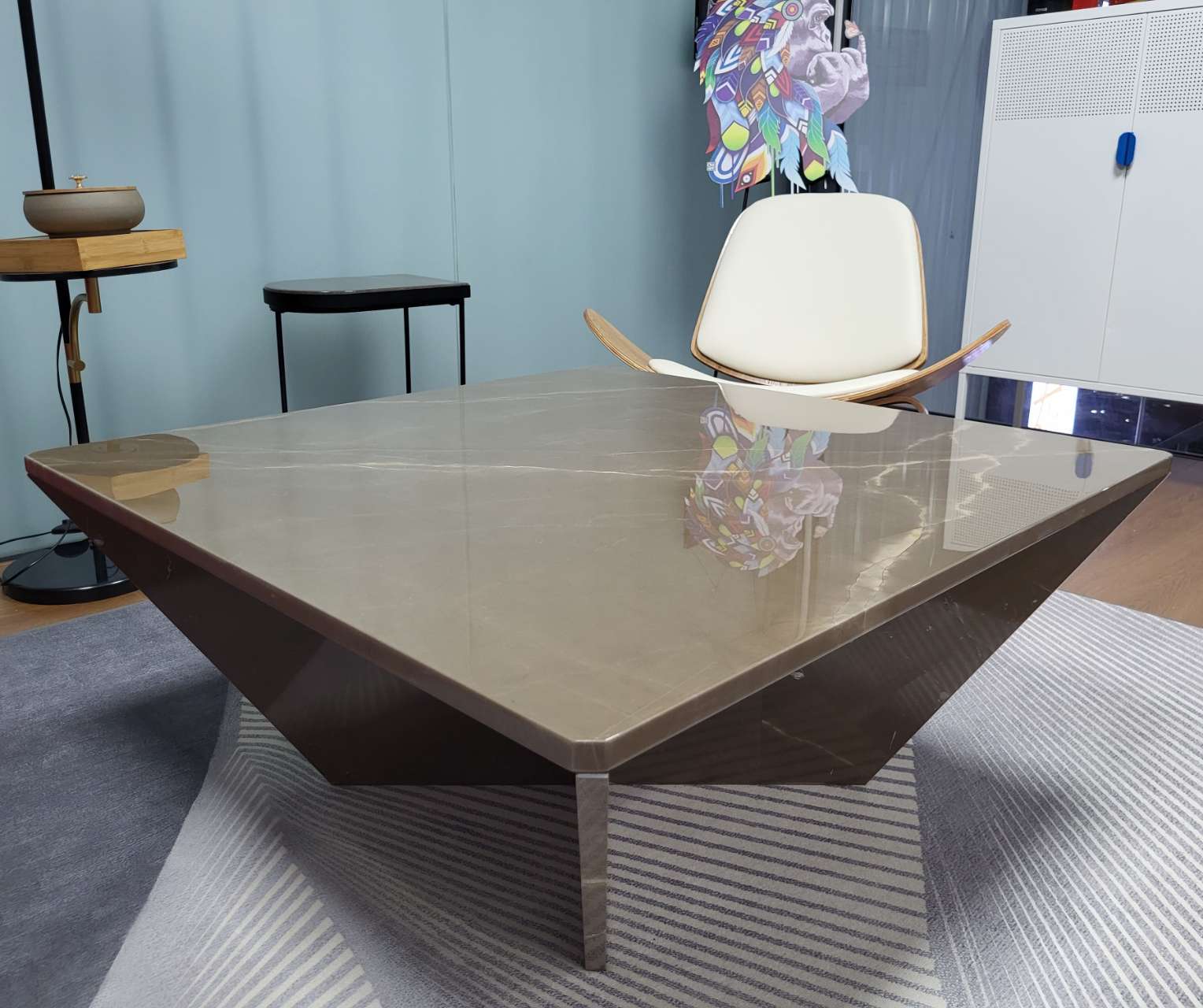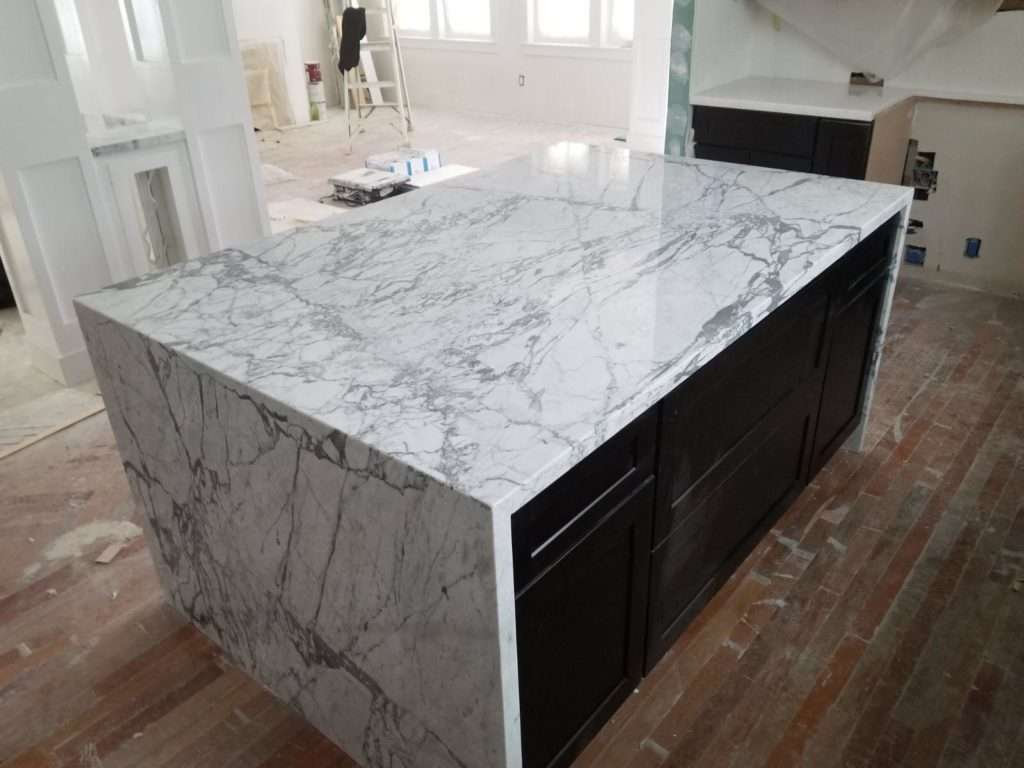

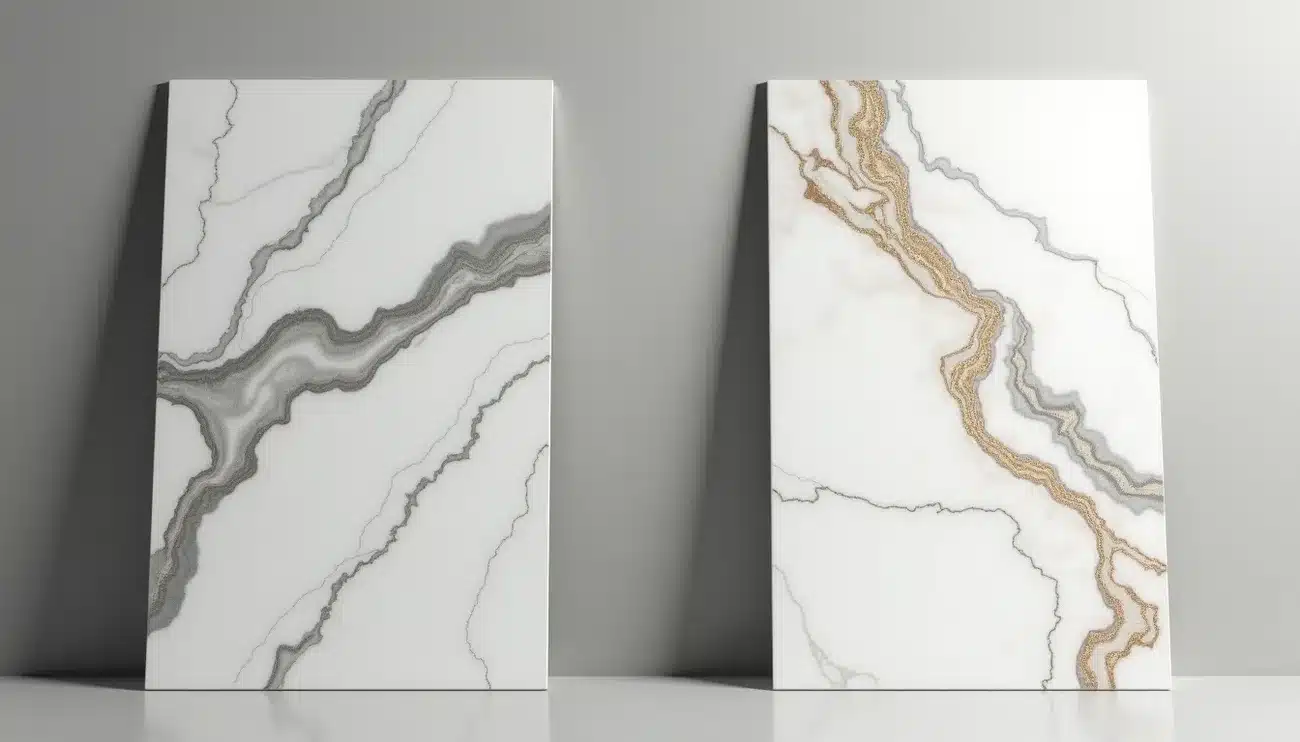
 In the marble basins of the Apuan Alps, geologists identify 7 commercial varieties for more than fifty local names (Massa & Pieruccioni, Geoheritage, 2020). Calacatta and Bianco Carrara are two of these varieties, quarried in the same territory: what separates them is the structure of the rock, not a ranking of rarity.
Carrara marble and Calacatta both come from the Carrara region of Italy, but their visual characteristics are quite distinct. Carrara can be recognised by its soft grey background with darker grey veins, while Calacatta is distinguished by its immaculate white with bold, spectacular veins running through it. To put it simply: «Calacatta = large, contrasting veins. Carrara = fine, softer veins».
The choice between these two types of marble matters for your project. On the one hand, Carrara marble can be seen as a generic term covering several varieties, including Calacatta, Bianco di Carrara and Statuario, described one by one by the geologist Piero Primavori. On the other hand, Calacatta is regarded as a luxury Italian marble, which naturally affects its price and use. In this article you will find all the nuances that separate these two stones, so you can make the right choice for your interior.
Origin and extraction: two emblematic Italian marbles
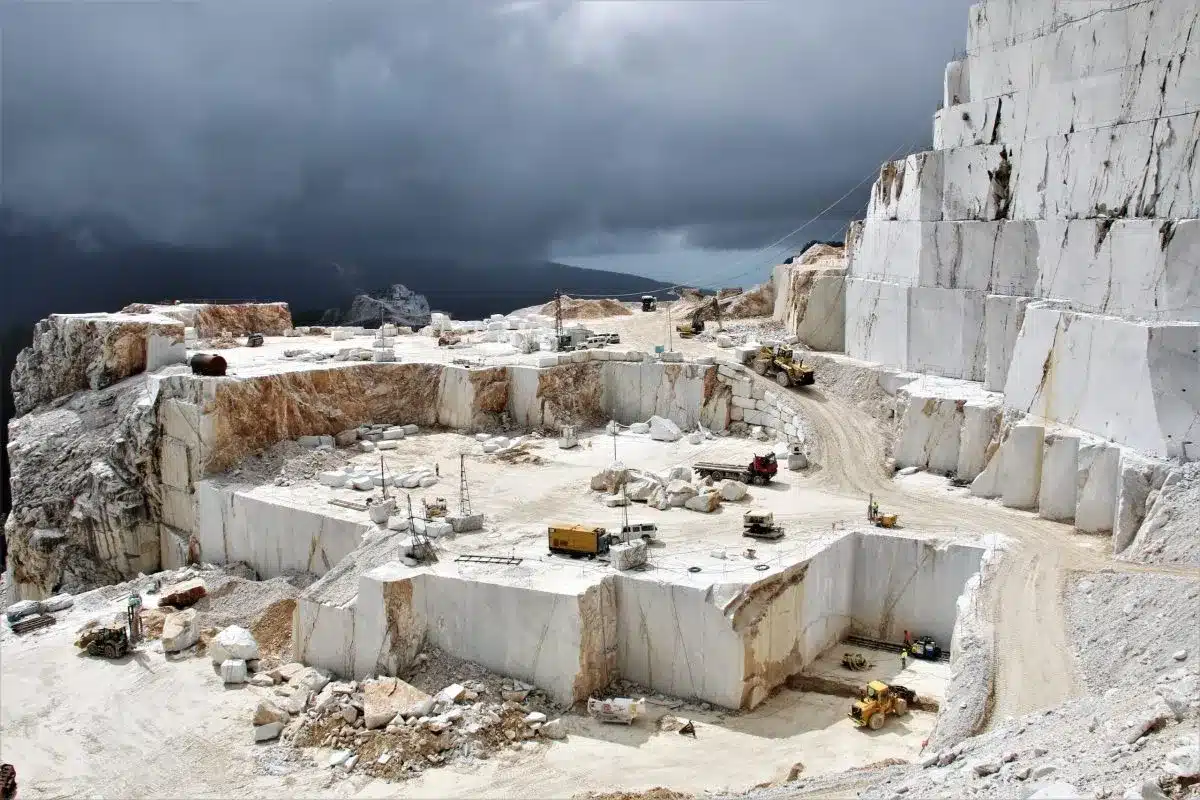
In the heart of the Apuan Alps in Tuscany lies one of the world's most beautiful regions.’marble extraction the most famous in the world. The Carrara mountains are home to quarries that have been in operation since Roman times, providing materials for some of the most iconic works of architecture and art in history.
The Carrara quarries: cradle of the two stones
The Carrara region is home to over 650 marble quarrying sites, making it the most prolific source of marble in the world. These quarries, which have been in operation since ancient times, have provided the raw material for countless masterpieces. Extraction techniques have evolved considerably over time, moving from traditional methods to the diamond wire cutting, introduced in the 1970s. This development made the work less arduous and safer, while enabling more precise cuts to be made.
Geographical differences between Calacatta and Carrara
Although Calacatta and Carrara marbles both come from the Carrara region, their precise geographical origins differ. Carrara marble is extracted specifically from the province of Massa Carrara, while Calacatta comes from the Apuan mountains. Contrary to popular belief, Calacatta does not come from a specific mountain or quarry, but rather from a series of quarries scattered across this vast mountain range.
Some quarries produce better quality Calacatta than others. For example, the Borghini quarry, one of the oldest still operating in the region, produces cuts dating back to Roman times.
Why their origin influences their rarity
The rarity of Calacatta marble is mainly due to the specific geological conditions in which it was formed. It is formed under specific and limited conditions, which considerably limits its availability. In addition, the number of sites where it can be extracted is extremely limited, unlike Carrara marble, which is available from numerous quarries.
The laborious and time-consuming process of extracting Calacatta also contributes to its rarity. These factors combined explain why Calacatta is considered one of the most exclusive and sought-after marbles in the world, while Carrara, although prestigious, remains more accessible and widely available.
Visual differences between Calacatta and Carrara
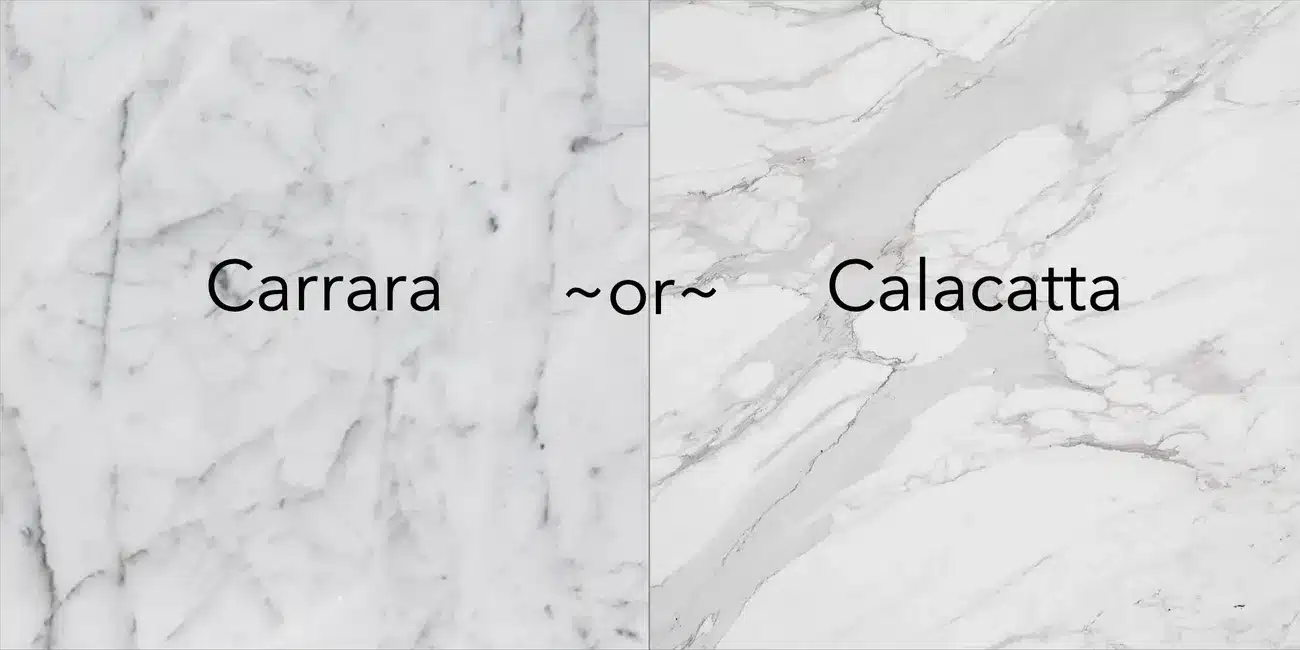
To distinguish Calacatta from Carrara, careful observation of their visual characteristics is essential. These two types of marble have marked aesthetic differences that have a considerable influence on their use in interior design.
Background colour: pure white vs. bluish grey
The fundamental difference between these two marbles lies in their basic colour. Calacatta has a dazzling, almost luminous white background, which serves as a backdrop for its spectacular veins. In comparison Carrara marble has a light grey base with subtle bluish tones. This softer, less pure tone gives Carrara a more discreet, but just as elegant look.
Veining: fine and diffuse or wide and contrasting
The veining is the most distinctive feature of these two natural stones. Calacatta has bold, thick and dramatic veins that can vary from grey to golden to brown. These patterns are generally more widely spaced, creating a strong contrast with the pristine white background.
Carrara is also characterised by its fine, delicate veins, creating a subtle, feathery effect. These light grey lines blend harmoniously with the greyish base, giving a more homogenous, less contrasting appearance.
Aesthetic impact on the interior
These visual differences determine the impact of each marble in a space. Calacatta, with its luxurious appearance and striking contrasts, naturally becomes the focal point of a room. It is ideal for installations designed to impress: kitchen islands, feature walls or majestic fireplaces.
Carrara, by contrast, offers a more understated elegance that blends into the overall design. Its subtlety makes it an excellent choice for larger applications such as floors, worktops or entire bathrooms, where its less dominant character helps create a calm atmosphere.
In short, choose Calacatta if you want an eye-catching centrepiece, and Carrara for a more subtle beauty that complements rather than dominates your space.
Applications and uses by room
Each type of marble finds its ideal place in different areas of your home, their distinctive visual characteristics determining their optimum application.
Kitchen: credenzas and worktops
Carrara worktops offer a timeless sophistication suited to any style of design, while those in Calacatta create spectacular focal points that will impress your guests. For credenzas, Carrara marble fits perfectly into kitchens where you want elegance without the stone stealing the show from your beautiful, colourful cabinets. Calacatta also stands up better in the kitchen, thanks to its darker veins that hide coffee, wine and food stains more effectively.
Bathroom: elegance and moisture resistance
In the bathroom, Calacatta illuminates the space with its large formats that give an impression of openness. The 18x18 Carrara tiles laid diagonally create a classic look reminiscent of the entrances to homes of yesteryear. For the showers, Calacatta offers a spa-like experience thanks to its bold veining, while Carrara brings a more subtle elegance with its more pronounced grey look.
Living room and offices: wall and floor coverings
Calacatta naturally becomes a central element in fireplaces, immediately capturing attention with its bold visual impact. Carrara, on the other hand, with its softer tones, is ideally suited to large surfaces such as floors, where its consistency creates a calm, balanced ambience.
What kind of marble for commercial spaces?
Calacatta, with its dramatic veining, is often used to create focal points in high-end lobbies, reception areas and exclusive commercial environments. Carrara, on the other hand, is more versatile with its subtle veining, making it ideal for wall coverings in offices and commercial spaces, where functionality and aesthetics must go hand in hand.
Price, maintenance and durability: what you need to know
As well as aesthetic considerations, the economic factor and maintenance have a considerable influence on your choice between these two natural stones. These practical aspects often determine the final decision for your landscaping project.
Carrara marble: more accessible
Carrara marble, being more widely available, is the basin’s standard production: Bianco Carrara is the ordinary variety of these basins, and from about 70 active quarries the municipality of Carrara extracted 656,000 tonnes of blocks in 2023, a historic low. This availability affects the price, as do the varied formats of standard slabs, which make large projects easier.
Le Calacatta: a top-of-the-range choice
Calacatta, regarded as a luxury marble, sells for considerably more. The rarity of the variety, which Piero Primavori stresses for the Calacattas, partly explains this; however, no public breakdown of Carrara production by variety makes it possible to quantify it. The selection of slabs with golden veining also plays a part. No prices are published here: the price is set by the batch, the thickness and the finish, not by the name.
Routine maintenance and precautions
Both marbles require similar care. Daily cleaning with a soft cloth and lukewarm water is generally sufficient. Absolutely avoid acidic or abrasive products that attack the stone. A impregnating water-repellent made for marble slows absorption and limits staining; it is renewed when a drop of water no longer beads, not according to a calendar. For spills, particularly of coloured or acidic substances, immediate cleaning is essential.
Durability and impact resistance
Calacatta and Carrara have exactly the same hardness: their dominant mineral is calcite, the reference for grade 3 on the Mohs scale which, as the University of Waterloo Earth Sciences Museum, scratches with a simple knife blade. Neither is therefore harder or more resistant than the other, and both remain sensitive to impacts. Both types require the same precautions in use. Their durability is proven by historic monuments that have lasted for centuries. In domestic use, a dulled or etched surface is restored by repolishing, as needed rather than to a schedule.
Key factors in making the right choice
To finalise your decision between Calacatta and Carrara, there are several key factors to consider. First and foremost, assess the desired visual impact in your space: Calacatta naturally stands out as a focal point with its bold veins, while Carrara provides an elegant backdrop that complements the whole without dominating.
Your budget plays a crucial role in this choice. Calacatta generally costs two to three times more than Carrara, reflecting its exceptional rarity and luxurious status.
Also consider the intended use. For rooms where you want to create a lasting impression, such as reception rooms or guest bathrooms, Calacatta excels. Carrara, on the other hand, is perfect for larger spaces that require a subtle, consistent elegance.
The size of your project will also influence your selection. The more affordable Carrara can cover large surfaces without compromising your budget, while Calacatta is ideal for kitchen islands or feature walls where its visual impact can be fully appreciated.
Ultimately, these two Italian marbles offer timeless beauty with distinct characters. Your choice will depend mainly on your personal aesthetic preferences, combined with the practical and budgetary constraints of your project.
Frequently asked questions
What is the main difference between Carrara and Calacatta marble?
The main difference lies in their appearance. Carrara has a light grey background with fine, subtle veins, while Calacatta has a bright white background with larger, contrasting veins.
Is Calacatta more expensive than Carrara?
Yes, Calacatta is generally more expensive than Carrara. Its rarity and luxurious appearance make it a more exclusive marble, which is reflected in its higher price.
Which type of marble is best for a kitchen worktop?
Both types are suitable, but Calacatta is more resistant to stains thanks to its darker veins. Carrara, however, is a more affordable option for larger surfaces.
How should these marbles be looked after day to day?
Daily cleaning with a soft cloth and warm water is generally enough. Avoid acidic or abrasive products, and renew the sealer when a drop of water placed on the surface no longer beads.
Which one to choose for a strong visual impact in a room?
Calacatta, with its bold, contrasting grain, is ideal for creating an impressive focal point in a room. It's perfect for eye-catching installations such as kitchen islands or fireplaces.
See also: Calacatta marble: real Carrara marble or a finish name?