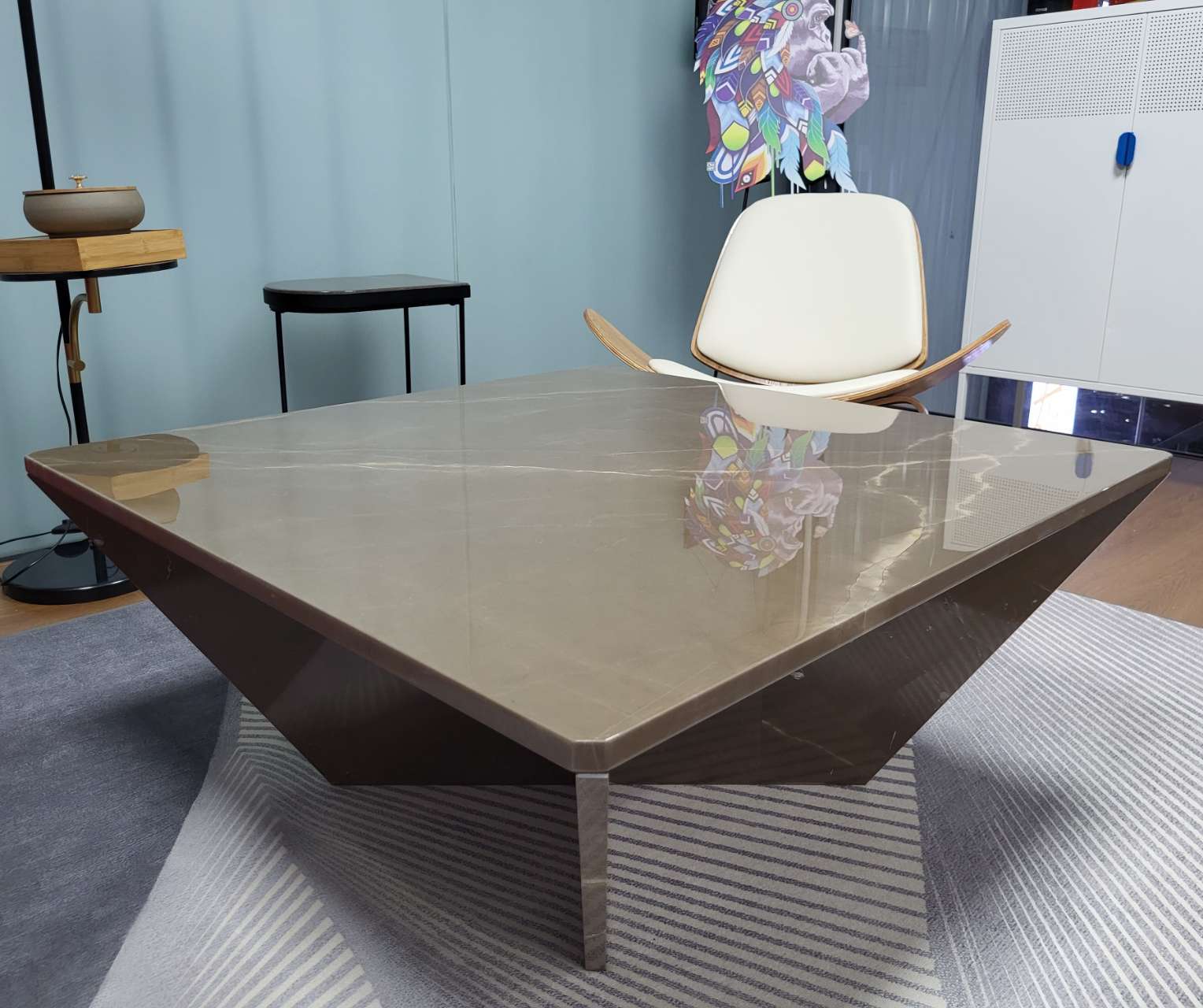
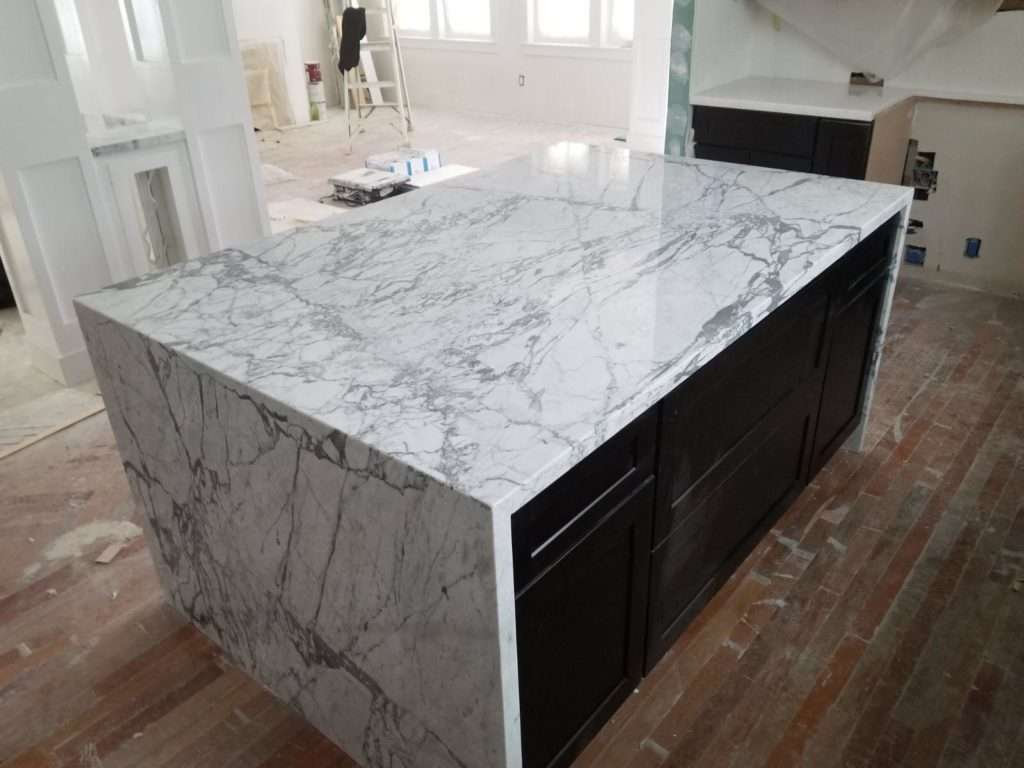
“Calacatta Gold” refers to two different products. It is first a marble quarried in the Carrara basin, a breccia with yellowish-white clasts. It is also a commercial finish name used by makers of porcelain stoneware and engineered quartz. Same name, different materials, different standards, and price levels with no connection.
Key points
– Calacatta is a breccia : clasts of yellowish-white marble separated by a carbonate matrix rich in muscovite and chlorite, greener and more ochre than the clasts. The name comes from the locality of Calacata, north of the village of Torano.
– There is no protected designation for “Calacatta” in 2026. Gold, Oro, Borghini, Michelangelo, Macchia Vecchia: these are names of quarries, blocks, beds or companies.
– “Calacatta” is also a finish name at Laminam, XTONE, Neolith and Silestone. A “Calacatta” slab 3 mm is not stone.
– A porcelain stoneware tile repeats. XTONE states 4 designs in 6 mm and 2 in 12 mm for its Calacatta Gold. A natural stone never repeats.
– “Calacatta is harder than Carrara” is false : same minerals, same calcite, hardness 3 out of 10 on the Mohs scale.
What Calacatta marble is
Calacatta is not a white marble with more veining than others: it is a breccia. The most solid petrographic definition available is that of Piero Primavori, who nominated Carrara marble as a Global Heritage Stone Resource with the Geological Society of London (Special Publications 407, 2015). He describes Calacata as “a breccia of very light yellowish-white marble clasts, set in a carbonate matrix rich in muscovite and chlorite, greener and more ochre-yellow than the clasts themselves” (Litos Online). The name comes from a specific place: the locality of Calacata, north of the village of Torano, in the Carrara basin in the strict sense. Primavori adds two useful points: the variety is rare, and makers of artificial stone copy it massively.
The material belongs to the Marmi formation of the Apuan Alps, in Tuscany. Its protolith is a Lower Lias carbonate platform limestone, and the metamorphism took place in the greenschist facies during the building of the Apennine chain. Note: the geological literature gives a metamorphic peak of 350–450 °C and a protolith of the order of 210 to 200 million years. These values come from an article whose PDF could not be checked line by line.
Calacatta, Bianco Carrara, Statuario: a difference of structure
The three names do not describe three intensities of the same marble. They describe three rock structures, and nobody explains this in French.
- Bianco Carrara : marble homogeneous, white to pearl-grey background, bright grain, diffuse smoky-grey veining. This is the standard production, in sub-varieties C, C/D, D and P.
- Statuario : marble very pure, ivory-white to cream background, rare light grey veining, renowned for carving with a chisel. Production markedly lower than the ordinary whites.
- Calacatta : breccia. The bold, contrasting gold, ochre or green veining is not a pattern within a homogeneous mass; it is the matrix that separates the clasts.
It is a difference in rock structure, not a difference of taste. It explains why you cannot get a Calacatta by selecting a “more veined” Bianco Carrara: the material is not built in the same way. The Apuan basin also produces other breccias and veined marbles: Paonazzo, Arabescato, Bardiglio, Nuvolato, Zebrino, Cremo.
Seven varieties, more than fifty names
You very often read that Carrara marble accounts for 95% of Italian quarry production and Calacatta 5%. This split is backed by no source: it has spread from commercial pages that cite none. It adds a territory to a variety, and it applies a ratio of white marbles to the whole of Italian stone production, granites and travertines included. No public breakdown of Carrara basin production by variety could be found, including in the work of the Osservatorio del Marmo.
Two figures, however, can be verified. In 2023, the municipality of Carrara recorded 656,000 tonnes of marble extracted as blocks, a historic low, from about 70 active quarries (Il Tirreno, 23 March 2024; Legambiente Carrara monitoring based on municipal records). And above all, the academic figure: in the nine basins of the Frigido valley, Massa and Pieruccioni identify 7 geologically characterised commercial varieties, including Calacatta, corresponding to more than fifty local names (Geoheritage, 2020). Carrara’s trade nomenclature is not a taxonomy.
Neither harder nor more resistant than a Bianco Carrara
Calacatta is a marble: its dominant phase is calcite. Its hardness is therefore that of calcite, 3 out of 10 on the Mohs scale, identical to that of a Bianco Carrara and a Statuario, since these are the same minerals (Handbook of Mineralogy, Calcite data sheet). The claim that “Calacatta is harder, or more resistant, than Carrara” is false.
Calcite is a carbonate: acids dissolve it. Lemon juice, vinegar or descaler leave acid etching, that is, a matt haze where the stone has been eaten away. This applies to all Carrara marbles, Calacatta included, and is corrected by repolishing, not cleaning. A water repellent or an impregnator reduces absorption but does not protect against an acid.
Marble, porcelain stoneware, engineered quartz: what separates them
These three families do not fall under the same standards, and that is not a specialist subtlety: it is the criterion that settles a quote.
| Calacatta marble | “Calacatta” porcelain stoneware | “Calacatta” engineered quartz / mineral surface | |
|---|---|---|---|
| Nature | Metamorphic carbonate rock, breccia with a muscovite-chlorite matrix | Pressed and fired ceramic product, printed décor | Industrial product based on resin, hydraulic cement or a mixture of the two, with mineral fillers |
| Commercial references found | Calacatta Franchi, Crestola, Macchia Oro, Gold, Oro | Laminam I Naturali Calacatta Michelangelo, Calacatta Oro Venato, Calacatta Viola ; XTONE Calacatta Gold, Green, Antico, Viola ; Neolith Calacatta Gold CG01 ; Apavisa collection Calacatta | Silestone Eternal Calacatta Gold |
| Thicknesses | Standard cut in 20 and 30 mm | 3, 3+, 5, 5+, 6, 12, 12+, 20+ mm according to the Laminam, XTONE and Neolith catalogues | Not documented in the sources consulted |
| Formats | Slabs cut from a block, dimensions variable | Formats constant : 1000×3000, 1200×3000, 1600×3200, 1620×3240 mm | Not documented |
| Maintenance | Sensitive to acid etching (calcite); can be repolished; water repellent depending on use | Unaffected by acid etching; surface décor cannot be repolished | Depends on the binder; follow the manufacturer’s data sheet |
| Applicable standards | NF EN 1469 (cladding slabs), NF EN 12058 (floors and stairs), NF EN 12057 (modular tiles), designation under NF EN 12440 | NF EN 14411 “Carreaux céramiques” (November 2016) | NF EN 14618 (terminology and classification), NF EN 14617 (test methods, 16 parts), NF EN 15285 and NF EN 15286 (product standards) |
The decisive point is written into the standards themselves. NF EN 1469 “Natural stone products, slabs for cladding, requirements”, April 2015 version, explicitly excludes artificially agglomerated stone materials from its scope. NF EN 12058 does the same. In other words, an agglomerated product cannot be declared under the natural stone standard, and vice versa.
And the comparison is not rhetorical, because the three families have the same legal standing. NF EN 14411 “Ceramic tiles: definitions, classification, characteristics, assessment and verification of constancy of performance and marking”, November 2016 version, is a harmonised European product standard. It makes CE marking mandatory, like the product standards of the other two families. It classifies tiles by manufacturing method and water absorption, with the suffixes GL for glazed and UGL for unglazed, and its scope also covers mosaics, defined as any piece fitting within 49 cm². Three families, three separate bodies of standards, one trade name. Asking under which standard the product is declared settles the question in one sentence, without geological assessment.
A note on engineered quartz, because the sales argument has changed. Writing today that “Silestone is 90% natural quartz” is out of date. Cosentino reformulated its range with HybriQ technology from 2022 to reduce crystalline silica content, and now presents Eternal Calacatta Gold as a hybrid surface combining minerals and recycled materials.
For the thicknesses, edge finishes and formats available in stone, see the marble tiles and the marble worktops.
The family of names: who defines a “Calacatta Gold”?
Nobody. That is the heart of the matter. In 2026 there is no protected designation for “Calacatta” : no standards consortium, no collective mark in force, no specification. Gold, Oro, Borghini, Michelangelo, Macchia Vecchia, Crestola, Franchi are names of quarries, blocks, beds or companies. The spellings Calacata and Calacatta are in fact both historically attested, the Carrara dialect reducing double consonants.
A certification mark « Marmo di Carrara », covering origin and quality, is being set up. It stems from the agreement of 4 August 2026 signed within the framework of theOsservatorio del Marmo (Comune di Carrara, Camera di Commercio Toscana Nord-Ovest, Agenzia delle Dogane). It covers Carrara marble, not commercial sub-names. A “Calacatta Gold” will therefore fall under it no more after its creation than it does today.
| Designation | What is established | What is not |
|---|---|---|
| Calacatta (family) | Breccia with yellowish-white clasts, muscovite-chlorite matrix; name taken from the locality of Calacata, north of Torano | That a specification exists |
| Calacatta Gold / Oro | Common name for Calacattas with golden veining. Also a product name at Silestone, Neolith and XTONE | That a colour threshold or a quarry defines it |
| Calacatta Borghini | Cited by Carrara producers, dove-grey to gold veins | NOT SOURCEABLE : its quarry of origin |
| Calacatta Michelangelo | Name of a Laminam porcelain stoneware. In natural stone, present in merchants’ lists | NOT SOURCEABLE : its quarry, and that it refers to an identified geological variety |
| Calacatta Macchia Vecchia | Cited by several producers: white background, grey-gold networked veining | NOT SOURCEABLE : its quarry of origin |
| Calacatta Crestola | Quarry Crestola, basin of Torano | |
| Calacatta Franchi | Quarries of Bettogli | |
| Calacatta Macchia Oro | Sub-variety cited by Primavori | |
| Calacatta Vagli | Quarried in Garfagnana (Vagli), another basin | That it is a Carrara Calacatta in the strict sense |
Only three quarry-to-name attributions can be sourced: Crestola, Franchi and Macchia Oro. Everything else is commercial usage, and that is exactly the information a buyer needs.
The direct consequence for online searching: when you type “calacatta michelangelo” or “calacatta oro”, you partly get ceramic products. These names are catalogue references at ceramics makers. This is neither fraud nor a Google error: it is a homonym you need to know about before comparing two quotes.
How to recognise the stone in practice
Five checks are enough, and none requires geological expertise.
1. Does the pattern repeat? This is the simplest marker, and it is given by the maker of the competing product itself. XTONE publishes that its Calacatta Gold exists in 4 patterns in 6 mm and 2 in 12 mm. After a few slabs, the pattern comes round again. A natural stone never repeats: each slab is a unique cut through a block.
2. What thickness? Marble is commonly cut to 20 and 30 mm. Ceramic catalogues go down to 3 mm. A 3 or 5 mm “Calacatta” slab is not stone, and the question is settled before you even look at the veining.
3. Are the formats constant? 1620 × 3240 mm, 1600 × 3200 mm, 1200 × 3000 mm: these perfectly stable dimensions are an industrial signature. A marble block yields slabs of varying dimensions.
4. What does the edge show? On a stone, the veining runs through the thickness; on porcelain stoneware, the décor stops at the surface, except for full-body products. Note: this criterion follows from the nature of the products, but no standard or technical source consulted states it in black and white. Use it as an indication, not as proof.
5. Ask for the documents. NF EN 12440 “Denomination criteria” requires the trade name to be accompanied by a petrographic name, a colour and a place of origin. Porcelain stoneware and agglomerates have no petrographic name. Then ask under which standard the product is declared: NF EN 1469, 12057 or 12058 for stone, NF EN 14618 and following for agglomerates, NF EN 14411 for ceramics. All three are harmonised product standards: in each case, the manufacturer has a declaration of performance to produce.
A word on the vinegar test, often recommended on forums. It works, since calcite reacts to acids, but it is destructive : it leaves a permanent matt mark. It must never be done never on a laid slab, on a sample entrusted to a client, or on an offcut intended for use.
As for test values, only one producer data sheet was consulted for a Calacatta. Mandarin Stone declares a water absorption of 0,10 % under NF EN 13755, an apparent density of 2,680 kg/m³ and an open porosity of 0,30 % under NF EN 1936. The declared flexural strength is 7.72 MPa under NF EN 12372. Note: these values could not be re-checked against the source PDF. Above all, they are not “the values of Calacatta”: a test value applies to a batch, not to a variety. NF EN 12058 requires the manufacturer to declare these characteristics, and it is the supplier’s data sheet that is authoritative.
Frequently asked questions
What is Calacatta marble?
It is a marble quarried in the Carrara basin, in Tuscany, and more precisely a breccia. Clasts of yellowish-white marble are separated by a carbonate matrix rich in muscovite and chlorite, which gives the bold, contrasting veining. Its name comes from the locality of Calacata, north of the village of Torano. It is not a synonym for “white marble”, nor a particularly veined Bianco Carrara: the structure of the rock is different.
What colour is Calacatta?
A very light background, white to yellowish-white, crossed by bold veining ranging from gold to ochre-yellow, with green tints. This colouring is not decorative: it comes from the matrix rich in muscovite and chlorite, greener and more ochre than the clasts it separates. Trade names follow this colouring, Gold and Oro for golden veining, without any threshold being defined.
Why is Calacatta so expensive?
Two factors are documented. The variety is rare at the scale of the basin, as Primavori explicitly points out. And Carrara’s block production is low: 656,000 tonnes in 2023, a historic low, from about 70 active quarries. Over the period 2005–2022, blocks accounted for only 22.8% of the material extracted, the rest going to aggregates and fillers. Add to that the sawing yield on a brecciated material and selection at slab level. No prices are published here; see the publication notes.
What does Calacatta marble cost per m²?
This article publishes no prices. What is useful to know for reading a quote: the price is set by the batch, not by the name. Four parameters count: the quarry and batch of origin, the thickness and slab format, the finish, and the quality of veining selection. One figure to watch: the cheapest “Calacatta” products on online comparison sites are ceramic tiles, not stone, and are no price reference for a marble.
In summary
The word “Calacatta” does not tell you which material it is. A single question does: under which standard is the product declared? Stone falls under NF EN 1469, 12057 and 12058, which expressly exclude agglomerated materials; agglomerates fall under NF EN 14618, 14617, 15285 and 15286; ceramics under NF EN 14411. Three separate bodies of standards, three different declarations of performance, one trade name. The rest, golden veining, quarry name, thickness, format, can be checked in a few minutes with the five checks above. To look at real slabs and read the data sheets of the batches available, contact us.