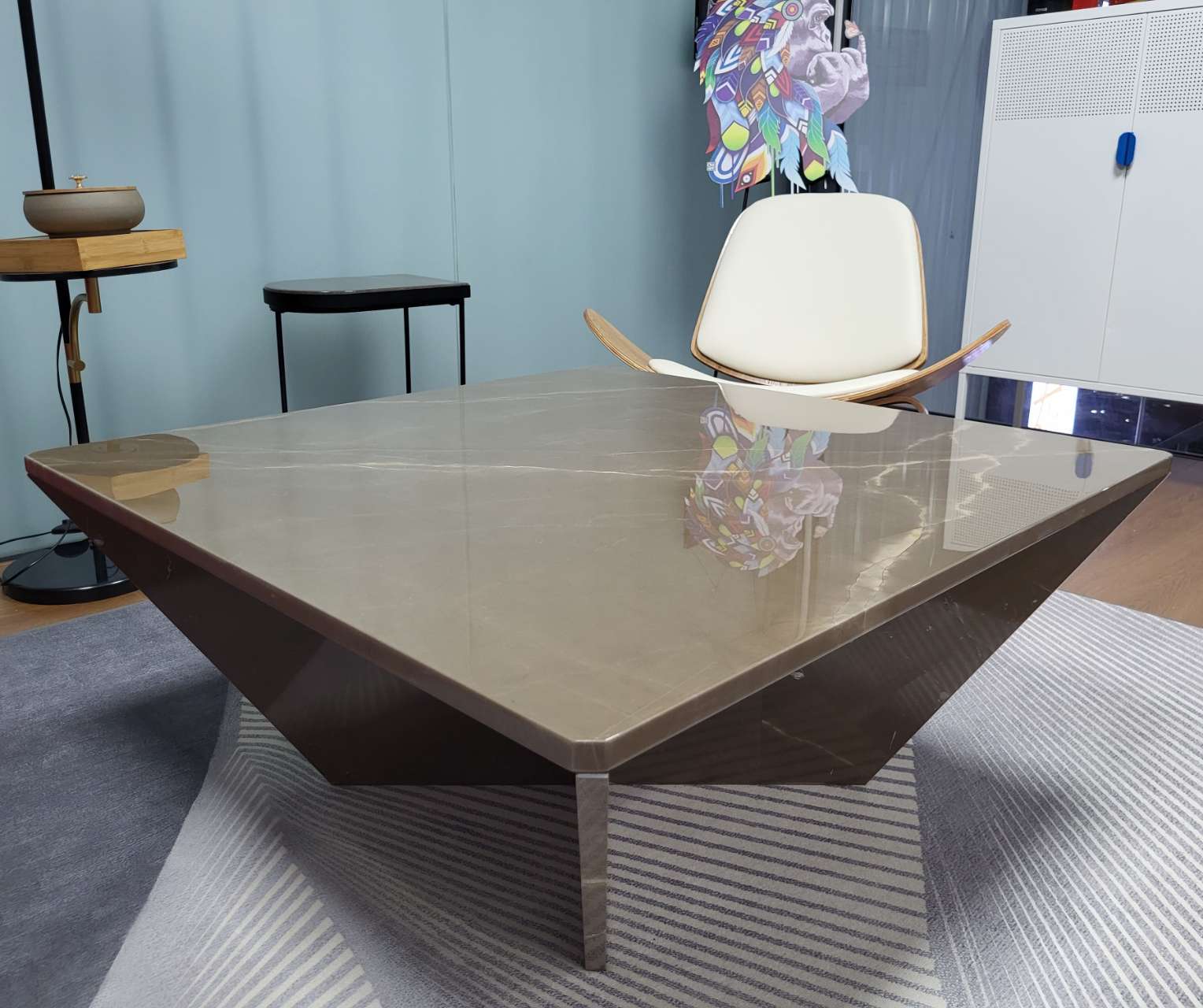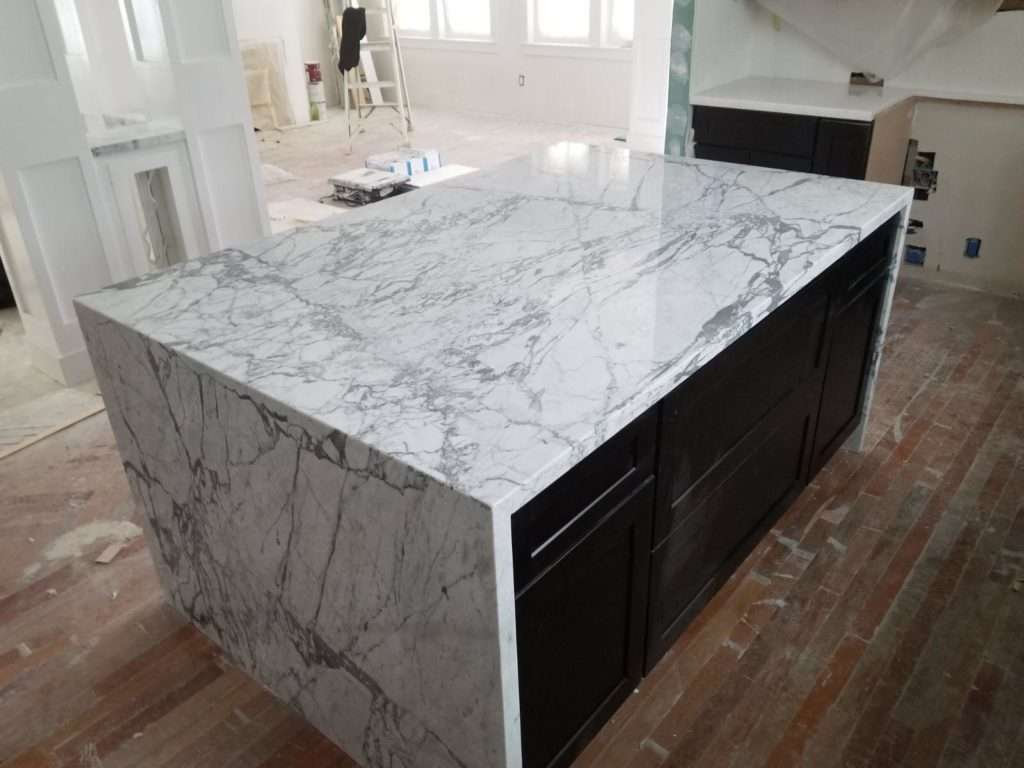


On standardised tests, granite clearly outperforms marble on only four criteria: compression, abrasion, frost resistance and acid resistance. For density, open porosity and flexural strength, the ranges overlap. Choosing between marble and granite therefore comes down to those four points.
This comparison is less clear-cut than most you will read, and that is deliberate. It keeps only values published with their test standard: six technical documents for granite, including three data sheets from CTMNC’s COFRAC-accredited laboratory, and five producer data sheets for marble. Missing data are flagged as such, never filled in. See also our marble worktops.
Key points
- Only four criteria clearly separate the two stones: compression (140 to 219 MPa against 96 to 145 MPa, NF EN 1926), abrasion, frost resistance and behaviour with acids.
- Granite is not denser than marble: 2,650 to 2,710 kg/m³ against 2,660 to 2,720, on the same NF EN 1936 test.
- “Hardness 6 to 7 Mohs” for a granite is a category error: the scale is defined for minerals, and a granite contains at least three.
- The only clear chemical difference: the calcite in marble dissolves in a weak acid, the silicates in granite resist it. That is what the USGS writes.
- No temperature limit in degrees is published for either family. And a mechanical value quoted without its test standard cannot be used.
Four criteria genuinely separate the two stones
On identical tests, granite’s advantage is clear and consistent on four lines only: compression, abrasion wear, frost resistance and acids. Elsewhere the ranges overlap, sometimes completely. That is why the “test standard” column is there: without it, two figures cannot be compared.
| Criterion | Test standard | Marble | Granite | Real difference |
|---|---|---|---|---|
| Nature and minerals | NF EN 12407 | Carbonate rock, 91.5 to 98% calcite | Fully crystallised igneous rock: quartz, feldspar, micas | Carbonates versus silicates |
| Bulk density | NF EN 1936 | 2,660 to 2,720 kg/m³ | 2,650 to 2,710 kg/m³ | None: the ranges overlap |
| Open porosity | NF EN 1936 | 0.2 to 1% (Nero Marquina), 16 to 17% (Vratza) | 0.2 to 0.5% | Granite tightly grouped, marble spread over two orders of magnitude |
| Water absorption | NF EN 13755 | 0.1 to 0.18%, up to 4.5 to 5% (Vratza) | 0.1 to 0.7% (a single source, family values) | Inconclusive as things stand |
| Flexural strength under centre-point load | NF EN 12372 | 13.7 to 20 MPa | 10 to 22.6 MPa | Wide overlap: granite is not systematically higher |
| Compression | NF EN 1926 | 96 to 145 MPa | 140 to 219 MPa | Clear, consistent advantage to granite |
| Abrasion wear (lower = better) | NF EN 14157 | 21.5 to 22 mm | 16.5 to 22.5 mm | Advantage granite, upper ends of the ranges meet |
| Frost resistance | NF EN 12371 | Contradictory sources: “resistant” for one producer, not determined for another | 144 to 240 cycles | Advantage granite, and above all: the value is declared |
| Sensitivity to common acids | No standardised test | Yes: calcite dissolves in a weak acid | No: silicates resist acid etching | The clearest difference in the table |
| Hardness | No standard in force (NF EN 14205 withdrawn in 2013) | Calcite, grade 3 on the Mohs scale | No single figure: quartz 7, feldspar 6, micas softer | Badly framed question, see below |
| Heat resistance in degrees | NF EN 14066, NF EN 16306 (marble) | No value in °C. Zero mass loss after thermal shock on the 2 data sheets that declare the test | No value published, either in °C or under NF EN 14066 | Not comparable as things stand |
| Routine care | Outside the standards, summary | Neutral detergent, no vinegar or lemon, water repellent depending on exposure | Neutral detergent, water-repellent useful despite low porosity | Same method, marble less forgiving |
| Uses where each stone is at its best | Outside the standards, summary | Splashback, lightly used island, bathroom except shower floor | Heavily used kitchen, cooking area, outdoors in a frost zone | Depends on exposure to acids and frost |
The granite values come from CTMNC Lithoscope for three identified French stones, from the Association Granit et Pierres du Sidobre and from Grupinex. For marble, five producer data sheets, including a “Vratza marble” made of 91.5% calcite: it is this one that widens the porosity range so much. All rights reserved to CTMNC, www.ctmnc.fr.
A value without its test standard means nothing
Two figures can only be compared if they come from the same test, and most online comparisons break this rule. The most common case: they set a water absorption measured under NF EN 13755 for marble against an open porosity measured under NF EN 1936 for granite. Two quantities, two protocols. The comparison makes no sense, and it always comes out the same way.
The most telling demonstration comes from a single stone. Lanhélin granite, in Ille-et-Vilaine, is declared at 210 MPa in compression under NF EN 1926, the paving standard, and at 221.5 MPa under NF EN 772-1, the masonry standard. Same quarry, same block, two numbers. So ask for the data sheet of your batch with its standards, not that of the stone family: granite compression varies from 80 to 270 MPa depending on the producer.
A granite’s hardness cannot be reduced to one figure
“Granite has a hardness of 6 to 7 on the Mohs scale” is a category error, not an approximation. TheMohs scale is defined for minerals: the protocol consists of scratching the smooth surface of a mineral to identify it. A granite is not a mineral; it is a rock that combines several.
The Association Granit et Pierres du Sidobre describes its own stone as an assemblage of feldspar, quartz crystals and small crystals of black mica and biotite. Quartz is grade 7, feldspar grade 6, and micas are markedly softer than both. Scratching a granite therefore means scratching whichever mineral the point meets. Marble, by contrast, can be read as a single figure because it has only one key mineral, calcite, at grade 3.
The scale is also ordinal. The University of Auckland describes it as arbitrary and non-linear, the intervals between grades not necessarily being equal: writing that a granite is “twice as hard” as a marble on the basis of 6 against 3 therefore makes no sense. There is in fact no longer a European standard for the hardness of natural stone, NF EN 14205 having been withdrawn in September 2013. The usable comparison is wear under NF EN 14157: 16.5 to 22.5 mm for granites, 21.5 to 22 mm for marbles.
Acids: the only clear chemical difference
Marble and granite do not react in the same chemical register, and that is the decisive difference for a worktop. TheU.S. Geological Survey puts it in two sentences. The first: “granite is composed mainly of silicate minerals, such as feldspar and quartz, which are resistant to acid attack”. The second: “limestone and marble are composed mainly of calcite, calcium carbonate, which dissolves readily in a weak acid”.
In kitchen terms: a forgotten slice of lemon, a dash of vinegar or the dregs of a glass of wine mark a marble and not a granite. The mark is not a stain but acid etching, a very superficial loss of material that dulls the surface and makes it look lighter. It is corrected by repolishing: the drawback is real, but reversible.
A nuance is needed, which the market systematically skips: the sources write “resistant”, never “impervious”. Granite weathers too, through slow hydrolysis of its feldspars into clay minerals, on a geological timescale. That is not what lemon juice does to a worktop, but nobody should write that granite is chemically inert either.
Heat: the most widespread argument, and the hardest to source
“Granite resists heat, marble does not” is supported by no serious source, either way. No maximum temperature in degrees is published by a technical body for either family. The only pages that put forward figures, from 176 °C to 450 °C depending on the article, are commercial, and they do not agree with one another.
What is solid is worth more than an invented figure. There is a European test of accelerated ageing by thermal shock, NF EN 14066, and a standard dedicated to marble alone for its behaviour under thermal and moisture cycles, NF EN 16306; granite has no equivalent. On the two data sheets consulted that declare the NF EN 14066 test, the marbles tested lose no mass, one reporting zero change after twenty cycles. Use a trivet on both stones, and treat the question as open.
Drawbacks of marble and granite
What are the drawbacks of marble?
Marble scratches and marks more easily than most worktop stones. Its key mineral, calcite, is at grade 3 on the Mohs scale and dissolves in a weak acid: vinegar, lemon, wine. Its porosity varies from 0.2% to 17% across the data sheets consulted.
Three practical consequences follow. Porosity is a property of the batch, not of the family, so susceptibility to staining must be asked about batch by batch. Frost resistance is frequently not declared by marble producers, which makes any outdoor use in a frost zone risky. And with a polished finish on a wet floor, a marble measured under NF EN 14231 drops to 10 to 15 SRV, enough to rule out polished finishes for a shower floor.
What are the drawbacks of granite?
Granite is neither scratch-proof nor waterproof. It is a multi-mineral rock, including micas markedly softer than quartz, and its open porosity remains between 0.2 and 0.5%. Its mechanical variability is wide, from 80 to 270 MPa in compression, and its speckled grey colouring offers little variation.
The Sidobre association itself acknowledges that its granites range from light grey to dark grey: that is the most concrete limitation compared with a veined marble. Be wary, too, of trade phrases. “Scratch-proof”, “harder than metal” or “200-year lifespan” do appear in professional documents, but outside their standardised test tables. They are statements, not measurements.
Does a granite worktop emit radon?
It is “extremely unlikely” that a granite worktop raises the annual radiation dose above natural background. That is the position of theUS Environmental Protection Agency, on a page updated on 12 January 2026.
The same agency adds that radon from the ground beneath homes is a more common problem and a “much greater” health risk than that from granite building materials. It recommends testing for radon in every home, with or without a granite worktop. The wording is “extremely unlikely”, not “zero risk”: it is a concern to keep in proportion, not to dismiss.
What makes the price of a worktop vary
No prices are given here: no public, verifiable source documents French price ranges for 2026. The figures in circulation come from quote aggregators that do not agree with one another. The six parameters that make the difference on a quote can, however, be identified, and they weigh more heavily than the choice of stone family.
- The variety and its availability: two grey granites are not worth the same depending on the quarry and the rarity of the batch.
- Thickness, in millimetres: 20 mm and 30 mm require neither the same material nor the same reinforcement.
- The finish : polished, honed, bush-hammered or flamed, each represents a different number of passes.
- Format and cut-outs : length of the largest piece, joints, sink, hob.
- Edge treatment : a polished square edge and a moulded edge do not take the same workshop time.
- The scope : supply only, supply and shaping, or a full service including installation.
One last pointer: the market prices by square metre of finished worktop, not by linear metre of cabinet. A quote expressed per linear metre hides the thickness, depth and edges, so it cannot be compared with another. Our marble tiles give a first point of reference on materials.
Care: what each stone requires
Both stones are cleaned with a neutral detergent, and neither tolerates vinegar. The producers’ instruction is a pH between 7 and 10, excluding bleach, ammonia and descalers. Scouring powders should also be avoided: they contain abrasives, and calcite scratches with a knife blade.
The difference lies in tolerance of error, not in method. On a marble, a spilt acidic liquid must be wiped up immediately, because the reaction starts straight away; on a granite, it leaves time to act. In both cases, a water-repellent or impregnating sealer reduces absorption without making the stone waterproof, and is renewed according to the worktop’s actual exposure, not to a fixed calendar. One last useful habit: resistance to accidental staining is the subject of a standardised test, NF EN 16301, which none of the data sheets consulted declares. Ask for it.
The choice does not stop at the rock family: two marbles can have porosities a factor of ten apart. To find out what a trade name covers, see what the trade name does not tell you about the rock.
Two extensions of this comparison deserve a page of their own. On the marble side, the real limits of a worktop — scratches, acid etching, variable porosity — are set out without softening them. Outdoors, where frost and run-off change the ranking, see marble or granite for terraces and paving.
Frequently asked questions
What is the difference between marble and granite?
It is mineralogical. Marble is a carbonate rock made of calcite, a mineral that dissolves in a weak acid. Granite is a fully crystallised igneous rock made of silicates, mainly quartz and feldspar, which resist acid attack. The rest, density, porosity, flexural strength, depends on the specific batch and not on the family.
Is marble suitable for a kitchen worktop?
Yes, provided you accept acid marks. A marble kitchen worktop will hold up mechanically, but spilt citrus or vinegar will leave a dulled area until it is repolished. If that patina bothers you, keep marble for the splashback, a display island or the bathroom, and use granite for the preparation area.
Does a granite worktop need a water-repellent treatment?
Yes, it is useful. Granite is not waterproof: its open porosity lies between 0.2 and 0.5% under NF EN 1936, and one family data sheet declares up to 0.7% water absorption. An impregnating sealer slows the penetration of grease and staining liquids, without eliminating porosity or replacing wiping.
How much does a marble or granite worktop cost?
No public French reference makes it possible to give a reliable range, and the figures in circulation come from quote aggregators that diverge. To compare two offers, bring them to the same scope: same variety, same thickness in millimetres, same finish, same number of cut-outs, same edge treatment, and installation included or not on both sides.
In summary
Granite wins on four measured criteria, and marble really loses on only one point that matters in the kitchen: acids. Everything else is decided at batch level and can be read on a data sheet with its test standards. Two documents are therefore enough to decide: the batch data sheet and the chosen finish. To look at materials and decide on a thickness for your project, contact us.