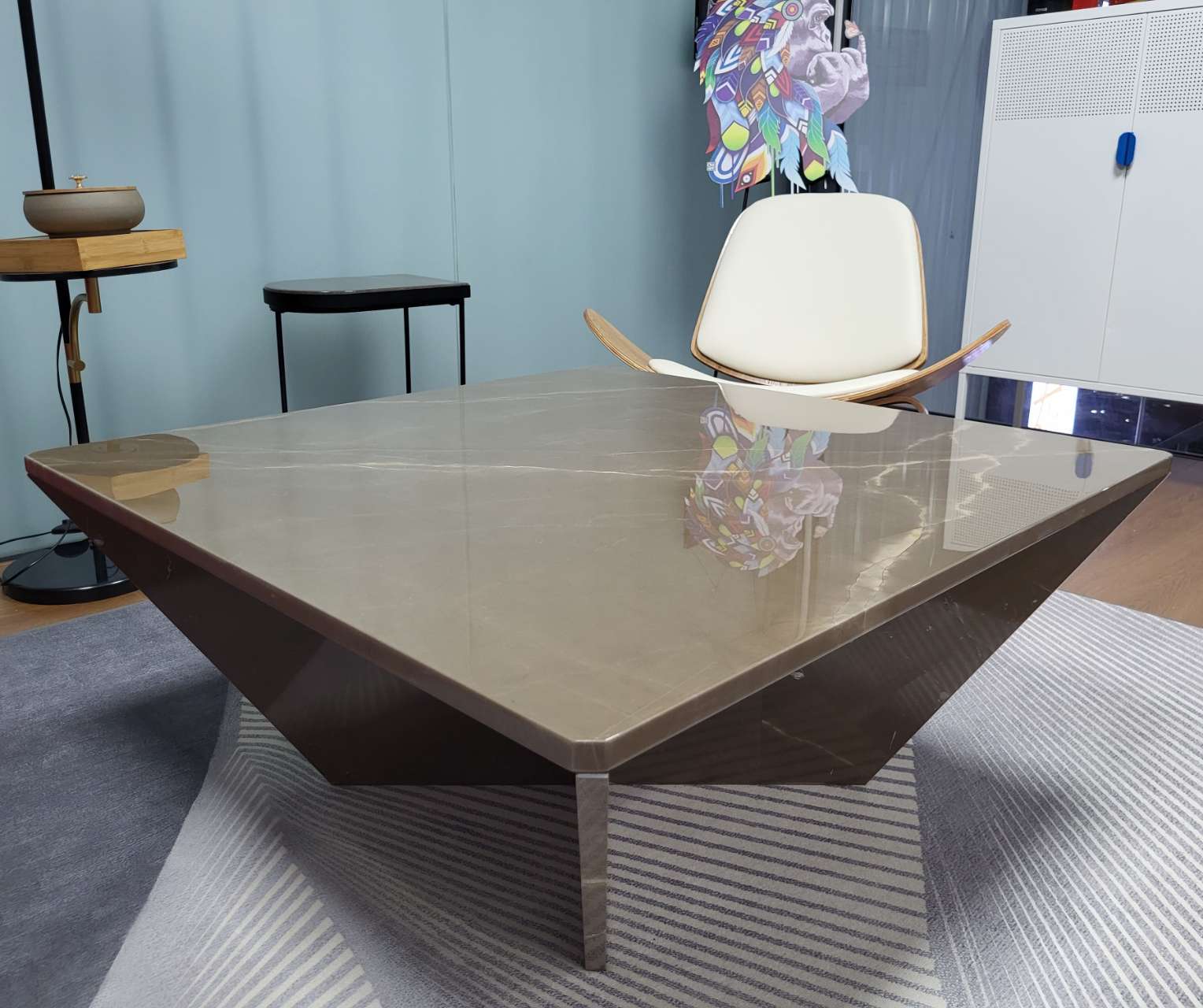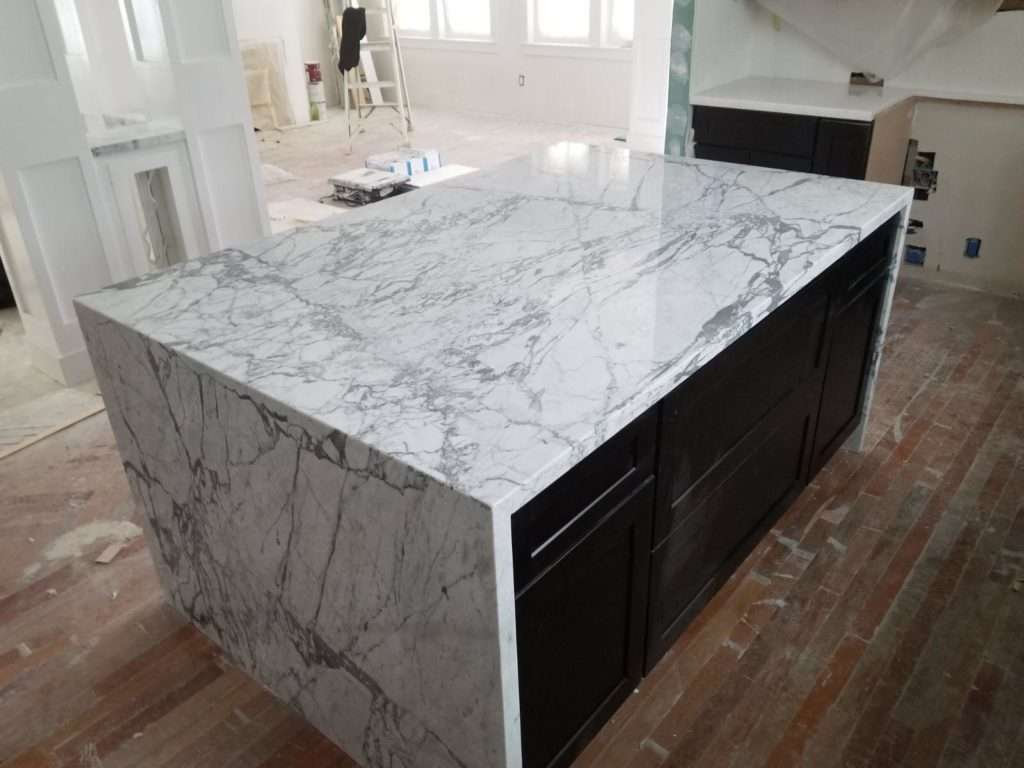

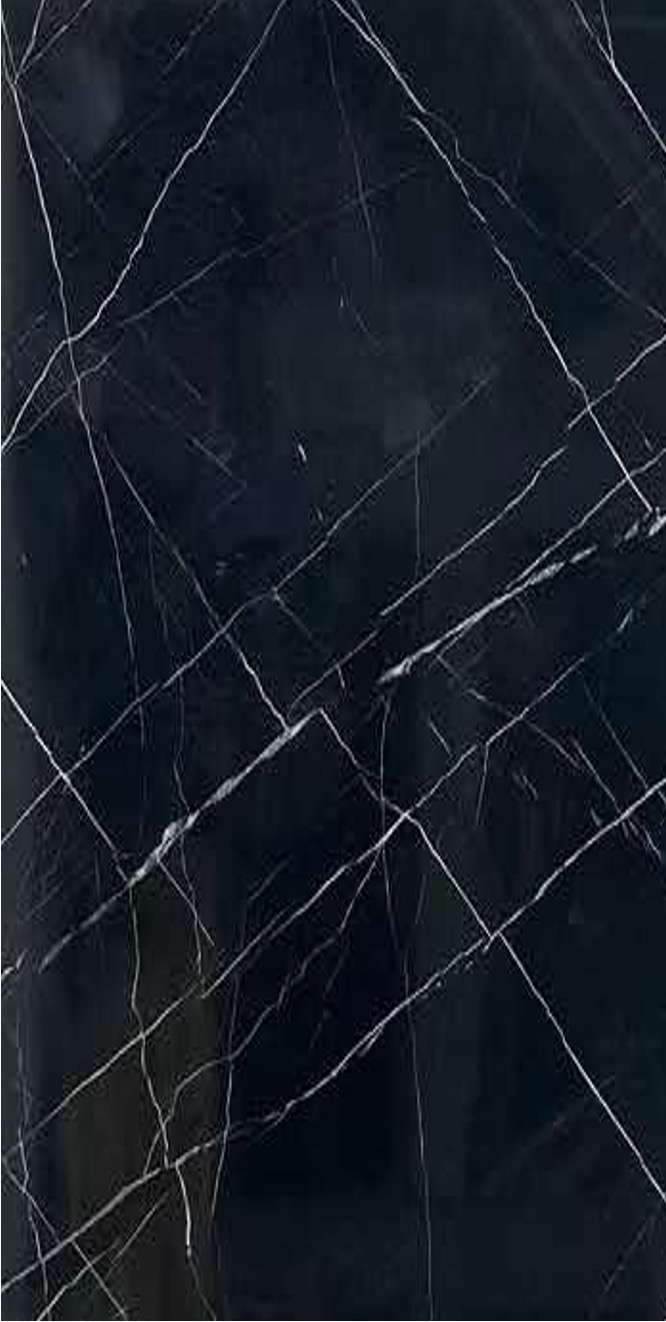
A white mark on black marble is almost never a stain: it is dulling, the local loss of polish caused by an acidic product. The ICOMOS-ISCS glossary classes this phenomenon as an “increase in lightness” and states that dark marbles often undergo it. The roughened surface diffuses light instead of reflecting it.
The distinction changes everything: a loss of material cannot be cleaned. Before choosing a product, you therefore need to know whether the mark is recessed or raised. The finish chosen at the outset also matters, as with our marble worktops.
Key points
– The mark is almost always a dulling by acid, not a deposit: ICOMOS classes “stain” and “dulling” in two distinct families of deterioration.
– Four mechanisms produce white: dulling, efflorescence, encrustation, film. Only one can really be cleaned off.
– Three actions settle it: raking light, fingernail, clean water.
– Dulling cannot be cleaned off, it must be repolished.
– Vinegar is the reagent geologists use to identify a limestone; bicarbonate, for its part, scratches: calcite is at degree 3 on the Mohs scale.
Why this white mark is not a stain
Standardised vocabulary exists, and it settles the debate. The illustrated ICOMOS-ISCS glossary (2008, 86 pages, bilingual, with LRMH and CICRP among the contributors) names what the market calls “white haze”. The dulling is the French name for what the glossary classes under roughening, a sub-type of erosion: “a selective loss of small particles from an originally smooth surface”, the substrate remaining sound. The same source explains why the mark looks white: loss of polish produces an “increase in lightness”, classed as discolouration, and “dark marbles and those of bright colours often undergo discolouration”. Nothing has been deposited: a micro-roughness diffuses light instead of reflecting it, and the contrast is greatest on a polished black background.
The classification is the real argument: ICOMOS places “stain” among the chromatic alterations and dulling among the losses of material. A chromatic alteration can be removed; a loss of material cannot. The mechanism is simple: a commercial marble is overwhelmingly composed of calcite. The University of Waterloo points out that calcite defines grade 3 on the Mohs scale and dissolves on contact with an acid, releasing carbon dioxide. The Natural Stone Institute confirms it: some products “etch the finish without leaving a stain”.
Acid etching or limescale deposit: the decision tree
Three checks are enough to tell the possibilities apart, with no product at all. Raking light first, with your eye level with the surface: a matt area with a sharp outline, following the shape of the spilt liquid, indicates dulling; a diffuse or milky haze points to a deposit. The fingernail next: if recessed, material has gone; if raised, the texture tells you more, powdery for salts, hard for precipitated limescale, soft and greasy for product residue. Clean water finally: soluble salts partly redissolve, dulling does not change.
| Criterion | Dulling (acid etching) | Efflorescence (salts) | Encrustation (limescale) | Film (wax, product) |
|---|---|---|---|---|
| Relief | Recessed or flush | Raised, powdery | Raised, hard | Raised, soft, greasy |
| Adhesion | It is the stone | Does not adhere | Adheres strongly | Follows the surface |
| Origin of the material | Dissolved stone | The pore network | Percolation, precipitation | Foreign, an applied product |
| Raking light | Matt area, sharp outline | Diffuse powdery haze | Irregular thickness | Even milky haze |
| With clean water | Does not change | Partly redissolves | Does not change | Does not change |
| Answer | Repolishing only | Cleaning, then moisture | Specialist intervention | Suitable stripper |
Definitions and families: ICOMOS-ISCS glossary, 2008.
Theefflorescence refers to a crystallisation of salts on the surface, whose constituents come from the stone’s pore network: it is not a deposit in the strict sense. When these salts crystallise under the surface, ICOMOS speaks of subflorescence, a frequent consequence of which is loss of stone through scaling. A mark that comes back after every wipe is not a cleaning problem; it is a water problem.
Three levels of severity, three responses
Level 1: a film or deposit on the surface
This is the only case that can be removed without touching the stone. ICOMOS defines a film as a thin, homogeneous, usually organic covering that follows the surface without penetrating it, and notes that a film may, as it ages, lose its transparency. That is the mechanism behind the whitish haze left by some waxes: a suitable stripper, then rinsing. For routine care, the Natural Stone Institute recommends a neutral cleaner or a mild washing-up liquid in warm water, and Levantina requires detergents with a pH 7 to 10.
Level 2: salts or encrustation
The damage is no longer merely cosmetic. Efflorescence is cleaned dry and then with clean water, but it will return as long as the source of moisture is not dealt with.encrustation is a compact, hard, adherent layer resulting from precipitation, in ICOMOS terminology, and it follows a different logic. The glossary warns that “the removal of encrustations may be accompanied by detachment of stone”. Scraping and aggressive descalers are therefore ruled out, in favour of specialist intervention.
Level 3: dulling
Dulling cannot be cleaned; it is repolished. No cleaner rebuilds a polish, which is not a layer but a surface state. Levantina writes that natural stone can always be restored by repolishing the surface, and the Natural Stone Institute refers readers to a professional restorer for repolishing etched areas. The work is done with abrasives of increasing grit, then polishing; (not verified): no standard consulted sets the grit sequence. There is one objective limit, since repolishing removes material: the available thickness, which is very small on a thin tile. No source gives a depth threshold for irreversibility, and none will be given here.
What you must not use
White vinegar is not a cleaning product for a calcareous stone: it is an identification reagent. Thethe Earth Sciences Museum at the University of Waterloo describes the geologist’s test: a dilute acid is poured cold onto the rock, “10% hydrochloric or sulphuric acid, or vinegar”. A limestone then gives off bubbles of carbon dioxide. Pouring vinegar on a black marble means running that test on your own worktop.
Bicarbonate poses a different problem, mechanical rather than chemical. Being alkaline, it does not attack calcium carbonate. But calcite is at Mohs 3 and “is easily scratched with a knife blade” (University of Waterloo). Scouring powders, for their part, contain abrasives liable to scratch some stones (Natural Stone Institute). Vinegar dissolves the stone, bicarbonate scratches it, and neither cleans a limestone. Also to be avoided: bleach, ammonia, descalers, metal utensils and rust stain removers, which contain traces of hydrofluoric acid.
One last point nobody mentions: susceptibility to staining is measured. The standard NF EN 16301 (March 2021) concerns the determination of resistance to accidental staining, and a test result can be requested from the supplier before purchase. None of the sources consulted, however, presents a water-repellent or impregnating sealer as protection against acid etching.
Two questions to see where you stand
Which product touched the surface, and how long ago? Is the area rough to the touch, or simply matt? Rough and recessed is level 3; smooth and raised, levels 1 and 2. For a laid floor, see made-to-measure marble floors and tiles and marble tiles.
Frequently asked questions
How do you restore black marble?
It depends on what has been lost. If the black is dulled by a film or a deposit, a neutral cleaner followed by a suitable stripper is enough. If the polish has gone, no product will bring it back: Levantina states that natural stone can always be restored by repolishing the surface.
How do you remove limescale marks from black marble?
A hard limescale deposit is what ICOMOS calls an encrustation : a compact, adherent layer resulting from the precipitation of carbonates. The glossary warns that removing it may be accompanied by detachment of stone, which rules out scraping and descalers. Wiping and drying after each contact with water remains more effective than any treatment.
Which products should not be used on marble?
Vinegar, lemon juice and any acidic product, descalers and limescale removers, bleach, ammonia, scouring powders, metal utensils, and rust stain removers, which contain traces of hydrofluoric acid according to the Natural Stone Institute. Levantina’s instruction is simple: neutral detergents, pH 7 to 10, and nothing else.
Does white vinegar damage marble?
Yes, and the mechanism is documented: vinegar is one of the reagents in the limestone identification test described by the University of Waterloo, alongside hydrochloric and sulphuric acids diluted to 10%. There is no pH threshold below which the attack would “start”: calcite dissolves as soon as the solution is undersaturated; only the speed varies. Below about pH 3.5, that speed is limited only by diffusion (Penn State, course CE 574, after Plummer and Wigley, 1978).
How do you rescue a stained marble?
Through diagnosis, above all. A real stain, that is a chromatic alteration, is treated by cleaning or with a poultice suited to the staining agent. A loss of material can only be treated by refinishing. Applying a stain-removal protocol to dulling achieves nothing.
How do you remove white vinegar marks?
There is nothing to remove, and that is the key to this page. A mark left by vinegar is dulling, a dissolved surface, not deposited matter. No cleaning will make it disappear; only repolishing restores the original surface.
Key points
On a polished black marble, the contrast forgives nothing: damage invisible on a light stone becomes an obvious white mark. The right reflex is not to look for a product but to qualify the mark in three checks, then choose between cleaning, treating the moisture and repolishing.
Sources
- Vergès-Belmin V. (ed.), ICOMOS-ISCS: Illustrated glossary on stone deterioration patterns, Monuments and Sites XV, ICOMOS, 2008, 86 p., ISBN 978-2-918086-00-0.
- University of Waterloo, Earth Sciences Museum, “Calcite, limestone and marble”.
- Natural Stone Institute, “Care & Cleaning”.
- Levantina, Negro Marquina, ficha técnica, March 2025, p. 5.
- CTMNC, Principales exigences techniques applicables aux produits de construction en pierre naturelle, July 2021, p. 15, for the title of the NF EN 16301 standard. All rights reserved to CTMNC, www.ctmnc.fr.
- Penn State, College of Earth and Mineral Sciences, course CE 574, Mineral Reaction Kinetics.
All sources were consulted on 25/09/2026.
See also: Nero Marquina: material guide to the black marble from Markina