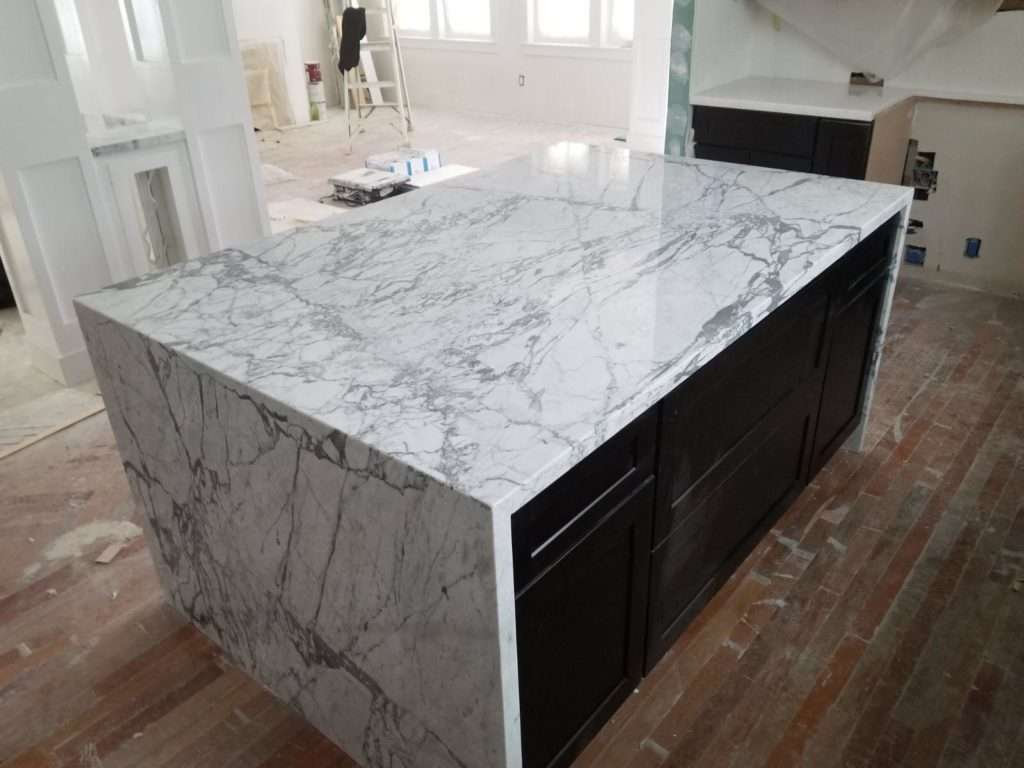

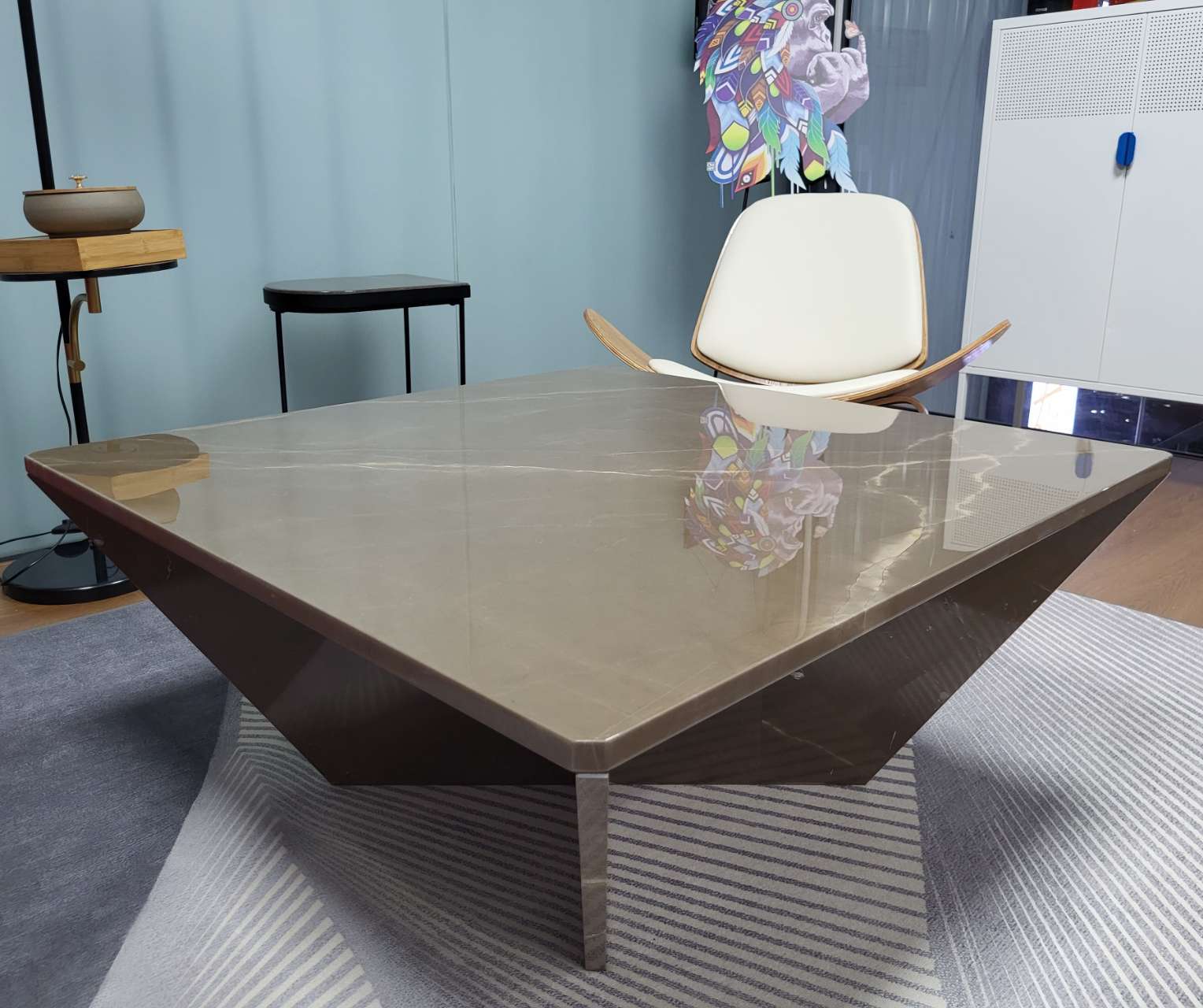
A “marble-effect” worktop is a marble décor applied to another material: laminate, porcelain stoneware, engineered quartz, adhesive film or resin. Real marble is a rock. It scratches and etches with acid, but it can be repolished. Imitations stand up better to daily life and cannot be repaired: they are replaced.
This comparison sets four product families against the same criteria. It comes down twice out of six in favour of the imitation. For the stone side alone, see our page on marble worktops in a kitchen.
Key points
- Four families are sold under this décor: laminate, the porcelain stoneware and engineered quartz, the adhesive film and resin. For worktops, the volume competitor is laminate, not ceramics.
- Three separate bodies of standards. Natural stone: NF EN 1469, 12057, 12058. Agglomerated stone: NF EN 14618, 14617, 15285, 15286. Ceramics: NF EN 14411.
- Reparability is the one argument no imitation can counter. A dulled marble can be repolished. A scratched laminate, a torn film or a chipped tile are replaced.
- A ceramic décor repeats. XTONE publishes 4 designs in 6 mm and 2 in 12 mm for its Calacatta Gold. A stone slab never repeats.
- Marble remains calcite, grade 3 on the Mohs scale, dissolved by vinegar and lemon. For a rental or a tight budget, laminate is the best answer.
Four product families are sold under the words “marble effect”
“Marble effect” is not a material but a décor, and it covers four industrial families with different standards and repair methods. The term itself appears in no product standard.
Le laminate is a wood-based panel faced with a resin-impregnated decorative sheet. It is the dominant marble-effect worktop product in DIY stores. The stated thickness, 28, 38 or 39 mm depending on the products found, is that of the substrate panel, not of the décor.
Le porcelain stoneware is a pressed or extruded and then fired ceramic tile, falling under NF EN 14411 “Ceramic tiles”, November 2016 version, which classifies it by manufacturing method and water absorption. This European standard is harmonised: CE marking is mandatory.
La agglomerated stone is, according to NF EN 14618, an industrial product based on hydraulic cement, resin or both, stones and other additives. It is the family of engineered quartz.
That leaves two solutions that cover the existing worktop without replacing it: decorative adhesive film on a roll and poured epoxy resin . They meet a real need: changing the look without removal.
The comparison table for the four materials
Cells marked “not documented” or “no data” are not oversights: no verifiable source fills them in the research file for this article. Filling them with estimates would be more comfortable and less honest.
| Criterion | Genuine marble | Laminate | Porcelain stoneware and engineered quartz | Adhesive film and resin |
|---|---|---|---|---|
| Nature | Rock. Overwhelmingly calcite, 91.5 to 98% on the data sheets consulted. Veining throughout the body. | Wood-based panel, resin-impregnated decorative sheet. Printed décor. | Pressed and fired ceramic tile, surface décor. Or hydraulic cement, resin or both, plus stones. | Covering applied over the existing worktop. |
| Thicknesses | 20 and 30 mm as standard cut. | 28, 38, 39 mm found in DIY stores. Thickness of the panel, not of the décor. | Ceramic 3, 5, 6, 12 mm (Laminam, XTONE, Neolith). Quartz: not documented. | Not comparable. |
| Product standard | NF EN 1469, 12057, 12058. Naming NF EN 12440. | No standard identified. | NF EN 14411, harmonised, CE marking mandatory. Quartz: NF EN 14618, 14617, 15285, 15286. | No standard identified. |
| Heat and acids | No temperature limit published; tests NF EN 14066 and 16306, 0% mass loss on the data sheets that declare them. Sensitive to acids : calcite dissolves. | Values in °C stated without testing. Wood-based substrate. Dissolution of carbonates not relevant. | No test value found. Ceramics unaffected by acids; quartz, chemical resistance under NF EN 14617-10. | No data found. |
| Reparability | Repolishing. Loss of polish is a loss of material, not a stain. Limit: thickness. | Not repairable. The worktop is replaced. | Surface décor cannot be repolished; a chip means replacement. Quartz: repair according to the manufacturer. | Not repairable, but renewable. |
| Lifespan | No standardised value. Several repolishings, within the limit of the thickness. | No standardised value. End of life when the décor is worn through. | No standardised value. End of life at chipping or wear of the décor. | No standardised value. Renewable. |
| Budget ranking | High. | Low, and the family most represented in DIY stores. | Mid to high. | The lowest, without removal. |
The useful way to read the table is diagonally. Only one column ticks “repairable”, and only one offers 20 to 30 mm of homogeneous material. The other three win on everyday durability and on budget.
What stone has that imitation does not
Three differences withstand the sales pitch, because buyers can check them for themselves. Two are documented by the makers of substitutes.
Reparability, the deciding argument
A damaged marble can be repaired; a damaged imitation is replaced. The ICOMOS-ISCS glossary on stone deterioration patterns classes dulling among features induced by loss of material, not among stains. An acid etch mark is therefore not a deposit to be cleaned: it is a surface that has become rough, and is reworked by restoring the finish.
Levantina writes in its March 2025 data sheet that natural stone “can always be restored by repolishing the surface”. The limit is clear, since repolishing removes material and thickness bounds it. On 20 or 30 mm the margin is real; on a surface décor it is nil. The habits that avoid getting there are in our article on how to clean marble.
The uniqueness of the veining, quantified by the competitor’s manufacturer
A ceramic décor repeats, and the number of patterns is public. XTONE states for its Calacatta Gold porcelain stoneware 4 designs in 6 mm and 2 in 12 mm, in a 160 × 320 cm format, with continuity of pattern between pieces. That is an industrial quality, consistency being exactly what you are buying. But beyond a few slabs, the pattern comes round again. A marble slab comes from a block: two neighbouring slabs look alike, none repeats.
Thickness and standard settle it in one sentence
A 3 mm “marble-effect” slab is not stone, and the thickness alone says so. Large-format ceramics are cut in 3, 5, 6 and 12 mm; marble commonly in 20 and 30 mm. The second question concerns standards, and it is written in the texts themselves: NF EN 1469 and NF EN 12058 explicitly exclude artificially agglomerated stone materials from their scope.
Three families, three separate bodies of standards, one commercial décor. Asking under which standard the product is declared settles the question without any geological expertise. The reasoning also applies to floors and vanity tops: see our guide to the uses of marble.
What marble does not do, and what needs saying
Marble has three nameable weaknesses in the kitchen, and keeping quiet about them helps nobody. The first is its hardness: it is essentially calcite, and the Earth Sciences Museum at theUniversity of Waterloo points out that calcite is number 3 on the Mohs scale and “is easily scratched with a knife blade”.
The second isacid etching. The same university source states that vinegar is used to identify a limestone, because calcite dissolves in it, releasing carbon dioxide. Vinegar is therefore not merely “not recommended” on marble: it is the test reagent. Lemon, wine and descaler act in the same way, at different speeds.
The third is porosity, and its variability is the real trap. On the same NF EN 1936 test, the data sheets consulted give 0.2 to 1% open porosity for a Nero Marquina and 16 to 17% for a Bulgarian limestone sold as marble. It is not the rock family that determines susceptibility to staining; it is the stone, batch by batch. A water repellent reduces absorption and does not protect against an acid: see our page onwater repellent for marble.
One point deserves correcting rather than repeating: the temperature limits in degrees that circulate in this market are backed by no published test, whether for marble, laminate or quartz.
Four situations where imitation is the right choice
A comparison that comes down four times out of four in favour of stone is not a comparison. In the following four situations, imitation is the best answer.
- A rented home. Marble’s strength is reparability over decades, and therefore length of ownership. In a rented property, with uses you cannot control, laminate makes sense: replaceable in one visit, with no care instructions to pass on.
- A tight budget. Laminate sits at the bottom of the budget ranking and delivers the desired décor. Putting stone into a project with no margin means sacrificing something else in the kitchen.
- A renovation without removal. If the existing worktop is sound and only its look is unwelcome, adhesive film or resin meet the need exactly: no dismantling, no splashback rework, no sink reconnection.
- A kitchen where nobody takes care. If nobody is going to wipe up lemon juice or get out a chopping board, porcelain stoneware is the best trade-off: surface décor, but no carbonate dissolution to fear and a declared performance under NF EN 14411.
The decision criterion is therefore not “real or fake marble”. It is how long you will keep this worktop, and how much care you are willing to give it.
Frequently asked questions
What are the drawbacks of a marble kitchen worktop?
Three, and they can be named. Calcite is at grade 3 on the Mohs scale and scratches with a knife blade. Everyday acids dissolve it, leaving a dulled area. And open porosity ranges from 0.2 to 17% depending on the stone on the same NF EN 1936 test, which makes susceptibility to staining impossible to state by family. The honest counterpoint is that all three kinds of damage can be reworked by repolishing.
How much does a marble kitchen worktop cost?
This page publishes no prices, and the reason is methodological. The amounts available cover incomparable scopes: a whole panel on one side, a price per square metre on the other, with or without shaping or a sink cut-out. What is reliable is the ranking: adhesive film and resin at the bottom, then laminate, then porcelain stoneware and engineered quartz, then marble. For a quote on real dimensions, go through our contact page.
What is the best material for a kitchen worktop?
There is none in absolute terms, and any single answer is a sales pitch. By use: laminate for a rental or a constrained budget, adhesive film or resin to change the look without removal, porcelain stoneware for an intensively used kitchen with no care instructions, marble for a unique piece you keep and repair. The discriminating criterion is reparability, combined with length of ownership.
What is the difference between granite and marble?
Mineralogy, and it determines resistance to acids. The USGS writes that granite is composed mainly of silicates, feldspar and quartz, “resistant to acid attack”, while marble and limestone are composed mainly of calcite, “which dissolves readily in a weak acid”. Two shortcuts are wrong: density does not separate the two families, their ranges overlapping on the same NF EN 1936 test, and attributing a single Mohs hardness to a granite is a category error, the scale being defined for minerals. The details are in our marble and granite comparison.
What to check before signing
Two questions qualify any marble-effect worktop: under which product standard is it declared, and what is its thickness in millimetres? The answer places the product in one of the four families and tells you whether a repair will be possible. If your choice leans towards stone, the rest is settled on drawings, not from a catalogue: see our marble worktops.